Place · Northumberland, England
Bamburgh and Spindlestone
The Northumberland landscape of Princess Margaret's transformation: a real castle, a defended settlement at Spindlestone Heughs and a legend whose printed history must be distinguished from both.
Also found as: Bamborough · Bambrough · Spindleston Heugh · Spindlestone Heughs. Research reviewed 17 October 2026.
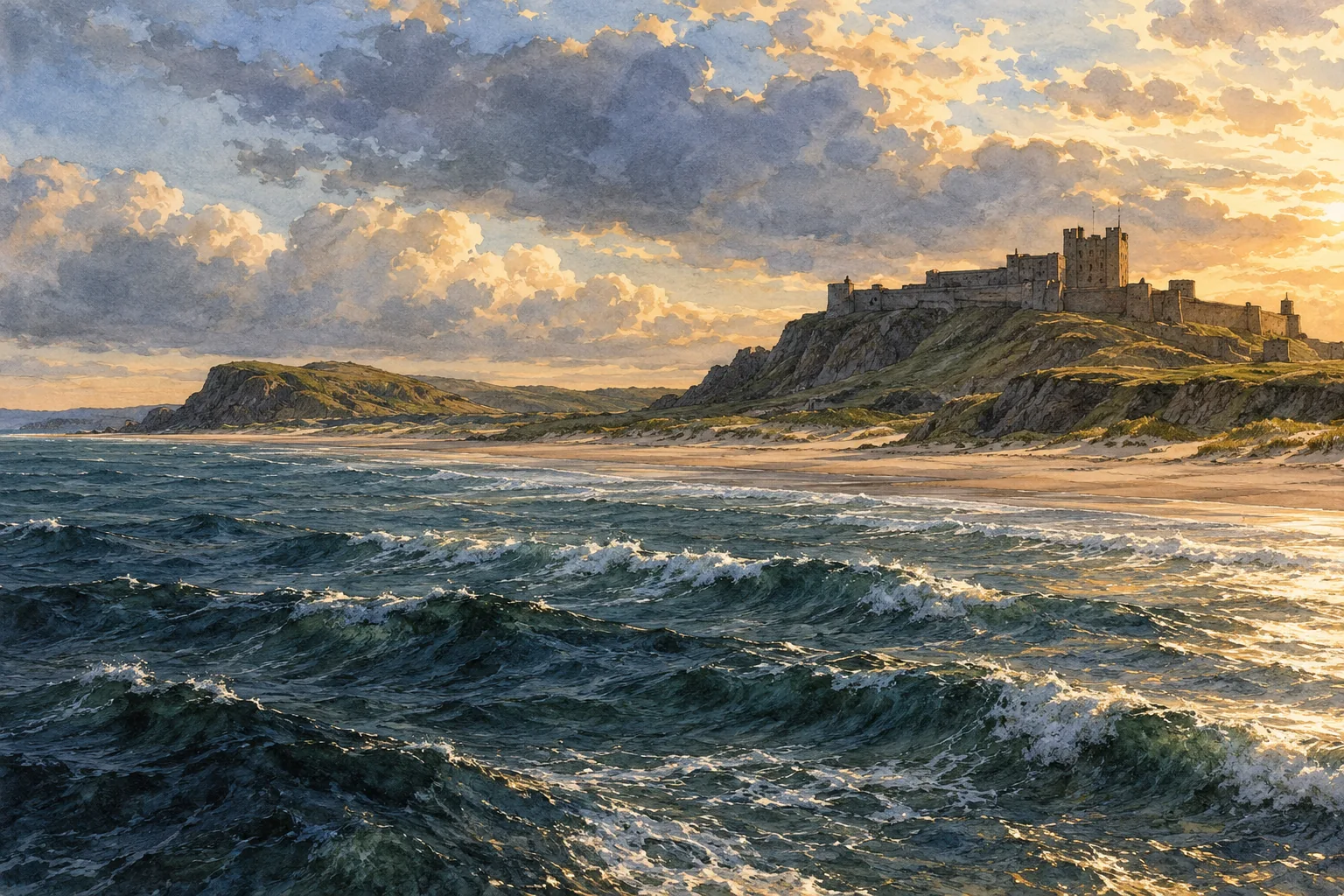
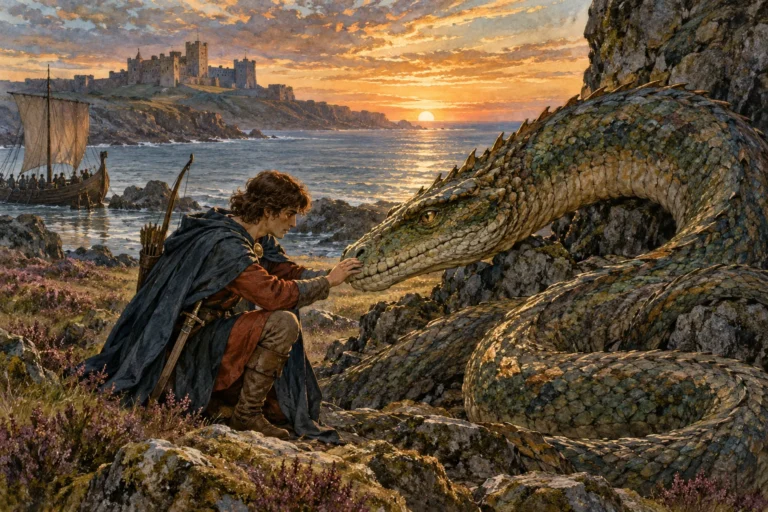
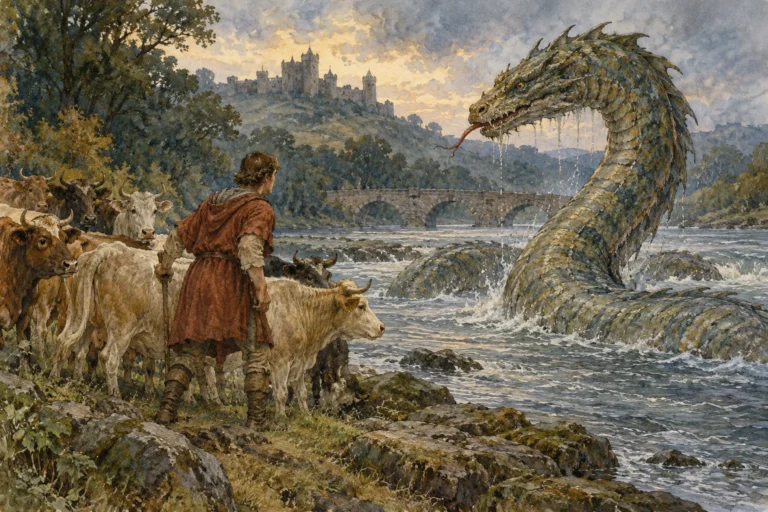
Bamburgh and Spindlestone belong together in the Laidly Worm story, but they play different roles. Bamburgh is the royal household where jealousy begins the enchantment. Spindleston Heugh is the place outside that household where Margaret lives as a worm. Her brother’s return across the sea connects the castle, coast and lair into a rescue narrative. “Bamborough” and “Bambrough” are spellings encountered in the examined texts; the archaeological record uses “Spindlestone Heughs”. Jacobs, The Laidly Worm; Child, appendix to No. 34.
The actual castle is a Grade I listed building. Historic England describes a twelfth-century keep and medieval fabric within a much altered complex, including eighteenth-century work and extensive restoration and rebuilding by C. J. Ferguson for Lord Armstrong between 1894 and 1904. The great visible building therefore contains several historical periods. It should not be presented as the unchanged home of the story’s princess. Historic England, Bamburgh Castle, Details.
At Spindlestone Heughs, Historic England records a defended settlement of a type dating to the Iron Age. Its builders used the cliff edge as part of the defences, with ramparts and adjoining enclosures completing the site. The record concerns human settlement and the surviving earthworks. It supplies no evidence for a monster, an enchanted princess or a trough used to feed her. Historic England, Spindlestone Heughs, Details.
The ballad printed by Child makes its own claims about the landscape. Stanza 12 invites readers to see the worm’s cave and stone trough. Stanzas 18–19 have Wynd recognise a tower and “King Ida’s castle” from the sea; stanza 25 lands him on Budle sand. These are precise parts of a literary itinerary. They do not date a surviving tower, establish the cave’s occupation or demonstrate that a historical king had children named Margaret and Wynd. Child’s commentary attributes almost the whole surviving ballad to the eighteenth-century Rev. Lamb. Child, pp. 308 and 312–313.
Later tellings also put different imaginary things in the same castle. Jacobs leaves the defeated queen wandering nearby as a toad. Kinloch’s tradition, quoted by Child, confines her in a cavern with a door that opens on Christmas Eve every seven years. Its sword, horn and sleeping adventurers belong to that particular sequel, not to an excavated room. Keeping the versions separate lets the place remain richly storied without manufacturing an archaeological discovery. Jacobs, ending; Child, p. 311.
Start with Margaret’s story for the rescue, then use the dragon guide to compare the very different creatures of Lambton and Wantley. The English book list identifies which editions preserve the passages discussed here.
Sources for this place
- Historic England, Bamburgh Castle. National Heritage List for England, entry 1280155; accessed 17 October 2026.. Official list entry, Details: castle fabric, twelfth-century keep, eighteenth-century works and Ferguson restoration of 1894–1904.. Read source — Official architectural description, used only for physical history, not corroboration of the enchanted-princess story.
- Historic England, Spindlestone Heughs defended settlement. National Heritage List for England, entry 1014745; accessed 17 October 2026.. Reasons for Designation and Details: Iron Age-type defended settlement, cliff-edge setting, ramparts and annexes.. Read source — Official archaeological description of the actual site; no evidence of a dragon is claimed.
- Joseph Jacobs, English Fairy Tales. First published London: David Nutt, 1890. Narrative and note examined in Project Gutenberg eBook 7439; this transcription does not identify its print impression.. 'The Laidly Worm of Spindleston Heugh'; Notes and References XXXIII, 'The Laidly Worm'; preface.. Read source — Directly examined prose adaptation used as the stated base for the retelling. Jacobs credits Lamb through Child and additional touches from Kempion. About this book
- Francis James Child, editor; ballad communicated by the Rev. Robert Lamb, The English and Scottish Popular Ballads, Volume I. Original Volume I, Part II, Boston and New York: Houghton, Mifflin and Company, 1884; examined in the unaltered Dover republication, New York, 1965, transcribed by Project Gutenberg.. No. 34, 'Kemp Owyne', discussion pp. 306–308; appendix 'The Laidley Worm of Spindleston Heughs', pp. 311–313, especially stanzas 1–39 and Kinloch prose tradition.. Read source — Directly examined Lamb ballad and Child's provenance discussion. Child reprints William Hutchinson, A View of Northumberland (1778), II, pp. 162–164; the Hutchinson volume and Kinloch manuscript were not separately inspected. About this book
Research coverage
Two official monument records examined alongside Jacobs, Lamb as reprinted by Child, and Child's quotation of Kinloch. This is a focused literary and monument guide, not an excavation report, access guide or survey of all Bamburgh traditions. No physical feature has been authenticated as a dragon's lair.
The Myths · English collection · Editorial approach
Further Reading