English comic dragon ballads · story
The Dragon of Wantley
A boastful Yorkshire champion orders armour covered in spikes, hides in a well and takes on an equally foul-mouthed dragon. The old ballad turns heroic combat into an outrageous brawl.
Also found as: More of More Hall and the Dragon of Wantley · The Wantley Dragon · The Wharncliffe Dragon
Research reviewed 17 October 2026.
Read the story
An original prose retelling of the anonymous ballad printed in Percy’s Reliques, using Wheatley’s edition. This is a comic, deliberately extravagant story. Some bawdy wording is abbreviated, but its ridiculous hero, drinking, insults and undignified victory remain.
Other heroes needed impressive weapons to kill their monsters. The singer of Wantley claimed that More of More Hall had done better: he had killed a dragon with nothing at all. What followed made that boast rather difficult to defend.
The dragon lived in Yorkshire, near Rotherham, beside a rocky hill and a house belonging to Matthew. The singer assured his audience that he knew the place, then could not quite decide how many miles away it was. The creature, however, he could describe in detail.
It had two wings, great claws, forty-four iron teeth and a tail armed with a sting as long as a flail. Its tough hide enclosed an enormous appetite. Cattle disappeared into it. Trees followed. It swallowed three children at a mouthful and treated houses and churches as casually as other creatures treated poultry. Only the hardest stones survived, because even those teeth could not crack them.
Smoke came from its nose. When it coughed into the well beside its den, the burning stuff made the water look like flowing spirits set alight. People argued whether such an animal was a witch or the devil. Whatever it was, they needed someone to stop it.
Nearby lived More, a man renowned for wrestling, quarterstaff fighting, kicking, punching and swearing. The ballad credited him with an appetite scarcely less alarming than the dragon’s: in a fit of anger he had once swung a horse to death and eaten almost the whole animal. An ordinary champion clearly would not suit this extraordinary enemy.
After the children were killed, the people came weeping to More Hall. They offered him all their possessions if he would save them. More refused their goods. He asked instead for someone to anoint him before the fight and help dress him in the morning. Having settled his preparations, he went to Sheffield to order a remarkable suit of armour.
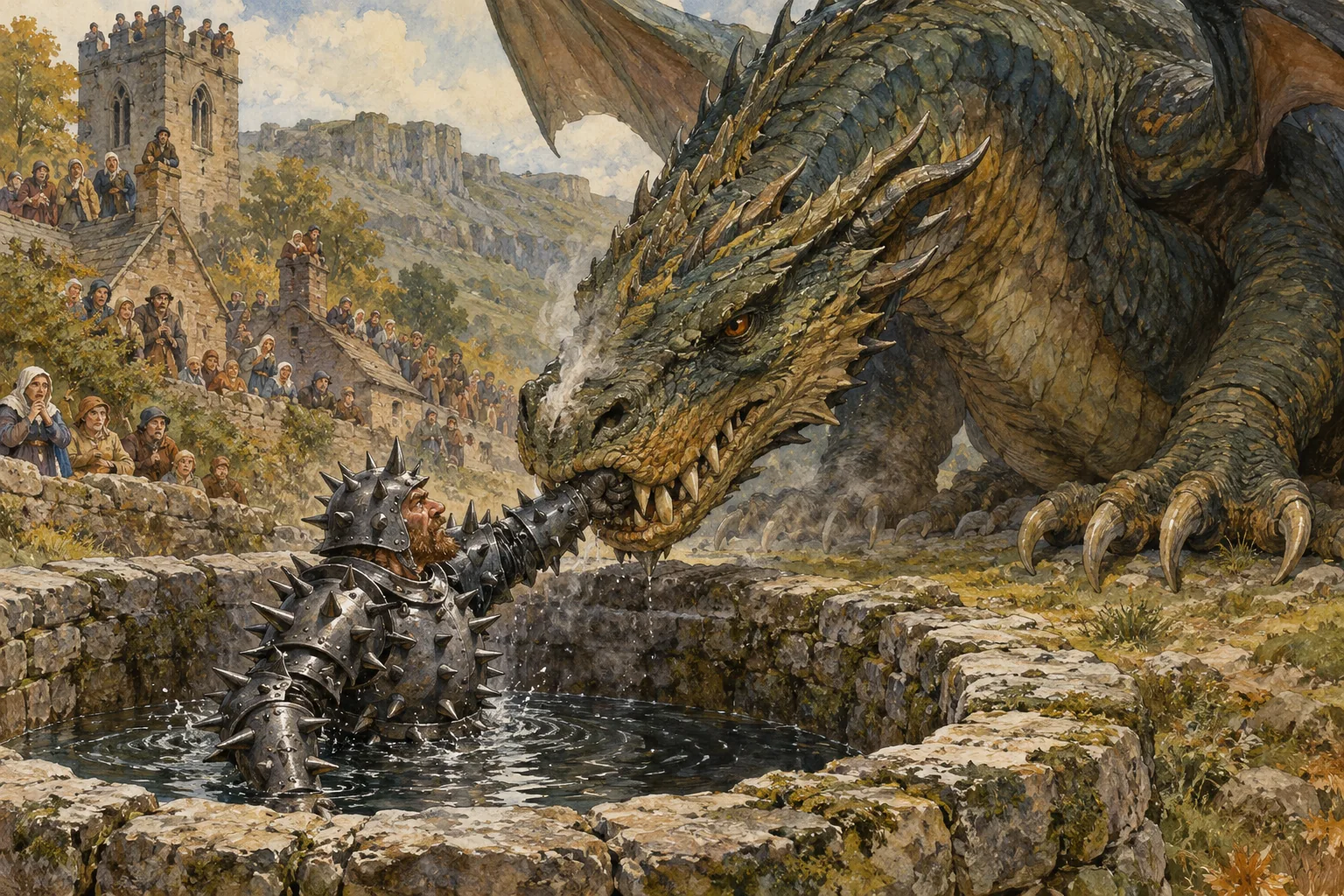
Steel spikes stood out all over it, some five or six inches long. They covered his limbs, front and back. When he appeared in it, cats, dogs, horses, cows and pigs scattered. He looked less like a noble knight than an enormous walking hedgehog. Percy, Volume III, Book III, XIII, lines 1–88.
The country turned out to watch. People climbed trees, roofs and churches; some found places on chimneys. More fortified himself with six pots of ale and a quart of spirits. Then, for all his celebrated strength, he chose an ambush. He climbed down into the well where the dragon came to drink.
The monster lowered its head. More sprang up and punched it in the mouth.
The dragon was furious at having its drink interrupted. It ordered him out, swore at him and fouled the place. More answered with complaints about the smell and insults concerning its diet. The contest had begun, though not in the manner of a courtly tournament.
He scrambled onto the brink and struck again. The dragon answered with its own blows. They battered and kicked at each other for two days and a night, neither managing a wound. Their noise and strength seemed enough to shake the ground, but neither would yield.
At last the dragon landed a blow that sent More reeling. It moved to lift him high and throw him down. More turned as it approached and delivered a tremendous kick to its backside.
The spike on his foot found the one vulnerable place. The dragon spun around six times, sobbing and cursing the man of More Hall. If the blow had landed anywhere else, it complained, he could have done it no harm.
It cried murder, shook, collapsed first onto one knee and then onto its back, and died. So ended the great combat: an armoured boot, a wounded monster’s complaints, and a singer still boasting that More had won with nothing at all. Percy, lines 89–152.
Versions and variations
Two printed forms, not two field recordings. Percy says that his text comes from a printed Pepys copy collated with others. Harland and Wilkinson reproduce another form through Gregson’s Fragments, tracing it to a Randal Taylor broadside dated 1685. We have examined the two later presentations, not the original broadsides. Their shared plot is therefore evidence of a circulating ballad, not independent testimony to a fight. Percy, introduction, pp. 279–283; Harland and Wilkinson, pp. 264–270.
The wording alters the joke. Percy’s dragon treats houses and churches like geese and turkeys; the other text compares them with gorse and birches, a reading Percy also records in a footnote. At the well, Percy’s censored wording and the following complaint about dung make the creature’s response scatological. Harland and Wilkinson print “spit”, while retaining the complaint. Percy’s decisive kick is explicitly directed at the rear through abbreviated coarse words; the other text substitutes “back” and “gut”. These are closely related comic versions with different verbal handling, not a new monster species.
The location is disputed by the editors. Harland and Wilkinson argue for a Lancashire More Hall through Gregson, yet their own reprinted ballad still names Yorkshire and Rotherham. Percy supplies a 1767 communication describing a visit to supposed landmarks near Wharncliffe. That describes how the story was attached to a landscape; it cannot verify a dragon.
Explanations should remain explanations. Godfrey Bosville’s contribution to Percy reads the dragon as a tithe dispute. Wheatley’s later note reports competing drinker and wild-animal interpretations, and a published objection to Bosville. None is established here as the proven original meaning. Nor should the opening seven heads be transferred to Wantley’s dragon: they belong to Hercules’s monster in the singer’s comparison.
Context and evidence
The ballad borrows the shape of heroic combat and continually punctures its dignity. More’s armour terrifies livestock, his courage is assisted by drink, and the monster complains like a person drawn into a street fight. Its self-confident but imprecise narrator is part of the entertainment. Percy explicitly reads the song as mockery of extravagant romance; identifying one particular romance or historical quarrel behind every detail would go beyond the evidence examined. Compare the much graver vow in the Lambton Worm, and the dragon who must be saved in the Laidly Worm.
Sources for this entry
- Thomas Percy, editor; Henry B. Wheatley, edition editor, Reliques of Ancient English Poetry, Volume III. London: George Allen & Unwin, 1927 reprint of Wheatley's edition first issued by Swan Sonnenschein in 1885. Percy's collection first published 1765.. Book III, XIII, 'The Dragon of Wantley', pp. 279–288; poem pp. 283–288, lines 1–152; footnote to line 29; editorial introduction and 1767 communication.. Read source — Directly examined main narrative and source commentary. Percy identifies a Pepys printed copy collated with other copies, not an oral field recording. About this book
- John Harland and T. T. Wilkinson, Lancashire Legends, Traditions, Pageants, Sports, &c.. London: George Routledge and Sons; Manchester: L. C. Gent, 1873.. Appendix, 'The Dragon of Wantley', pp. 264–270, introductory attribution and complete ballad; 'The Dragon of Unsworth', pp. 63–65, concluding comparison.. Read source — Directly examined second printed text and competing local attribution. Editors describe a route through Gregson's Fragments to a Randal Taylor broadside dated 1685; that broadside was not inspected directly. About this book
Research coverage
Complete Percy/Wheatley and Harland/Wilkinson texts examined, with their editorial apparatus. These are related printed forms. Pepys and Randal Taylor broadsides, Gregson's original printing, later theatrical adaptations, performance tunes and a comprehensive modern oral survey were not examined. Historical allegories remain attributed proposals.
The Myths · English collection · Editorial approach
Further Reading