Collected lake legends · story
The Lady of Llyn y Fan Fach
A farmer wins a bride from a mountain lake, on condition that he never gives her three causeless blows. Her departure takes the farm's prosperity with it, but her later visits give her sons a different inheritance.
Also found as: The Lady of the Lake of the Little Fan · The Physicians of Myddfai · The Lady of Llyn y Van
Research reviewed 17 October 2026.
Read the story
This original retelling follows William Rees of Tonn’s account, reproduced by John Rhŷs in Celtic Folklore, volume I, pp. 2–12. Rees assembled material from several contributors; the version is not a transcript of one storyteller.
A widow lived with her only son at Blaensawdde, near Llanddeusant. As their cattle increased, the young man took them to graze on the mountain near Llyn y Fan Fach. One day he saw a woman sitting on the water, combing her hair and looking at her reflection.
He offered her some of the bread he had brought for his meal. She refused it because it was too hard-baked, then slipped beneath the surface. When he told his mother, she suggested that he try the other extreme. The following day he brought dough. The lady appeared again, but that offering was too raw.
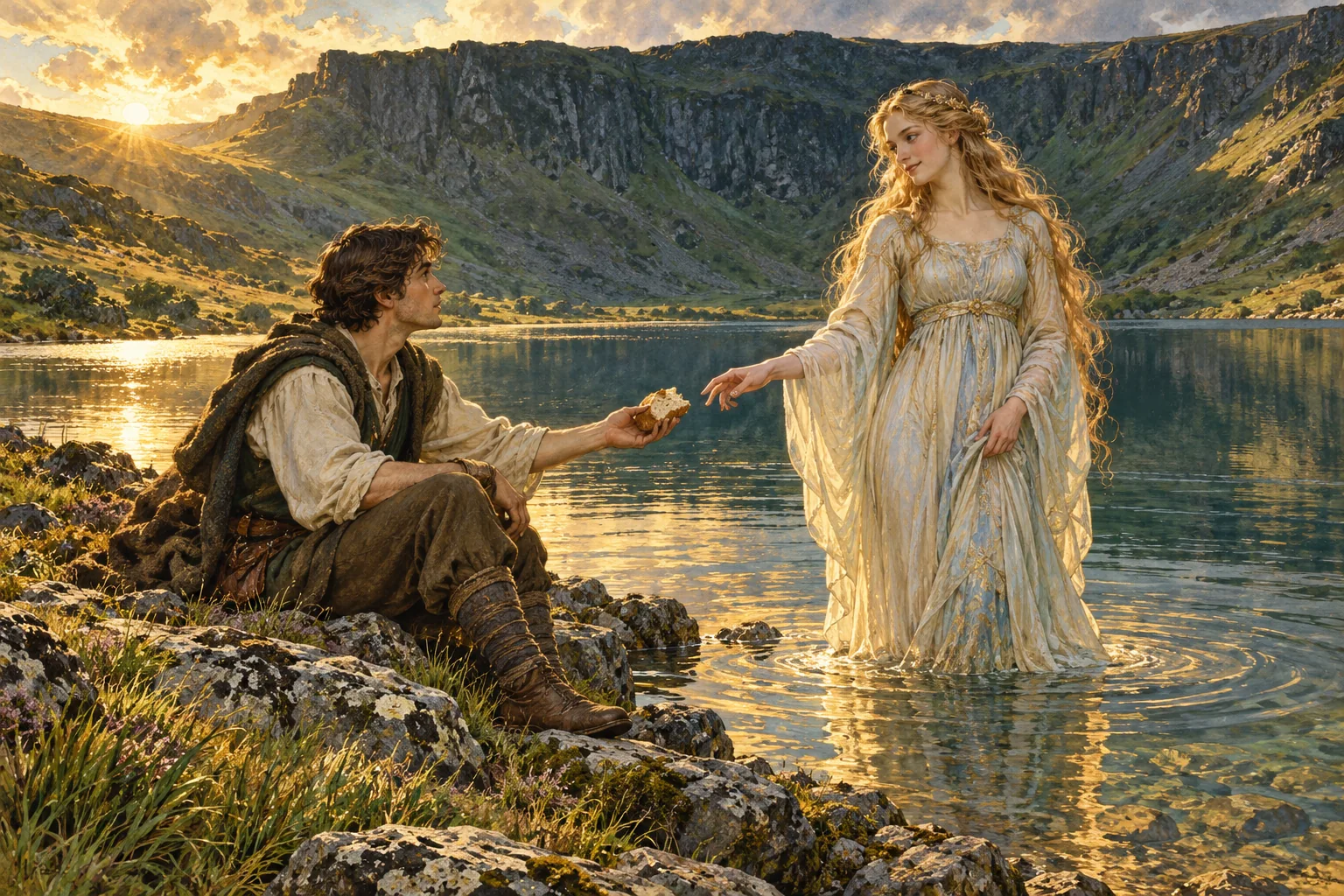
For the third attempt his mother prepared bread that was only lightly baked. He waited beside the lake until the day was almost gone. Then cattle appeared walking on the water, and the woman followed. This time she accepted the bread. He took her hand and asked her to become his wife.
She agreed, with a condition. If he ever gave her three blows without cause, she would leave him for ever. Eager to marry her, he accepted. She let go of his hand and dived into the lake again, leaving him suddenly afraid that he had lost her.
When she returned, she brought another young woman exactly like herself and a tall, white-haired father. He would permit the marriage if the young man could identify the daughter he had chosen. The sisters looked indistinguishable. Then one moved her foot forward. He recognised the way her sandal was tied and took her hand.
Her father granted a dowry of animals: as many sheep, goats, cattle and horses as she could count, separately, without drawing breath. She counted rapidly in groups of five. Each completed count brought another flock or herd out of the lake. But the warning remained. If the marriage condition was broken, she would return with everything she had brought.
The couple settled at Esgair Llaethdy, near Myddfai. Their farm prospered, and they had three sons. For several years their happiness seemed secure.
Then they were invited to a christening. She was reluctant to walk so far, and he suggested fetching a horse. She asked him to bring her gloves. When he returned and found that she had still not gone, he playfully tapped her shoulder with one of them, urging her to hurry.
That, she told him, was the first causeless blow. His intention did not cancel the condition.
At a wedding, while the other guests were celebrating, she began to weep. Her husband touched her shoulder and asked why. She was crying because marriage brought people into trouble, she answered. Now his own trouble was nearer: he had struck her a second time.
Years passed. Their sons grew into clever young men. The lady still loved her husband and warned him to be careful; once the final blow came, she would be unable to stay.
It happened at a funeral. Surrounded by mourners, she laughed. Shocked, her husband touched her and told her to be quiet. Death, she explained, released people from their troubles. But the third blow had fallen, and their marriage was over.
She returned to the farm and called her animals by name. All obeyed, even a black calf that had already been slaughtered: it rose alive and followed. Four oxen abandoned their work, dragging the plough behind them. The lady led the animals back to the lake, where they disappeared beneath the water. The story attributes a furrow leading towards it to that departing plough.
Her sons continued searching for her. Near Dôl Howel she appeared to the eldest, Rhiwallon, and gave him a bag of medical instructions. He was to relieve suffering. She returned again to meet the brothers and showed them the healing properties of plants.
The lost household was not restored. Yet the sons had received an inheritance that could be shared. They became renowned physicians and wrote down their knowledge so it would outlast them.
Versions and variations
Rhŷs reproduces Rees’s collection credits and account, rather than presenting the narrative as his own fresh discovery. The contributors include John Evans of Myddfai, David Williams of Morfa, Elizabeth Morgan of Henllys Lodge and Joseph Joseph, who gathered information around Llanddeusant. Their contributions form a composite published narrative. We do not possess separate complete tellings from each person in the passage examined.
Wirt Sikes, British Goblins, chapter III, sections IV–V, prints two substantially different presentations. In the first, three lake women appear; their moist bread enables the farmer to approach them. The dowry has fixed numbers of cattle. All three blows are taps with a glove during one departure for a fair, rather than incidents spread across years. The returning mother gives a box of remedies to her sons. Sikes calls their father Rhiwallon, whereas Rees’s narrative names the eldest son Rhiwallon. These details should not be silently harmonised.
Sikes’s second presentation introduces a golden boat, a golden oar and offerings of bread and cheese. Its three blows occur around a christening, a child’s funeral and a wedding involving a young bride and an elderly miser. The lady’s tears and laughter express foreknowledge or a different judgement of human happiness. This telling lacks the developed medical conclusion of Rees’s version. Sikes gives printed references and describes a more polished form; the pages do not establish two independently recorded oral performances.
Rhŷs also reports fragments he and a colleague obtained locally. One teller said the distant lady initially looked like a goose; another connected her with a farmer’s cart and later fertility. These are valuable differences, but incomplete reports. They cannot supply a whole alternative plot. Rhŷs’s reservations about Sikes’s sourcing further argue against treating every printed version as an equally documented field record.
Context and evidence
The named farms, lake and meeting places root the legend in a particular landscape. They do not independently establish a marriage with a supernatural woman. Rees’s historical framing and claims about later descendants also require evidence beyond the narrative itself.
There is a separate history of Welsh medical writing. Diana Luft’s 2020 edition draws on four late-medieval manuscripts and cautions against treating their material as one uniform work called Meddygon Myddfai. Those surviving texts deserve study in their own right; their existence does not prove the lake-lady genealogy. This page compares the folklore accounts rather than assessing the remedies.
Sources for this entry
- John Rhŷs; incorporating William Rees of Tonn's account, Celtic Folklore: Welsh and Manx, volume I. Oxford: Clarendon Press, 1901; first edition; Project Gutenberg 55025.. Chapter I, « Undine's Kymric Sisters », section I: Rees's lake-lady account and collection credits, pp. 2–12; Rhŷs's discussion and alternative reports, pp. 16–23.. Read source — Public-domain narrative basis and provenance discussion, read in full for the Llyn y Fan Fach material. Rees's 1861 introduction is examined through Rhŷs's reproduction. About this book
- Wirt Sikes, British Goblins: Welsh Folk-Lore, Fairy Mythology, Legends and Traditions. London: Sampson Low, Marston, Searle & Rivington, 1880; first edition; Project Gutenberg 34704.. Book I, chapter III, sections IV–V, pp. 38–44: two presentations of the Lady of Llyn y Fan Fach.. Read source — Public-domain comparison accounts, read in full. Their differences are described without treating them as independently documented field recordings. About this book
- Diana Luft, Medieval Welsh Medical Texts: Volume One: The Recipes. Cardiff: University of Wales Press, 2020.. Chapter 1, opening discussion.. Read source — Brief critical context; chapter extract only. About this book
Research coverage
Examined: Rees's complete legend and credits as reproduced by Rhŷs, Rhŷs's local fragments and discussion, and both Sikes presentations. The 1861 Physicians of Myddvai volume was consulted indirectly through Rhŷs; its entire medical text, Sikes's underlying Cambro-Briton reference, later recordings and all neighbouring lake legends were not examined. Luft is used only for a brief critical point from an accessible chapter extract.
The Myths · Welsh collection · Editorial approach
Further Reading