Fenian Cycle · story
Fionn and Aillén at Tara
At Samhain, an Otherworld musician puts Tara to sleep and burns its halls. A young Fionn accepts the challenge of staying awake, and wins the leadership of the Fianna.
Also found as: Finn and Aillen · The Burning of Tara · Fionn’s Defence of Tara · Aillén mac Midhna
Research reviewed 17 October 2026.
Read the story
This retelling follows the episode in the Acallam na Senórach, §§129–139, in Standish Hayes O’Grady’s English translation. Names are modernised where helpful.
The feast at Tara offered young Fionn something he could seldom find elsewhere: a chance to enter a crowded hall without an old quarrel immediately becoming a fight. While the feast lasted, feuds were forbidden. Goll mac Morna sat among the nobles, holding the command that had once belonged to Fionn’s father, Cumhall. Fionn, still only ten in this account, came into their company unknown.
King Conn had his drinking horn placed in the boy’s hand and asked who he was. Fionn named his father and offered the king his service. Conn recognised the claim of an old friend’s son and welcomed him beside his own son. For a while, the gathering returned to its drinking.
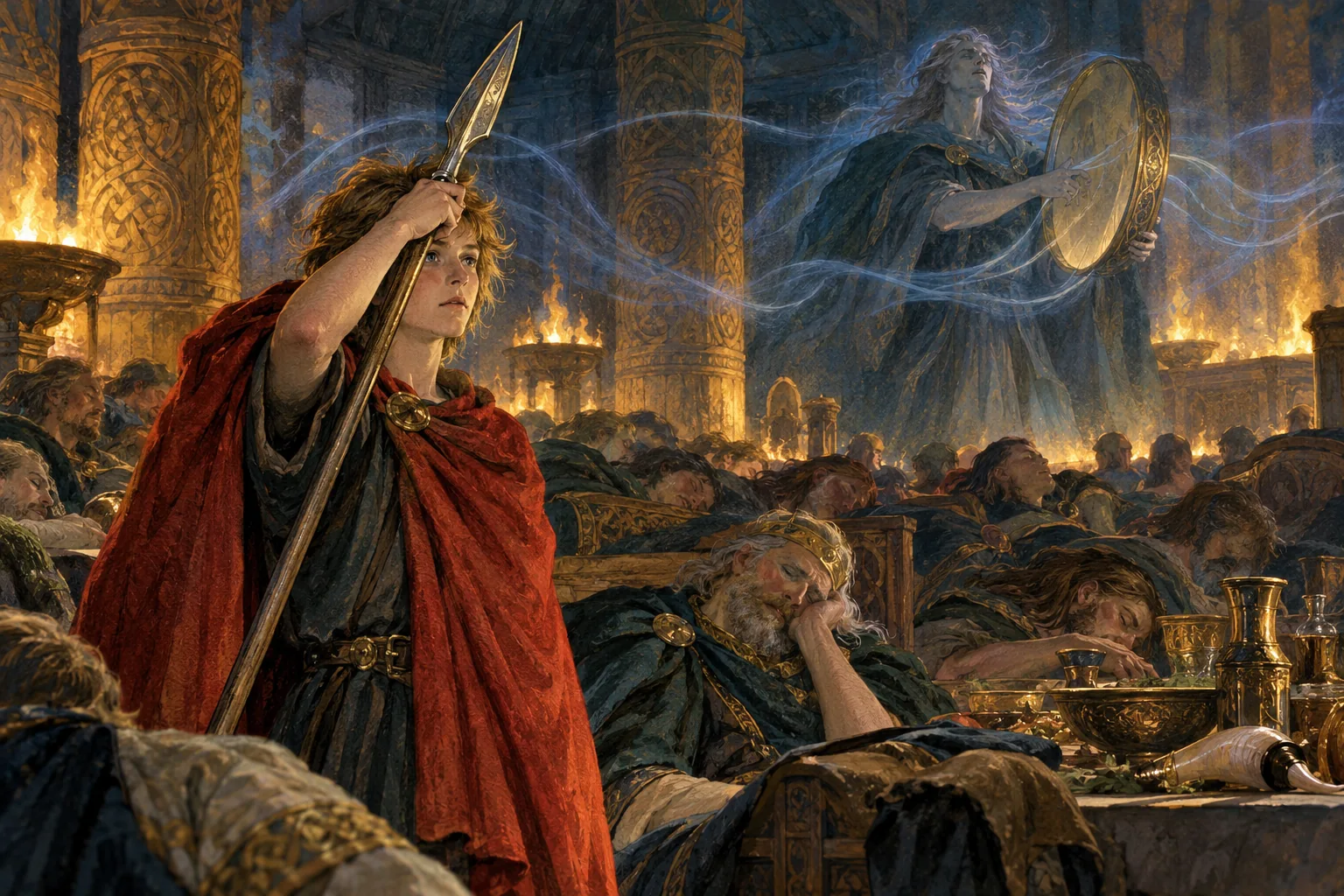
But everyone knew what threatened the night. At Samhain, Aillén son of Midhna came from the northern fairy dwelling of Finnachadh. He carried a musical instrument, a timpán, whose sound overwhelmed every listener. Pain could not keep anyone awake against it. When Tara lay asleep, Aillén breathed out fire and burned the place.
Conn offered the rightful inheritance of any man who could preserve Tara until morning. No one answered. Fionn stood up, but he first asked who would guarantee the promise. The provincial kings and the druids agreed to stand behind it. Only then did the boy take responsibility for the watch.
There was someone else who remembered Cumhall. Fiacha mac Congha approached Fionn privately with an offer: a spear whose cast would not go astray. His price was a third share in what Fionn’s right hand won, and a place in his closest counsel. Fionn agreed. Fiacha explained how to resist the music: uncover the spearhead and hold it against his forehead. Its terrible power would prevent sleep.
Fionn walked the circuit of Tara. When Aillén’s music began, the boy pressed the weapon to his brow. Around him the listeners surrendered to sleep, but he remained standing. Then the musician released his fire.
Fionn thrust his crimson mantle against the blast. Instead of spreading through the royal buildings, the flame fell downwards, driving the folded cloak deep into the earth. The defence had held. Aillén turned and fled towards his own dwelling on Slieve Fuad.
Fionn followed. As the fugitive reached the entrance, the boy cast Fiacha’s spear into his back. He cut off Aillén’s head and carried it to Tara. Away from the victory, Aillén’s mother found her fallen son and grieved for him: the enemy of the royal hall was also someone’s beloved child.
At sunrise, Fionn showed the king the head and the instruments that had brought Tara such misery. The gathering awarded him command of the Fianna. Conn gave Goll a choice: leave Ireland or place his hand in Fionn’s. Goll chose to give his hand. A hunted boy had entered the feast; a leader stood before the assembled company.
Versions and variations
Nine burnings or twenty-three?
The Acallam episode preserves a disagreement inside the same narrative. Its opening prose (§129) says Aillén burned Tara annually for twenty-three years; the lament placed after his death (§137) says nine times. Gregory’s “The Coming of Finn” gives nine years in the prose as well as nine in the lament. These should remain visible alternatives, rather than being turned into a single supposedly agreed chronology.
The weapon and the music
O’Grady’s translation has Fiacha prescribe the spearhead against the forehead or another part of the body; Fionn actually uses his forehead. Gregory keeps the forehead instruction. Neither passage describes the familiar modern image of deliberately stabbing the thigh to keep awake. The Acallam calls Aillén’s instrument a timpán and also mentions a pipe; Gregory calls it a little harp and later names both harp and pipe. A modern harp illustration therefore follows Gregory’s wording, rather than settling the medieval instrument’s identity.
A boy at whose court?
The Acallam explicitly places the ten-year-old Fionn before Conn of the Hundred Battles. Gregory calls him a young lad and usually calls his host the High King in this episode. The king should not silently become Cormac merely because Cormac appears in many other Fenian stories. Gregory lists Silva Gadelica among her authorities for this chapter: her version is a literary retelling within the same transmission, not a second independently collected report of an event.
Context and evidence
The episode is framed as Caoilte recognising Fiacha’s spear and explaining its history. That frame turns an object into a doorway to the Fianna’s past. The actual defence also explains two landscape names, Ard na Teinedh and Glenn an Bhruit; the text gives these names in §135, but this entry does not assign them speculative modern map coordinates. Tara is a real place; magical music, fire-breathing and Fionn’s appointment belong to this literary account. No archaeological evidence examined here establishes that this specific burning or battle occurred.
Sources for this entry
- Anonymous; English translation by Standish Hayes O’Grady, Acallam na Senórach: the story of Fiacha’s spear and Find’s defence of Tara. O’Grady, Silva Gadelica, vol. II (1892); parallel text hosted by UCC Irish Sagas Online. §§129–139, corresponding to lines 1654–1761 in the displayed Irish edition. Read source — Principal narrative; directly compared prose, poem and conclusion. About this book
- Lady Gregory, Gods and Fighting Men. First published 1904; consulted Project Gutenberg transcription of 1905 edition. Part II, Book I, chapter I, Aillén episode; Notes III, The Authorities. Read source — Later literary comparison; chapter bibliography identifies Silva Gadelica among its sources. About this book
Research coverage
Two directly examined accounts, with the internal prose/poem discrepancy retained. This is a documented starting comparison, not a census of manuscript and oral versions. Schools’ Collection records and other Acallam manuscripts remain to be checked.
The Myths · Irish collection · Editorial approach
Further Reading