Fenian Cycle · story
The Salmon of Knowledge
A young fugitive cooks a salmon for a poet, burns his thumb and receives the wisdom intended for someone called Finn. Other accounts put the same discovery inside a giant’s cave.
Also found as: Salmon of Wisdom · An Bradán Feasa · Boyhood Deeds of Fionn · Boyish Exploits of Finn · Macgnímartha Find · Finnéces · Finegas · Finnegas
Research reviewed 17 October 2026.
Read the story
This retelling follows the medieval Boyhood narrative in Kuno Meyer’s English translation, especially sections 17–20. Names and events from later accounts are compared below.
Before he became the leader of the Fianna, Fionn was a boy whose life depended on remaining unknown. His father Cumall had fallen in battle, and his father’s enemies still watched for the son. His mother Muirne could not safely keep him. Two women, Bodbmall and the Grey One of Luachair, brought him up in the woods of Slieve Bloom, where he learned to hunt and to survive.
He was called Demne. His strength made it difficult to disappear into a crowd. Wherever he went, someone noticed that this was no ordinary youth. He served kings, travelled through unfamiliar country and recovered the treasure-bag once carried by his father. At last, after finding his father’s old companion Crimall, he left to learn poetry.
His teacher was Finnéces, a poet living beside the Boyne. For seven years Finnéces had watched for the salmon of Féc’s Pool. A prophecy promised that he would eat that fish and afterwards possess knowledge beyond the reach of other people. Seven years of waiting had gathered around a single meal.
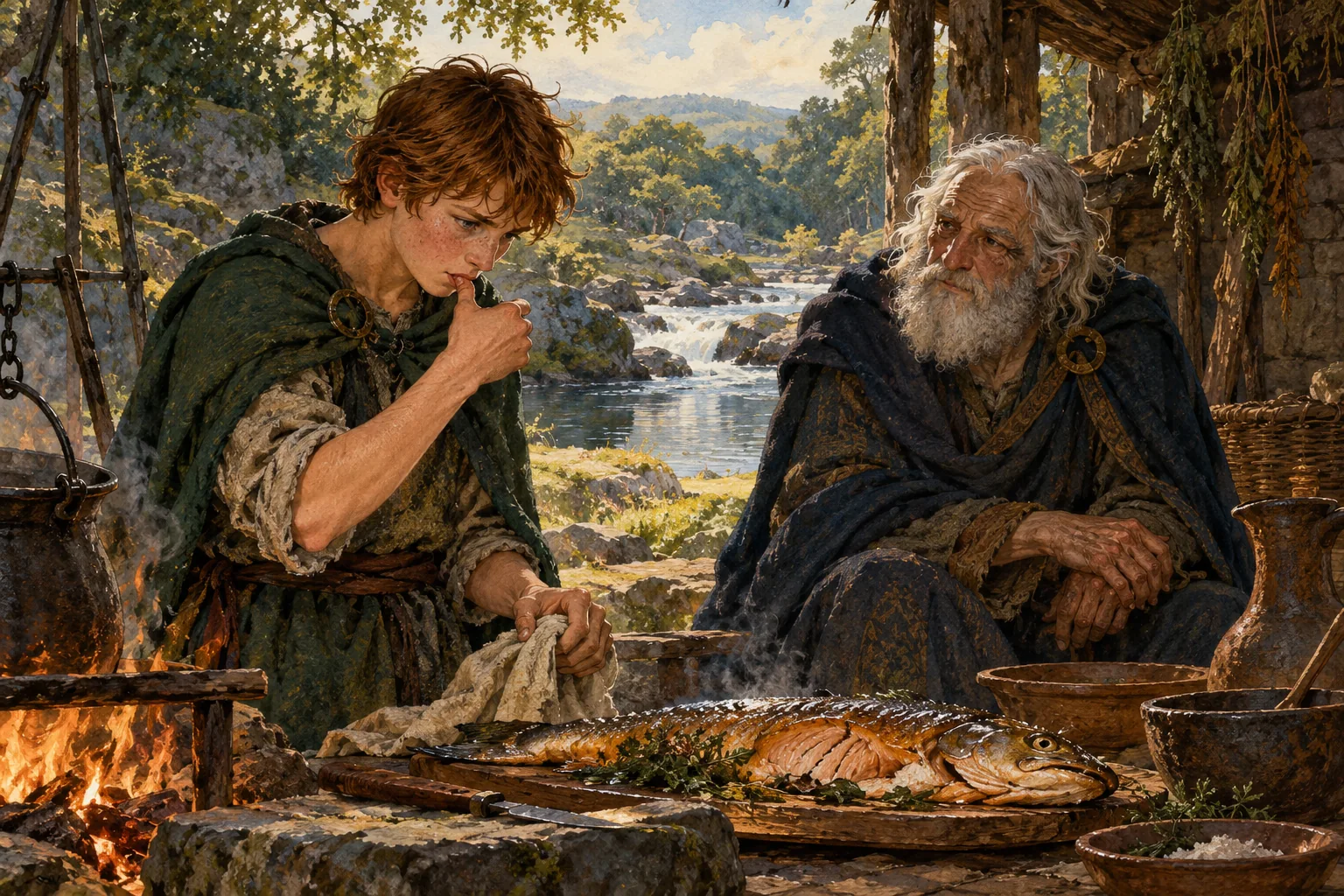
When the salmon was finally caught, Finnéces gave it to Demne to cook. His instruction was plain: prepare the fish, but eat none of it. The boy did the work and brought the cooked salmon to his teacher.
Finnéces asked whether he had tasted it. Demne answered that he had not eaten any. But he had burned his thumb during the cooking and, without thinking, put it into his mouth to ease the pain.
The poet asked his name. Demne gave the name by which he knew himself. Finnéces understood the prophecy differently now. The Finn for whom the salmon was intended was the boy standing before him. He told the youth to eat it.
From that meal came Fionn’s power of discovery. When he put his thumb into his mouth and used the poetic practice called teinm láida, something previously hidden could be revealed. He learned the other arts of a poet as well. The narrative then gives him a poem celebrating summer: birds calling, woodland growing thick and the world stirring into colour. The hunted boy had gained a kind of power that no weapon could give him. Read Meyer’s text, §§4–20.
Versions and variations
The poet, the hazels and the giant
Meyer’s medieval text: Finnéces waits seven years at Féc’s Pool. The boy burns his thumb, explains what happened and is given the salmon. The passage links the resulting knowledge to teinm láida and names three poetic arts. It does not tell the familiar introductory episode about nine hazelnuts falling into a well. §§17–20.
Lady Gregory: in “The Coming of Finn”, the teacher is Finegas. Fionn burns his thumb while pressing down a blister on the fish. Gregory expressly connects the wisdom to nine hazels growing beside a well beneath the sea. Her composite book also places a separate acquisition of wisdom beside this one: water from Beag’s guarded well accidentally enters Finn’s mouth. That is a second episode, not another detail of the salmon meal. Part II, Book I, chapter I.
Jeremiah Curtin: in “Birth of Fin MacCumhail”, a one-eyed giant orders Fin to roast a salmon without blistering it. Fin burns his thumb and bites down to its marrow, acquiring knowledge. He blinds the giant with the spit and escapes beneath a goatskin. This is a different narrative setting, with a threatening captor instead of a generous teacher. Curtin’s chapter supplies no precise location for this cave. pp. 139–142.
Context and evidence
The Boyne matters here because it is named in the medieval narrative: its association is stronger than a modern illustration or an unsourced claim about where the lesson took place. The source also makes poetry central to Fionn’s knowledge. Reducing it to an instant gift of general intelligence loses that connection. Gregory’s later arrangement and Curtin’s printed folktale demonstrate how the episode can acquire a different explanation or become part of a larger escape story. These texts establish that such versions were recorded; they do not establish that a historical Fionn acquired supernatural knowledge. Meyer, §§17–20 and manuscript details.
Sources for this entry
- Anonymous; translated by Kuno Meyer, The Boyish Exploits of Finn (Macgnímartha Find). Ériu 1 (1904), pp. 180–190; CELT electronic edition T303023. §§4–20, especially §§17–19, pp. 185–186; manuscript Laud 610, fols. 118a2–121b1. Read source — Principal narrative and medieval textual witness in translation; directly consulted.
- Lady Gregory, Gods and Fighting Men. 1905 edition displayed by Project Gutenberg; work first published 1904. Part II, Book I, chapter I, The Coming of Finn; Notes III, The Authorities. Read source — Later literary arrangement: nine hazels, blister and separate well episode; directly consulted. About this book
- Jeremiah Curtin, Myths and Folk Tales of Ireland. Project Gutenberg text no. 36540, with printed page markers; collection first published 1890. Birth of Fin MacCumhail, pp. 135–147; salmon-and-giant episode pp. 139–142. Read source — Different printed folktale account; no individual narrator identified in this chapter; directly consulted. About this book
Research coverage
Three texts compared. Further work: collate modern critical discussion of the Boyhood text, other thumb-of-knowledge origin tales, and individual Dúchas records with narrator and school metadata. A Dúchas search located salmon transcripts, but the individual record did not load reliably, so it is not presented here as an examined witness. Nine-hazel material is attributed to Gregory, not inserted into Meyer’s passage.
The Myths · Irish collection · Editorial approach
Further Reading