Kerry coastal folklore · place
Ballinskelligs Bay and Trafraska
The Kerry shore from which Maurice Connor follows a sea-woman beneath the waves. Croker names the bay and strand, but the legend does not supply a verified modern site.
Also found as: Trafraska strand · Ballinskellig bay
Research reviewed 18 October 2026.
The shore in The Wonderful Tune
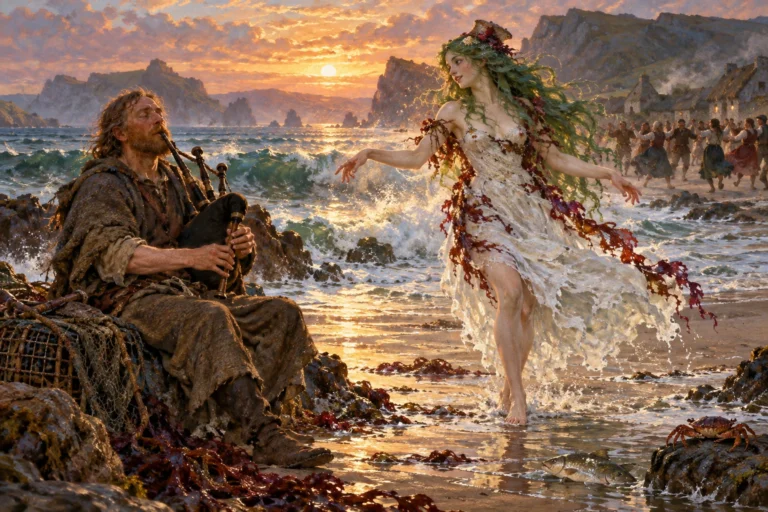
Croker brings Maurice Connor and his mother into Iveragh and places the dancing scene on Trafraska strand in Ballinskelligs Bay. The sand becomes a meeting place for villagers, musician and the creatures of the water.
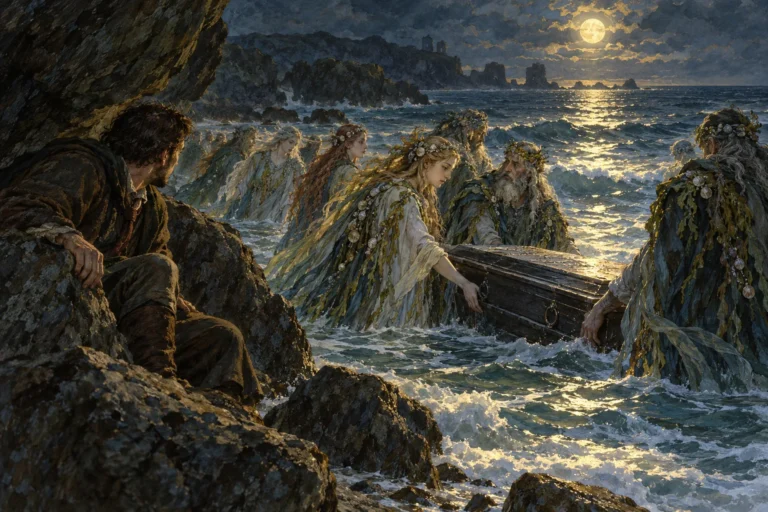
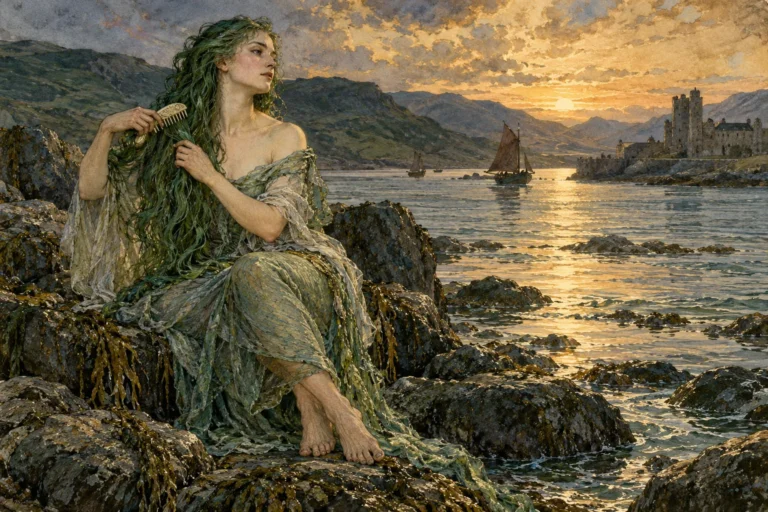
The sea-woman can cross that boundary more freely than the human characters. She emerges dancing, makes her proposal and takes Maurice away when a wave covers them. His mother remains ashore. The landscape gives their separation a visible edge.
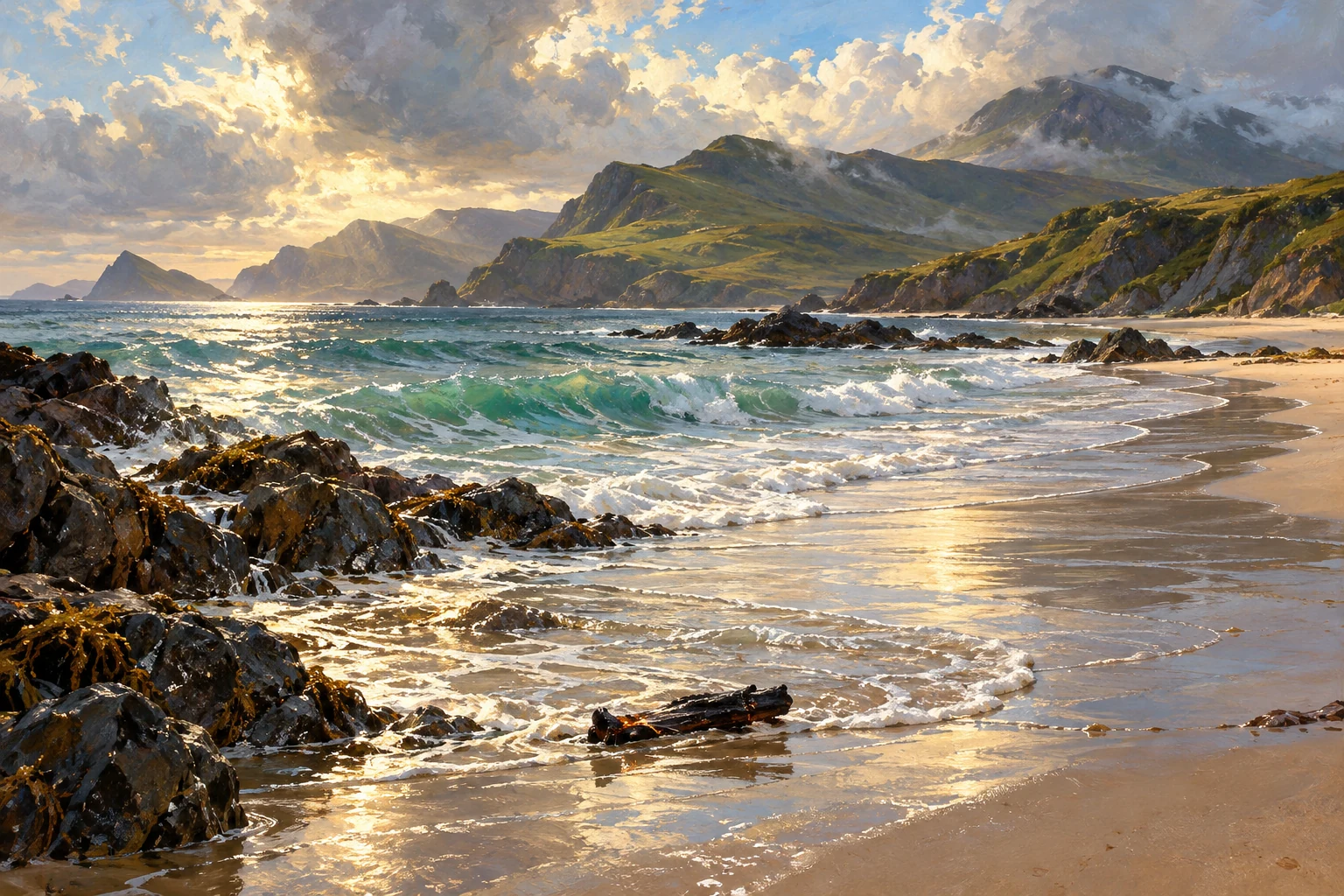
The burnt wood promised as an annual token is another crossing of that edge. It is supposed to show that the piper lives beneath the water, although it cannot bring him home. The narrator’s later music heard by sailors extends the tale beyond the gathering on the beach.
A place carried between books
The Lilac Fairy Book retains the Kerry setting and the annual token while simplifying some of Croker’s language. Its credit to Croker’s collection makes this an inherited literary location, not a second independent identification of the strand.
Neither consulted text gives survey coordinates or enough modern landmarks to identify a particular patch of sand confidently. This page retains the source’s spelling Trafraska without moving the story to a similarly named place elsewhere.
The Lady of Gollerus belongs to another named coastal setting and another kind of sea marriage. It is a useful Irish comparison, but its household, shore and returning merrow should not be merged with Maurice’s departure.
Landscape evidence and open questions
The geographical reference is evidence for where the printed narrator places the story. It is not proof that the dancing gathering occurred, that Maurice can be identified in local records, or that generations actually received a token on a known anniversary.
A closer place-name study would need historical maps and local evidence for Trafraska before attaching the tale to a modern beach marker. A surviving name could clarify the setting without verifying the supernatural event.
The accompanying coast painting interprets the story’s bay and token. It is not a map or a record of a surviving piece of burnt wood. Readers can follow the story and its book references while keeping that distinction clear.
Sources for this entry
- Thomas Crofton Croker, Fairy Legends and Traditions of the South of Ireland. Consulted seventh edition, edited by Thomas Wright, June 1906. “The Wonderful Tune”. Read source — Base narrative, named Kerry shore, sea-woman and annual token. About this book
- Andrew Lang, editor; Leonora Blanche Lang, adapter, The Lilac Fairy Book. Longmans, Green, 1910. “The Wonderful Tune”; preface for adaptation credits. Read source — Later adaptation explicitly credited to Croker’s collection; not an independent oral witness. About this book
Research coverage
Croker’s narrative geography and its transmission into the Lilac Fairy Book were examined. Exact strand identification, local archival evidence and the history of the claimed annual token remain open.
The Myths · Irish collection · Editorial approach
Further Reading