Folklore and local legends · story
The Wonderful Tune
A blind Kerry piper plays a tune that nobody can resist. When the sea itself begins to dance, an unexpected bride comes ashore to claim him.
Also found as: Maurice Connor and the sea-woman
Research reviewed 18 October 2026.
Read the story
This retelling follows Croker’s “The Wonderful Tune” in the consulted 1906 edition. The changes in the 1910 Lilac Fairy Book are compared below.
Maurice Connor could make a gathering forget everything but his pipes. He was blind and travelled with his mother to guide him, carrying the music on which they depended. In Iveragh they came to Trafraska strand in Ballinskelligs Bay, where people were gathered to dance.
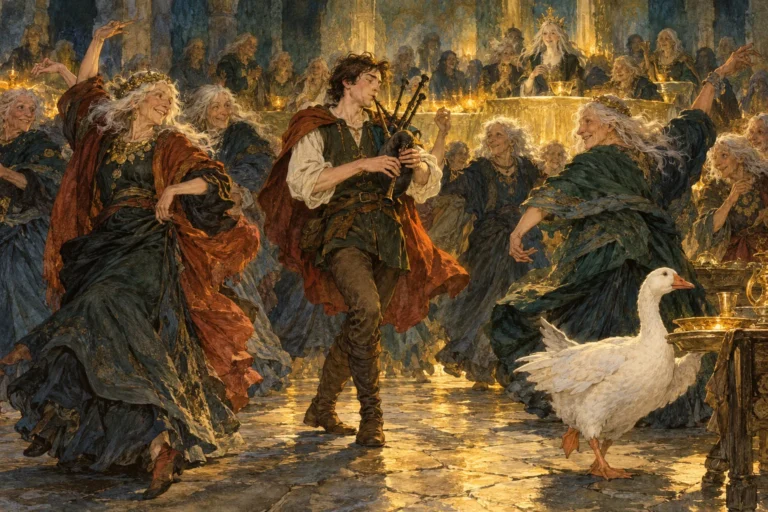
Paddy Dorman, the dancing master, offered Maurice a bottle of whiskey. The piper drank freely, then began a tune unlike any the dancers had heard. Their feet moved faster. They could not stop. His mother was swept into the dance along with the rest, while the power of the music reached beyond the sand.
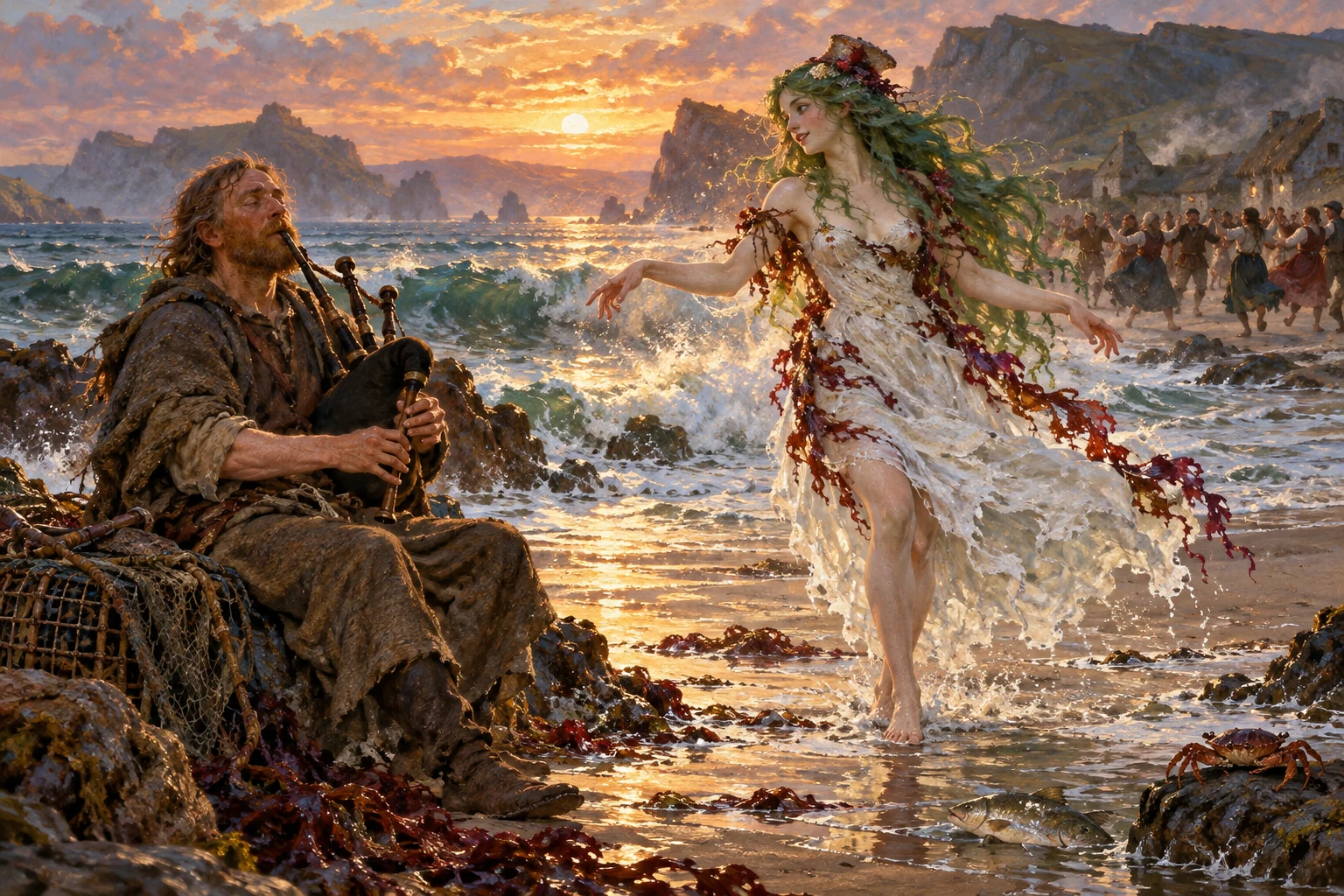
Fish rose and turned in the water. Crabs and shellfish joined the movement. The whole shore seemed caught in a rhythm which Maurice alone could sustain. Then a woman came out of the sea, dancing towards him. Her hair was green, her gown white as foam and trimmed with red and purple seaweed. She wore a little cocked hat.
She had heard his music and wanted him for her husband. Beneath the waves, she promised, he would be a king among the fishes, with a splendid life and gold plates to dine from. Maurice wondered how he could live in salt water. But the stranger’s invitation, and the prospect of her underwater kingdom, overcame his hesitation.
His mother heard what was happening and begged him to stay. Still the tune held her feet, so that she could neither reach him nor keep still. Maurice promised to send a token to the strand once a year: a piece of burnt wood which would show that he remained alive and well.
The sea-woman drew her cloak about him. A great wave rose and broke over the place where they stood. When it passed, Maurice and his companion were gone. The dancing ended, leaving the people on the shore to wonder what they had seen.
The narrator says the promised wood came ashore year after year, for more than a century, though the date was eventually forgotten. Maurice’s mother never saw the first token. She died three weeks after his disappearance. Later sailors spoke of music beneath the water and a voice longing for the coast of Kerry.
Versions and variations
Croker’s shore gathering
The consulted Croker text describes a dancing gathering on Trafraska strand. It does not explicitly call the occasion a wedding. Paddy Dorman, the whiskey, the compulsory dance and the mother’s distress all matter to the sequence. The sea-woman’s offer is a marriage invitation, but it comes after the music has begun.
The Lilac Fairy Book, 1910
The later version explicitly credits Fairy Tales and Traditions of the South of Ireland. It retains the piper, dancing fish, underwater marriage, burnt-wood token and the mother’s death. These agreements show a literary relationship. They should not be counted as two separately collected oral testimonies. The book’s preface credits Leonora Blanche Lang with its adaptations apart from specified exceptions.
The rewriting changes some of the texture. Croker’s jig and planxty become a jig and reel; brogues become shoes; a patron becomes a feast. The sea-woman wears a shining pale-green gown in the later book, whereas Croker makes it white like foam. The political aside about Daniel O’Connell also disappears. These are identifiable editorial differences rather than evidence that all Kerry storytellers described different gowns.
Other sea marriages and musical encounters
The Lady of Gollerus also brings a woman of the sea into a marriage, but there a man conceals the object she needs to return home. Maurice instead accepts an invitation to leave the human shore. The Piper and the Púca offers another supernatural adventure for a musician, while the Welsh Rhys and Llewellyn centres on music and a dance from which a companion cannot easily return. These are comparisons, not additional Maurice Connor episodes.
Place, grief and evidence
The named bay and strand anchor the story in a recognisable coastal world. They do not establish that Maurice was a documented local musician, or that a piece of wood was historically delivered every year. The token belongs to the narrator’s claim, and the loss of its anniversary is part of the ending.
Croker’s narrator offers several possible explanations for the mother’s death, including grief and the strain of the dance. None is a medical finding. Her loss also complicates the piper’s apparent good fortune: a splendid marriage under the sea means separation from the person who guided him on land.
The sea-woman is unnamed. Calling her a merrow provides a useful connection to Irish sea-folk traditions, but it should not give her an invented biography or a fixed relationship to every other mermaid in the collection.
Sources for this entry
- Thomas Crofton Croker, Fairy Legends and Traditions of the South of Ireland. Consulted seventh edition, edited by Thomas Wright, June 1906. “The Wonderful Tune”. Read source — Base narrative, named Kerry shore, sea-woman and annual token. About this book
- Andrew Lang, editor; Leonora Blanche Lang, adapter, The Lilac Fairy Book. Longmans, Green, 1910. “The Wonderful Tune”; preface for adaptation credits. Read source — Later adaptation explicitly credited to Croker’s collection; not an independent oral witness. About this book
Research coverage
The two printed tellings and the Lilac Fairy Book’s adaptation credit were examined. This is not a complete survey of Irish-language oral recordings. No historical identity for Maurice or exact modern identification of Trafraska strand has been established here.
The Myths · Irish collection · Editorial approach
Further Reading