Lincolnshire Cars · story
The Buried Moon
The Moon comes down to help people lost in the marshes, only to become trapped herself. The neighbours must find her before darkness takes over their world.
Also found as: The Dead Moon
Research reviewed 18 October 2026.
Read the story
This retelling follows Joseph Jacobs’s “The Buried Moon”, an adaptation of M. C. Balfour’s “The Dead Moon”. Balfour places the tradition in the Lincolnshire Cars of the Ancholme valley.
When the Moon shone, people could pick their way along the marsh paths. Without her, the dark belonged to misleading lights and frightening things that lurked in the pools. Hearing how people suffered on those nights, the Moon decided to see the trouble for herself.
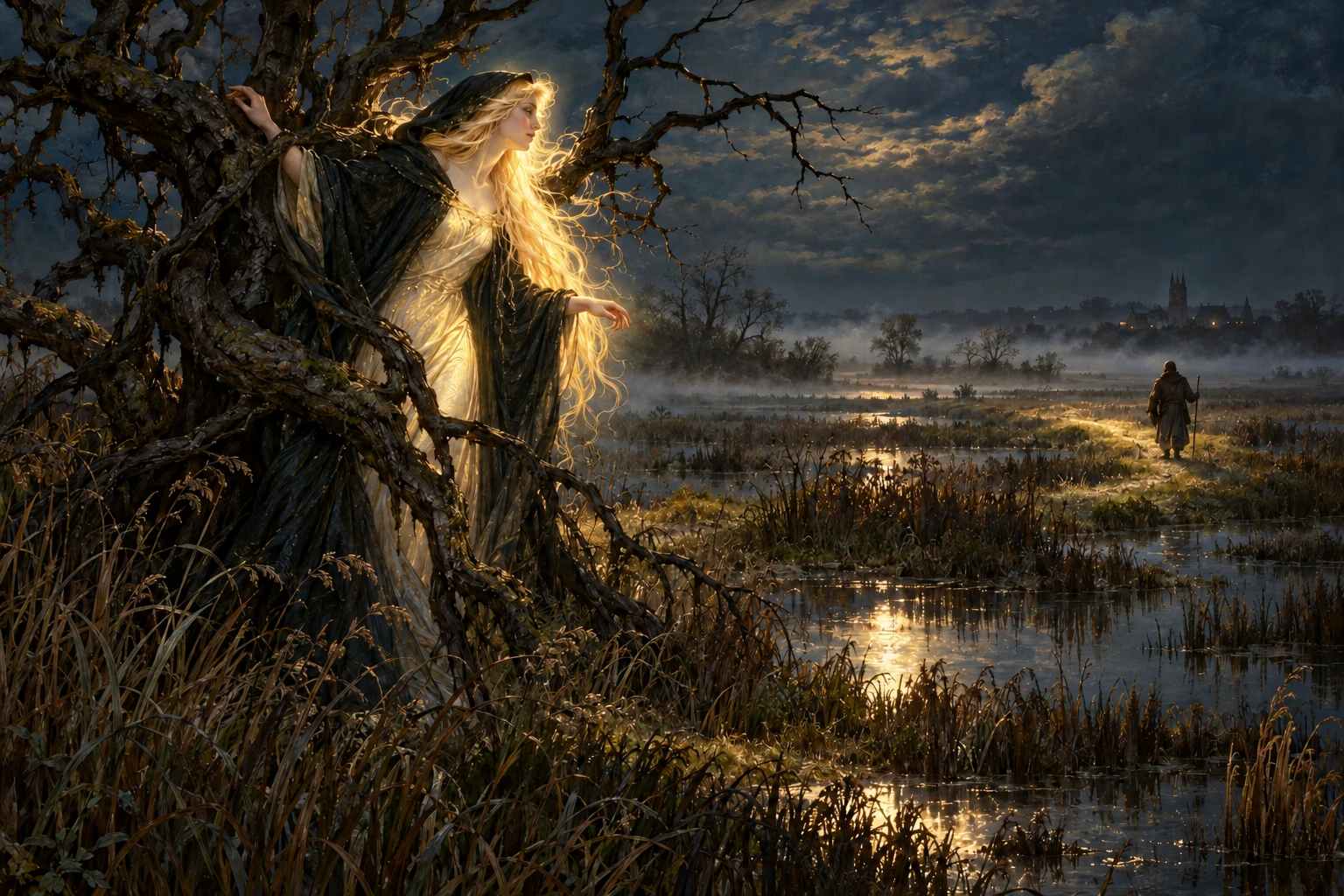
She covered her shining hair with a dark hood and stepped down into the marsh. Water lay between the tussocks. Black tree-stumps rose from the peat. Near a deep pool her foot slipped, and she caught a branch to steady herself. The snag twisted around her wrists and held her fast.
A man was struggling nearby, lost and terrified. He followed the lights that would lead him deeper into danger. The Moon fought to reach him. She could not free herself, but her hood fell back. Light poured from her hair, scattering the horrors and showing him the safe path. Overwhelmed with relief, he escaped without understanding who had helped him.
The Moon struggled again, exhausted herself and fell forward. Her hood covered the light. The creatures returned and crowded around their enemy. They quarrelled over what to do until dawn threatened. Then they forced her into the pool, rolled a great stone over her and set wandering lights to watch.
The next new moon never appeared. Night after night the marsh remained dark. The frightened neighbours consulted a wise woman, who could find no answer until the rescued traveller remembered the light he had seen beside the black snag.
The wise woman told them to enter the marsh together in silence, carrying hazel twigs and looking for a coffin, a candle and a cross. They reached the pool and understood the signs: the great stone resembled a coffin, the snag spread like a cross and a small false light flickered on it.
Keeping silent, they offered their prayer and lifted the stone. For an instant a beautiful face looked up from the water. Then a dazzling light forced them back. When they could see again, the full Moon was shining above them. The paths were clear, and the darkness had lost its prisoner.
From “The Dead Moon” to “The Buried Moon”
Balfour’s 1891 printed account
Balfour introduces the tale as one obtained from a nine-year-old girl who said she had heard it from her grandmother. The collector also mentions first encountering it through a children’s rhyme. She thought the girl’s own imagination coloured the gruesome details. This is a layered record of telling and editing, not a verbatim sound recording of an unchanged ancient myth.
Jacobs’s acknowledged adaptation
Jacobs calls his version an abridgement of Balfour with the dialect removed. His note identifies the girl as Bratton. He changes the title and reduces several frightening episodes. Balfour’s lost traveller is tormented by memories of his own wrongdoing; Jacobs makes the rescue more direct. Balfour also gives the wise woman temporary household protections and ends with a claim that the narrator’s grandmother saw the snag and stone. Jacobs omits those details.
Prayer and practical signs
Both printed versions retain the silent journey, hazel twigs, the stone in each rescuer’s mouth and the coffin, candle and cross. Balfour describes the Lord’s Prayer being said forwards and backwards; Jacobs compresses this wording. These are elements in a supernatural story, not instructions for entering marshes or evidence for a single historical ceremony.
Related, not another version: Tiddy Mun
Balfour prints Tiddy Mun beside the Moon narrative. That story also concerns the Cars, dangerous water and a community seeking supernatural help, but its central conflict is drainage and an offended marsh being. It does not retell the Moon’s imprisonment.
Landscape and interpretation
Balfour distinguishes the Cars of north Lincolnshire from the better-known Fens farther south. Jacobs opens with a general description of fens. The specific collecting landscape should not disappear behind that broader word.
The story gives a familiar dependency a human form: darkness makes wet ground difficult to cross, and moonlight makes a path visible. Reading it as a story about mutual care is an interpretation supported by its action. Calling it proof of a prehistoric Moon cult would require evidence that these texts do not supply.
Balfour’s introductory claims about ancient pagan survivals and the character of local people reflect her period. They are not adopted as established history. The published text documents a late nineteenth-century presentation of folklore, while leaving questions about its earlier transmission open.
Sources for this entry
- M. C. Balfour, Legends of the Lincolnshire Cars, Part I. Folk-Lore, volume II, 1891, pp. 145–170. Introduction, “Tiddy Mun” and “The Dead Moon”. Read source — Original printed accounts and collecting commentary. The dialect transcription and historical interpretations are the collector’s presentation. About this book
- Joseph Jacobs, More English Fairy Tales. 1894. LXVI, “The Buried Moon”, and its source note. Read source — An expressly abridged adaptation of Balfour, with much of the dialect removed. About this book
Research coverage
Balfour’s collecting introduction and full “The Dead Moon” were compared with Jacobs’s narrative and note LXVI. The related Tiddy Mun text was also read. Earlier oral history and later independent recordings have not been established in this entry.
The Myths · English collection · Editorial approach
Further Reading