figure · Britain · shared tradition
Merlin
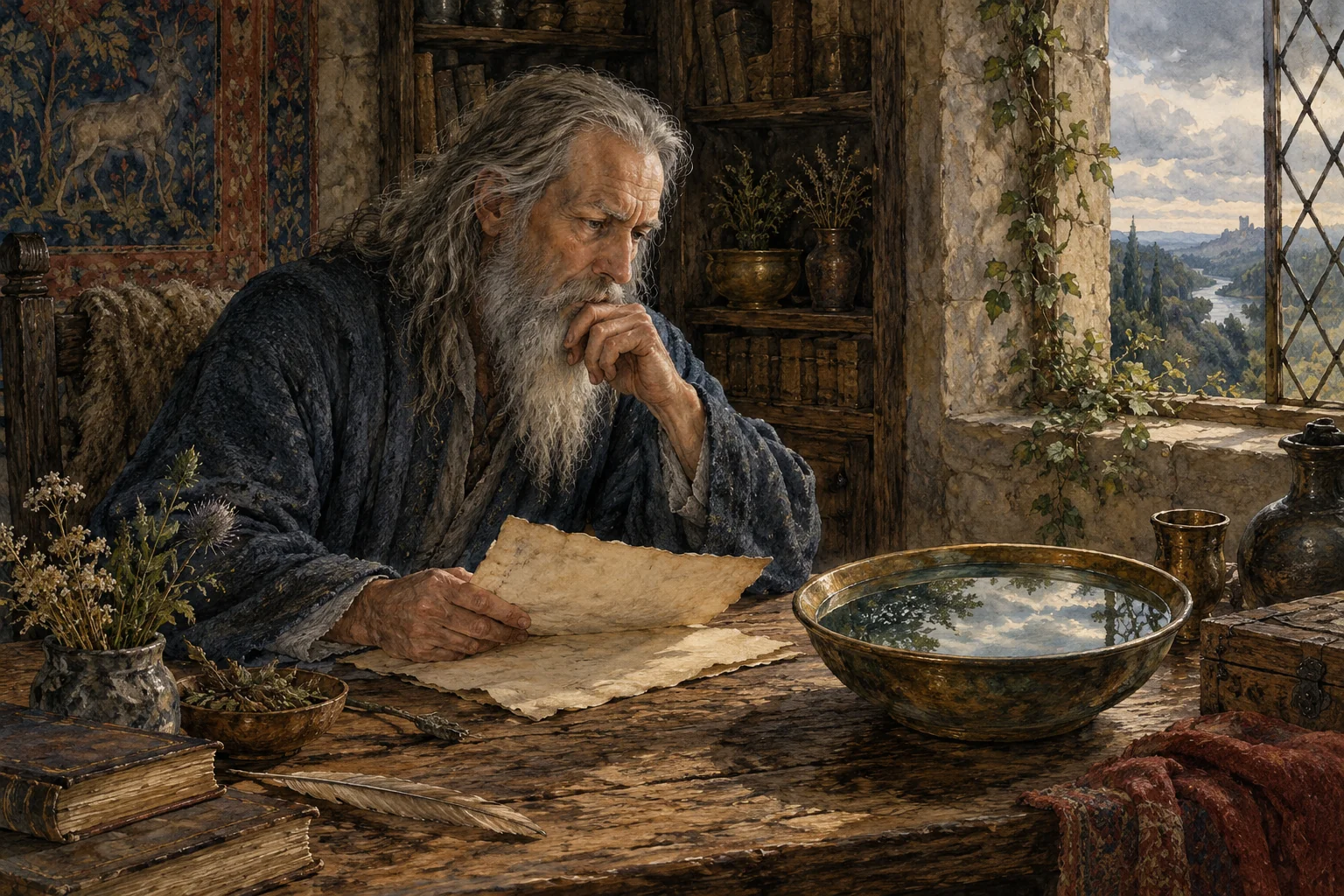
Prophet, engineer, political adviser and dangerous enchanter: Merlin’s knowledge does not make him innocent or invulnerable.
Also found as: Merlin Ambrosius · Myrddin. Research reviewed 18 October 2026.
The child who knew more than the advisers
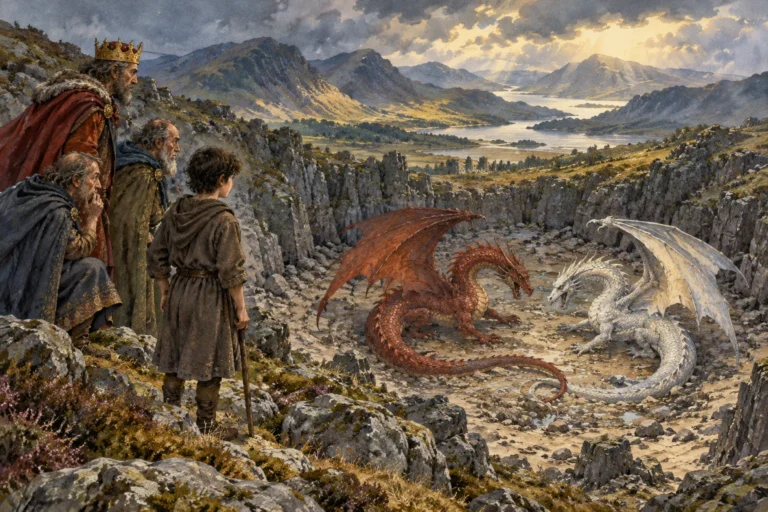
The threatened boy in the dragon story exposes what Vortigern’s advisers cannot explain. In the earlier Historia Brittonum he is Ambrosius. Geoffrey calls his boy Merlin, also Ambrose, and develops his prophecies into a substantial part of the History of the Kings of Britain. The famous name and the familiar scene therefore have a textual history.
Geoffrey’s Merlin also knows how to move the Giant’s Dance from Ireland to Britain. The men’s strength fails where his mechanical knowledge succeeds. This is Geoffrey’s legendary explanation of the monument, not an account to substitute for archaeological evidence about Stonehenge.
Helping a king can mean harming someone else
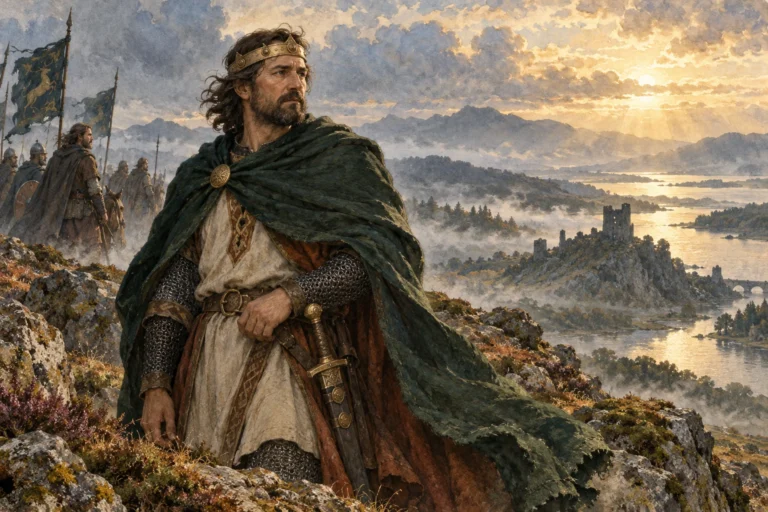
At Tintagel, Merlin enables Uther to take the appearance of Igerna’s husband Gorlois. She is deceived, and Arthur is conceived. The text’s celebration of the future king should not hide the sexual deception on which this episode turns. Merlin’s service to royal power is morally troubling.
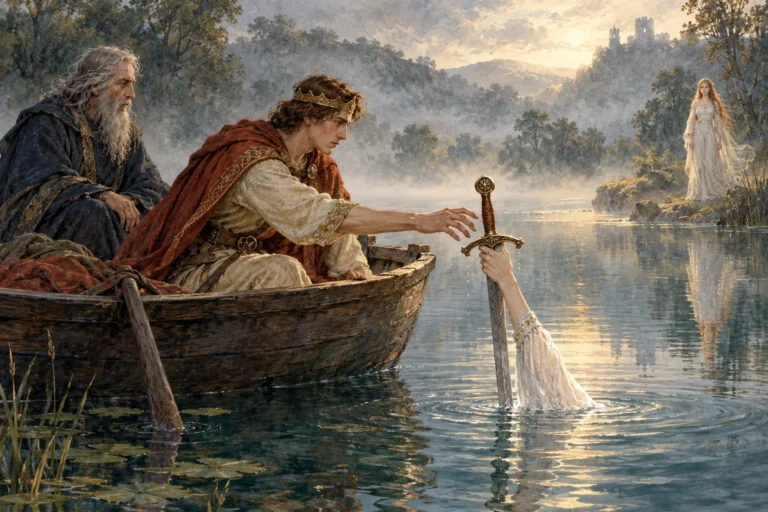
In Malory, Merlin helps arrange the young Arthur’s recognition and repeatedly advises him. At the lake he teaches Arthur that the life-preserving scabbard is worth more than the admired sword. He can explain a danger that a warrior overlooks; he cannot make all of his own desires safe.
Versions and variations
The end under a stone
Malory’s Book IV.1 describes Merlin’s persistent pursuit of Nimue, one of the lake damsels. She learns from him, obtains an undertaking that he will not use enchantment against her, and eventually traps him beneath a stone. A retelling that presents only a wicked temptress and an innocent old man leaves out the unwanted pursuit explicitly described in this version.
Several Merlin traditions need separate treatment
The dragon boy, Uther’s enchanter and Arthur’s counsellor can be connected within particular works. The Welsh Myrddin poetry and Geoffrey’s later Vita Merlini need their own detailed treatment. This entry does not silently merge those uncollated traditions into the biography presented here.
The Lady of the Lake is not one simple label
Malory has more than one lake-associated woman. The lady in the sword-gift episode should not automatically be treated as identical with every later character called Nimue, Vivien or a Lady of the Lake.
Context and evidence
Merlin is useful to read as a figure through whom stories ask who controls knowledge and how rulers use it. That is an interpretation of the passages compared, not a claim that he represents one recoverable historical profession.
The Dinas Emrys remains support a history of the place. They cannot verify the existence of a boy prophet or establish that the dragons were real animals.
Sources for this entry
- Anonymous compiler, traditionally attributed to Nennius, Historia Brittonum (History of the Britons). Ninth-century compilation; Fordham transcription of Giles (1848), with §§56 and 73 supplied from the Camelot Project. Sections 40–42. Ambrosius before Geoffrey’s Merlin. Read source · About this book
- Geoffrey of Monmouth, History of the Kings of Britain, Book VI. Composed c.1136–38; English version in J. A. Giles, Six Old English Chronicles (1848). Book VI, chapters 17–19. Boy and tower. Read source · About this book
- Geoffrey of Monmouth, History of the Kings of Britain, Book VII. Composed c.1136–38; Giles collection (1848). Book VII, chapter 3. Opening prophecies. Read source · About this book
- Geoffrey of Monmouth, History of the Kings of Britain, Book VIII. Composed c.1136–38; Giles collection (1848). Book VIII, chapters 10–12 and 19. Giant’s Dance and the deception at Tintagel. Read source · About this book
- Thomas Malory, Le Morte Darthur, volume I. Caxton book-and-chapter arrangement, first printed 1485; Project Gutenberg 1251. Book I, chapters 5 and 25; Book IV, chapter 1. Counsel to Arthur and confinement by Nimue. Read source · About this book
Research coverage
The named passages have been examined and compared. This is a first source-led guide, not a collation of every manuscript, translation, local telling or adaptation.
The Myths · Arthurian collection · Editorial approach
Further Reading