
Learning & activities / Wales
Compare versions
The Welsh dragons: compare two tellings
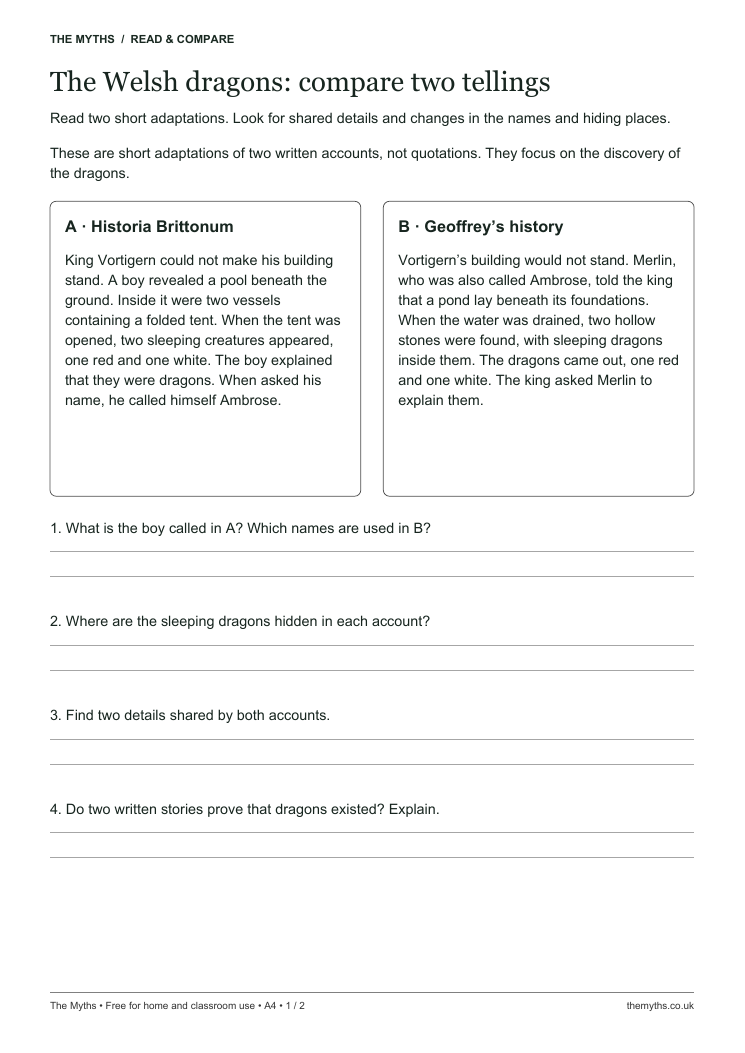
Compare Ambrose and Merlin in two dragon accounts, with a two-page printable, short adapted passages and an adult answer guide.
WalesAges 9+A4 · 2 pages
Download and print
Read two short adaptations. Look for shared details and changes in the names and hiding places.
Black-and-white printable. Select A4 and “Fit to page” when printing. Free for personal, home and classroom use. No sign-up needed.
Try this activity
Print page 1 for the learner and use page 2 for discussion and answers. Underline a detail in each passage to support the comparison, then try the existing Welsh dragons colouring sheet.
Suggested ages are a guide. Choose the reading and practical support that suits your learner.
More to try: Colour the red and white dragons
The story behind the picture
Both accounts connect Vortigern’s troubled building with hidden dragons. The Historia Brittonum calls the boy Ambrose and puts the creatures inside a folded tent in vessels. Geoffrey of Monmouth names Merlin, also called Ambrose, and places the sleeping dragons in hollow stones beneath a pond.
About this version
These are literary accounts, not independent eyewitness evidence for dragons. The extracts focus on the discovery and omit the threat to kill the boy and the later political prophecies. Geoffrey develops an earlier tradition. The names are not a simple swap: his text explicitly calls Merlin Ambrose as well.
Follow the story
Sources for this activity
Source notes are for adults and older readers. Full texts may contain material beyond the selected activity.
- Historia Brittonum: Ambrose and the dragons
Fordham’s English text, sections 40-42. Traditionally attributed to Nennius. The relevant discovery sequence has a pool, two vases, a folded tent and sleeping serpents. - Geoffrey of Monmouth: the hollow stones
History of the Kings of Britain, Book VI, chapter 19, in the English translation printed in Six Old English Chronicles. Merlin is also called Ambrose. - Geoffrey of Monmouth: red and white dragons
Book VII, chapter 3. Supplies the colours and subsequent dragon struggle; the worksheet does not reproduce the political prophecy.
How we use sources and illustrations · Browse all activities