place · Wales
Dinas Emrys
A hill near Beddgelert associated with concealed dragons and a threatened child who knows what lies beneath the foundations.
Also found as: Dinas Emreis · Dinas Ffaraon · Beddgelert. Research reviewed 18 October 2026.
Two stories beneath the hill
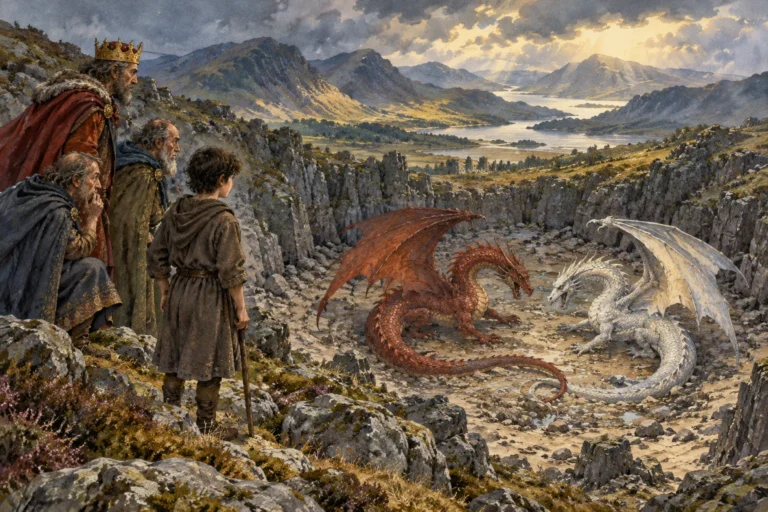
In the Historia Brittonum, Vortigern’s advisers demand the blood of a fatherless child to secure his failing stronghold. Ambrosius instead reveals a pool and the concealed dragons. Geoffrey develops the scene into Merlin’s confrontation with the advisers. The boy’s name and the details of the hiding place differ.
The Welsh tale of Lludd and Llefelys answers a different question: how were the dragons concealed? Lludd traps them with mead, wraps them while they sleep and buries them at the strong place the tale identifies as Dinas Emrys, formerly Dinas Ffaraon. Read that naming sequence as part of the story, rather than an archaeological record of the hill’s successive names. Guest’s translation.
Associations and distinctions
Pool and fortifications
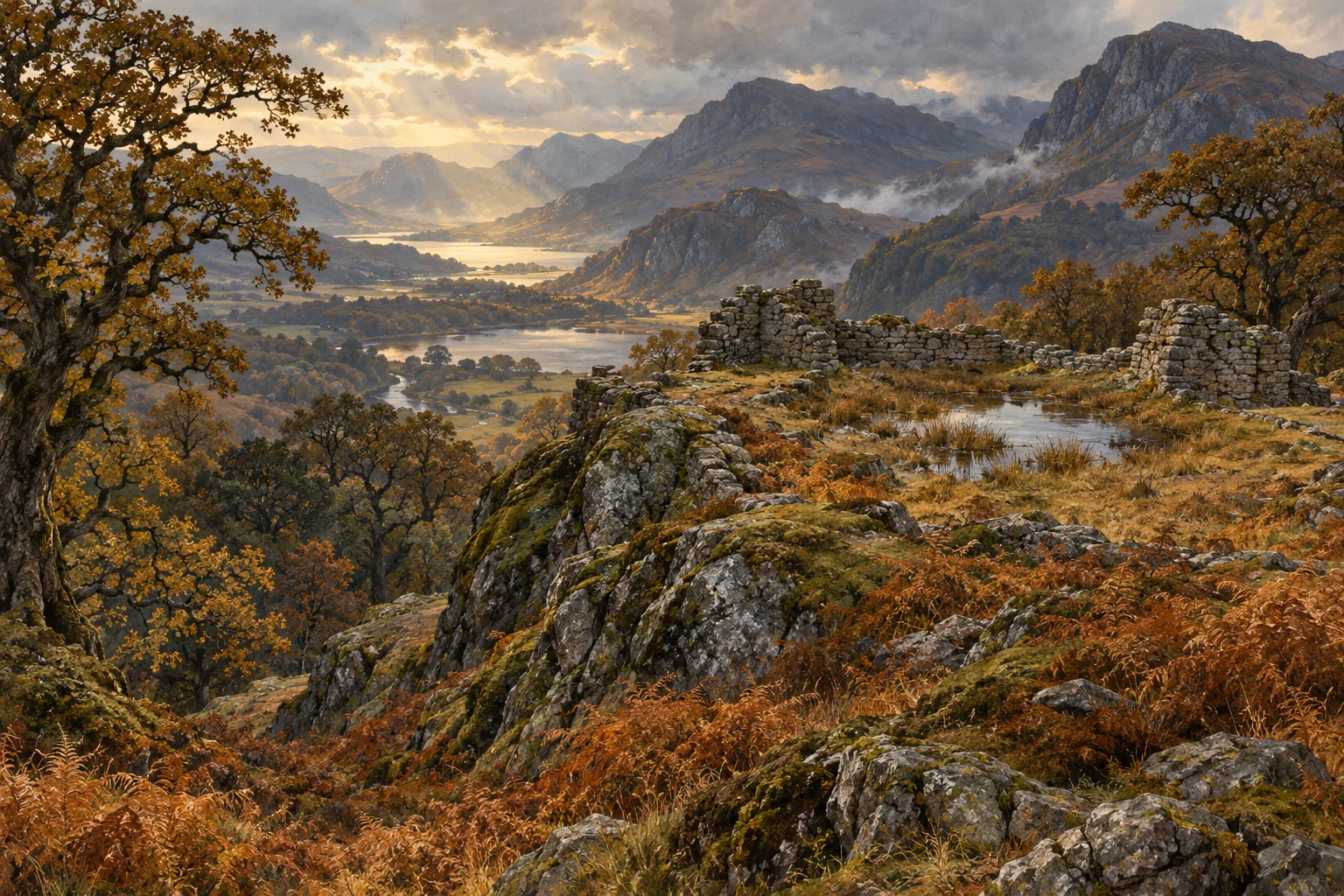
The National Trust records a pond near the summit and describes surviving fortifications and a tower on its trail. These are physical features that can be investigated independently of the dragon narrative. A pool can make the story feel present in the landscape without proving the hidden creatures existed. Pond record; site trail.
Ambrosius is not simply a spelling of Merlin
The earlier compilation calls the child Ambrosius. Geoffrey’s use of Merlin, also Ambrose, is part of the story’s development. A site guide that calls every version “Merlin’s story” can conceal this useful difference.
Context and evidence
The place provides a meeting point for narrative, naming and material remains. Each source below is labelled for the question it can answer. The heritage record is not a new witness to the medieval story, and a medieval story is not an excavation report.
This page covers the boy-and-dragons accounts and the burial episode in Lludd and Llefelys. Later treasure legends, local oral accounts and the full archaeological sequence require separate research. The illustration is an evocation of the hill, not a reconstruction claiming to show Vortigern’s building.
Sources for this entry
- Anonymous compiler, traditionally attributed to Nennius, Historia Brittonum (History of the Britons). Ninth-century compilation; Fordham transcription of Giles (1848), with §§56 and 73 supplied from the Camelot Project. Sections 40–42. Ambrosius and the concealed dragons. Read source · About this book
- Geoffrey of Monmouth, History of the Kings of Britain, Book VI. Composed c.1136–38; English version in J. A. Giles, Six Old English Chronicles (1848). Book VI, chapters 17–19. Geoffrey’s Merlin version. Read source · About this book
- Anonymous Welsh storytellers; translated by Charlotte Guest, The Mabinogion. Nineteenth-century translation, collected edition; Project Gutenberg 5160. “The Story of Lludd and Llevelys”. Burial of the dragons and the hill’s name. Read source · About this book
- National Trust, Pond, Dinas Emrys, Hafod y Porth. Heritage record MNA135979 / 44248, consulted 18 October 2026. Record MNA135979 / 44248. Physical pond. Read source
- National Trust, The legendary trail of Dinas Emrys. Site trail and interpretation, consulted 18 October 2026. Summit description. Visible remains and place interpretation. Read source
Research coverage
The named passages have been examined and compared. This is a first source-led guide, not a collation of every manuscript, translation, local telling or adaptation.
The Myths · Arthurian collection · Editorial approach
Further Reading