story · England
Arthur and Excalibur
A sword rises above a lake, but its scabbard matters more than Arthur expects. Follow the lake episode, the older sword names and the complications of the stone sword.
Also found as: Excalibur · Caledfwlch · Caledvwlch · Caliburn · The Lady of the Lake. Research reviewed 18 October 2026.
Read the story
The gift on the water
Arthur’s courage had carried him into a fight he could not win. Facing Pellinore, he had lost his horse and then his sword, which broke under the other knight’s blow. Merlin intervened before Pellinore could kill him, casting the challenger into sleep. After a hermit treated Arthur’s wounds, king and counsellor rode on.
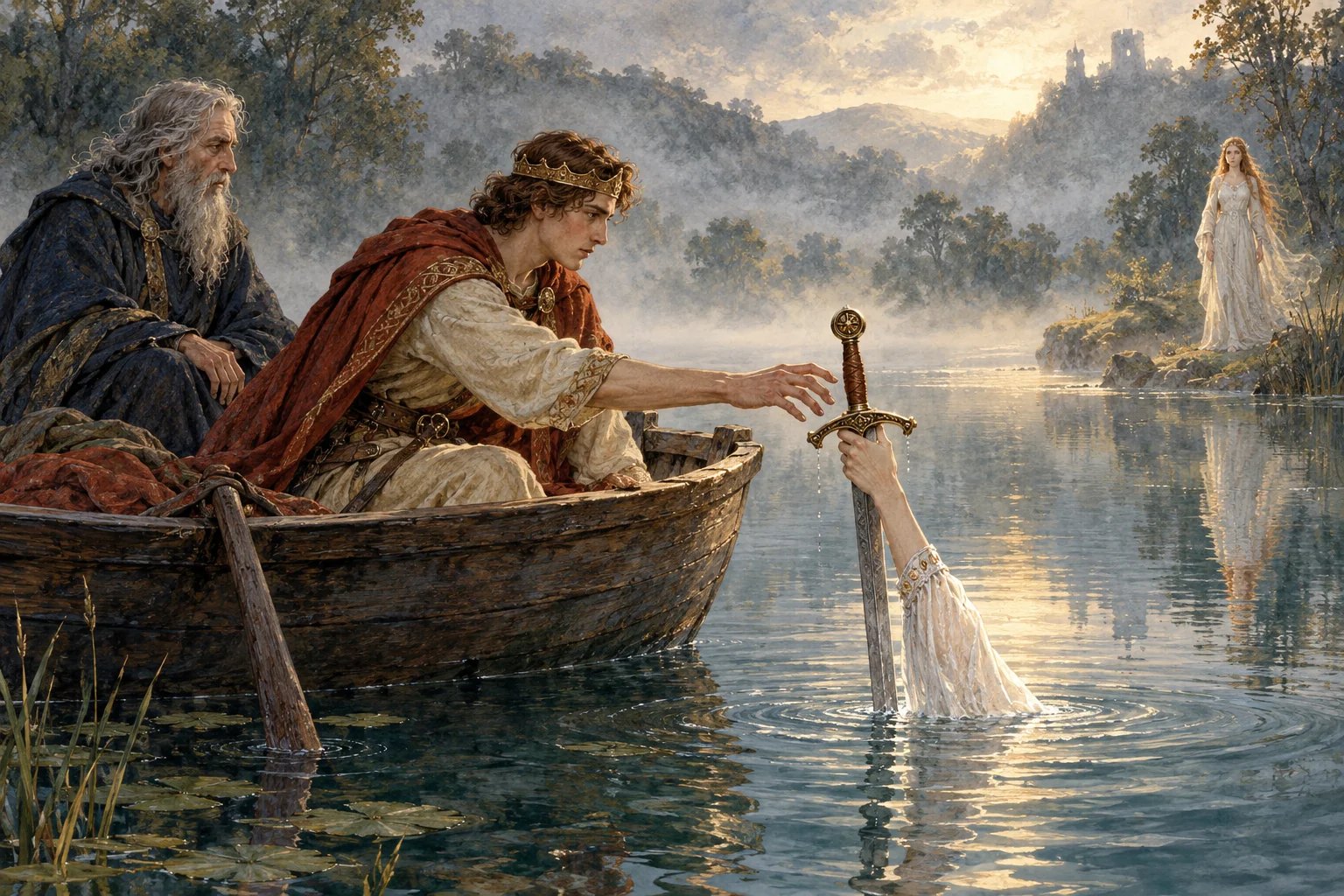
Arthur had no sword. Merlin brought him to a broad lake, where an arm clothed in white silk held a blade above the water. A woman approached across the lake. Merlin identified her as the Lady of the Lake and advised Arthur to ask courteously for the weapon.
The lady declared that it belonged to her. Arthur could have it if he promised to give her a gift when she chose to ask. He agreed before knowing what that request would be. She directed him to a boat. Arthur and Merlin rowed out; Arthur took both sword and scabbard, and the arm disappeared beneath the surface.
On land again, Arthur admired the sword. Merlin asked which he preferred, the blade or its sheath. Arthur chose the blade. That was the less valuable choice: Merlin explained that the scabbard would keep its wearer from losing blood, however badly wounded. The thing that looked like an accessory was the protection on which a fighting king’s life might depend.
Arthur soon wanted to use his new weapon against Pellinore. Merlin restrained him: attacking an exhausted opponent would bring little honour, and Pellinore would yet serve him well. The new sword did not remove Arthur’s need for judgement. Malory, I.23–25.
Versions and variations
Caledfwlch in the Welsh tale
In Culhwch and Olwen, Arthur names Caledfwlch among possessions he will not give away. Later Llenlleawg uses the sword during the seizure of Diwrnach’s cauldron. That text supplies neither a churchyard test nor this lake acquisition. Guest spells the name Caledvwlch.
Caliburn in Geoffrey
Geoffrey’s Book IX.4 describes Caliburn as a sword made in Avalon. It is already Arthur’s weapon in battle. “Made in Avalon” and “received from an arm in a lake” are different statements from different works.
Malory’s two episodes and one difficult name
The sword from the stone is called Excalibur in I.9; Arthur later breaks his sword in combat and obtains the lake sword in I.25. Preserve that sequence and its naming complication. At the end of the work, Bedivere returns Excalibur to water, where a hand catches it. Read the departure for Avalon.
Context and evidence
An unasked future favour is a dangerous kind of bargain. Malory also makes preservation more valuable than attack through Merlin’s judgement of the scabbard. These are readings of the episode, rather than proof of an ancient sword cult.
The passage does not name a modern lake. Claims for a particular body of water require their own dated local source; they cannot be established by supplying a place-name that Malory leaves out.
Sources for this entry
- Thomas Malory, Le Morte Darthur, volume I. Caxton book-and-chapter arrangement, first printed 1485; Project Gutenberg 1251. Book I, chapters 9 and 23–25. Stone-sword naming, broken blade, lake gift and scabbard. Read source · About this book
- Anonymous Welsh storytellers; translated by Charlotte Guest, The Mabinogion. Nineteenth-century translation, collected edition; Project Gutenberg 5160. “Kilhwch and Olwen”: Arthur’s reserved possessions and Diwrnach’s cauldron. Welsh Caledfwlch comparison. Read source · About this book
- Geoffrey of Monmouth, History of the Kings of Britain, Book IX. Composed c.1136–38; Giles collection (1848). Book IX, chapter 4. Caliburn and Avalon. Read source · About this book
- Thomas Malory, Le Morte Darthur, volume II. Caxton book-and-chapter arrangement, first printed 1485; Project Gutenberg 1252. Book XXI, chapter 5. Return of Excalibur to the water. Read source · About this book
Research coverage
The named passages have been compared for this entry. This is an initial source-led guide, not a collation of every manuscript, translation, oral account or modern adaptation.
The Myths · Arthurian collection · Editorial approach
Further Reading