figure · Britain · shared tradition
Gawain and Gwalchmai
Arthur’s nephew is a capable Welsh companion, a young knight at a wedding and the hero whose courage is tested by a green stranger.
Also found as: Sir Gawain · Gwalchmai · Walgan. Research reviewed 18 October 2026.
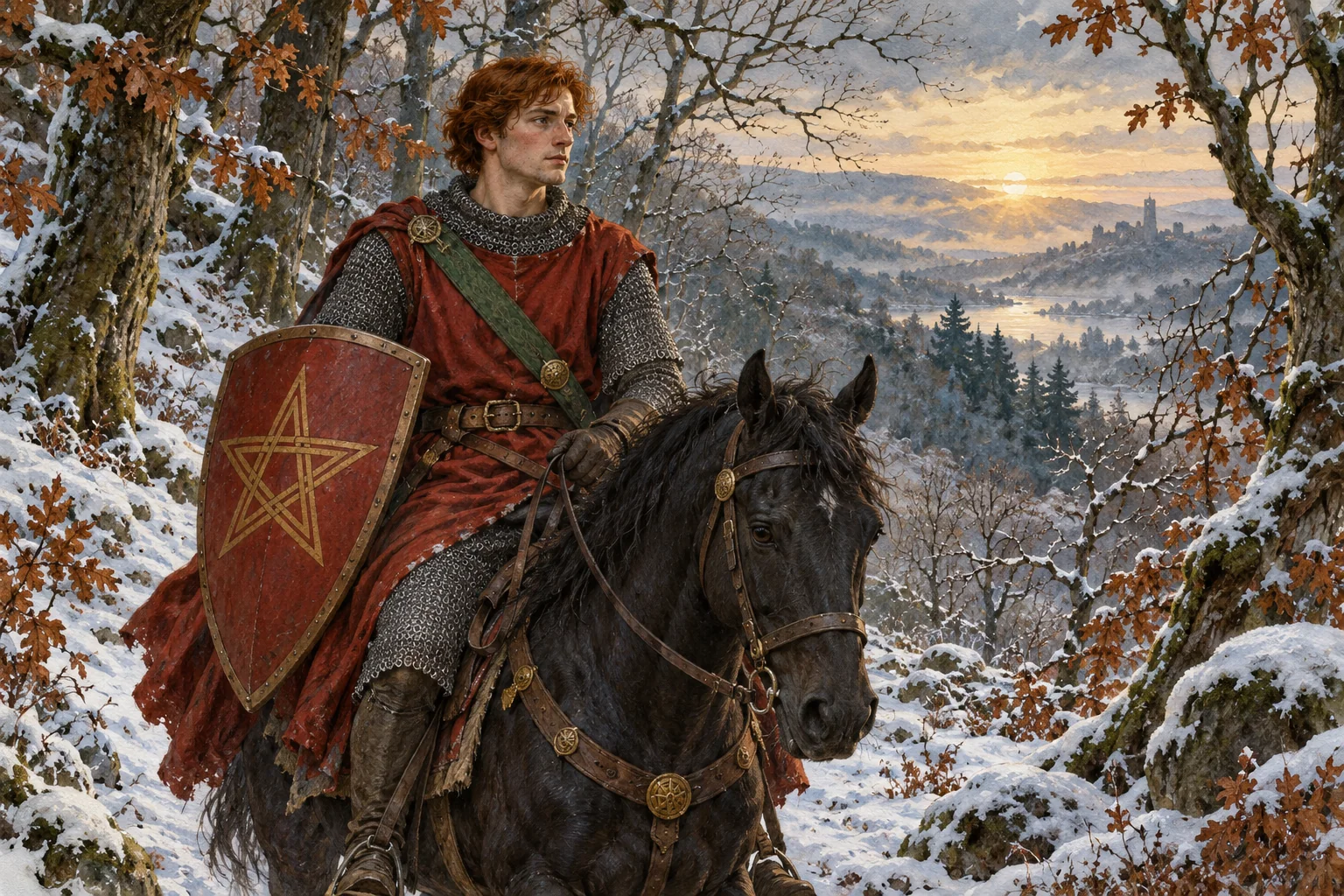
A figure approached through several texts
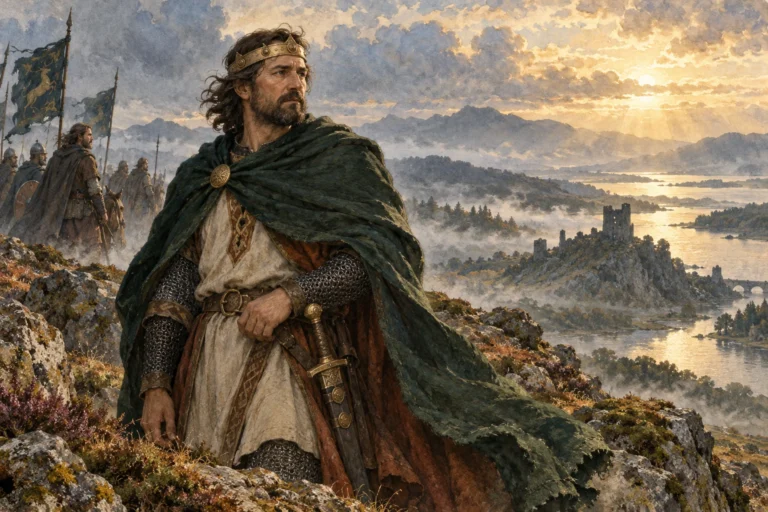
In Guest’s Culhwch and Olwen, Gwalchmai is Arthur’s nephew and one of the six companions sent to help the suitor. He belongs to an immense company in which particular people possess particular gifts. This is a useful starting point before treating every appearance of Arthur’s nephew as an episode in a single later chivalric career.
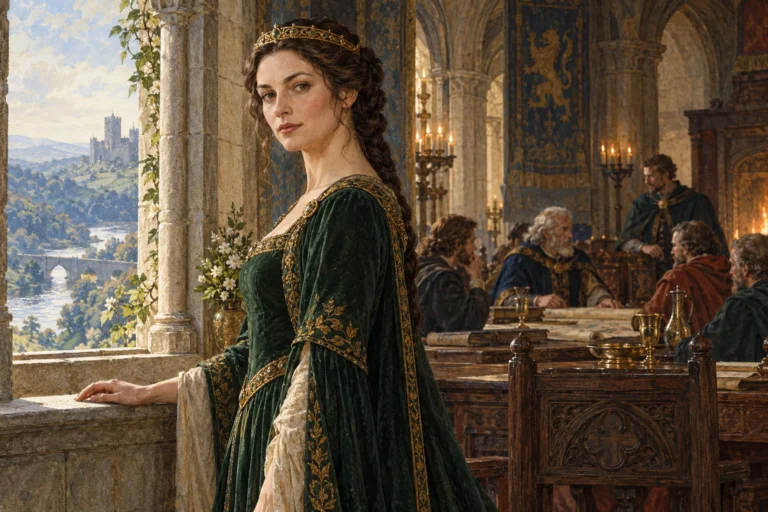
Geoffrey calls him Walgan. His death appears during Arthur’s return to fight Modred in Book XI. Malory introduces Gawain’s request to be knighted at Arthur’s marriage to Guinevere. These passages give him different positions in their authors’ much larger accounts.
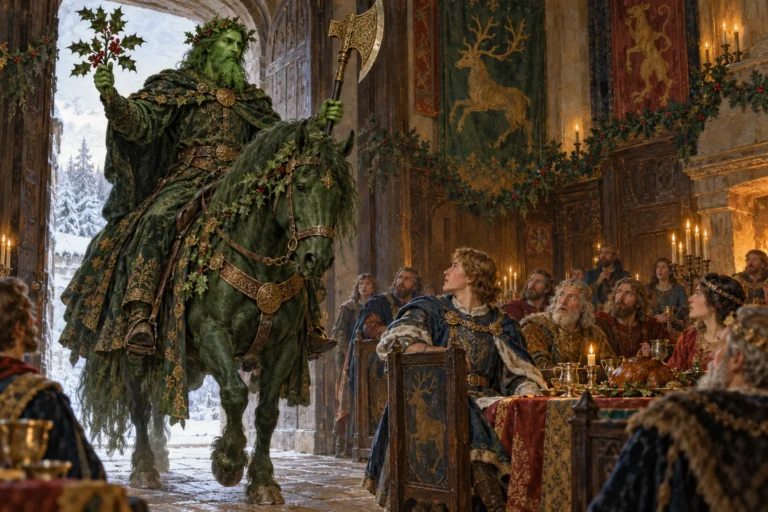
The anonymous Middle English Gawain and the Green Knight places him at the centre. His offer to take Arthur’s place is both an act of loyalty and an attempt to describe himself as an expendable member of the court. The adventure then makes his conduct important enough to test the fellowship’s reputation.
Versions and variations
Courage, courtesy and a concealed gift
Gawain keeps his dangerous appointment, but conceals a protective girdle from the host with whom he has promised to exchange winnings. His lapse is not cowardice in every situation: the poem sets different obligations against each other. Weston’s prose rendering preserves the host’s mitigation and Gawain’s harsher judgement of himself.
The later Greene Knight
The shorter later English reworking alters the machinery of the test. The story entry identifies what has been compared through Hahn’s scholarly introduction and what still needs full textual collation.
Names do not settle origins
Gwalchmai, Walgan and Gawain help readers trace related literary figures. A list of spelling forms cannot establish the exact route by which every episode travelled. This guide does not claim to resolve the name’s etymology or every proposed early origin.
Context and evidence
Compare Gawain’s promised return with Cú Chulainn’s response to the beheading challenges in Bricriu’s Feast. The comparison is strongest when the actual acts, stakes and endings are set beside one another. A shared test is a research question, not proof of a direct borrowing.
Further work is needed on Gawain’s roles throughout Malory, French romances and the other English Gawain poems. This initial profile deliberately identifies those limits rather than giving a composite personality assembled from unexamined episodes.
Sources for this entry
- Anonymous Welsh storytellers; translated by Charlotte Guest, The Mabinogion. Nineteenth-century translation, collected edition; Project Gutenberg 5160. “Kilhwch and Olwen”, choice of the six helpers. Gwalchmai in the Welsh company. Read source · About this book
- Geoffrey of Monmouth, History of the Kings of Britain, Book XI. Composed c.1136–38; Giles collection (1848). Book XI, chapter 1. Walgan’s death. Read source · About this book
- Thomas Malory, Le Morte Darthur, volume I. Caxton book-and-chapter arrangement, first printed 1485; Project Gutenberg 1251. Book III, chapter 2. Request for knighthood. Read source · About this book
- Anonymous poet; translated and retold by Jessie L. Weston, Sir Gawain and the Green Knight. 1898 prose rendering of the Middle English poem; Project Gutenberg 66084. Complete narrative. Courtesy, promise and green girdle. Read source · About this book
- Thomas Hahn, The Greene Knight: Introduction. In Sir Gawain: Eleven Romances and Tales (1995), TEAMS. Introduction. Later Greene Knight comparison. Read source · About this book
Research coverage
The named passages have been examined and compared. This is a first source-led guide, not a collation of every manuscript, translation, local telling or adaptation.
The Myths · Arthurian collection · Editorial approach
Further Reading