story · Wales
Culhwch and Olwen
An impossible marriage quest draws Arthur’s extraordinary company into the search for a lost prisoner and the hunt for a devastating boar.
Also found as: Kilhwch and Olwen · The Wooing of Olwen · Twrch Trwyth · Mabon son of Modron. Research reviewed 18 October 2026.
Read the story
A promise that needed a kingdom
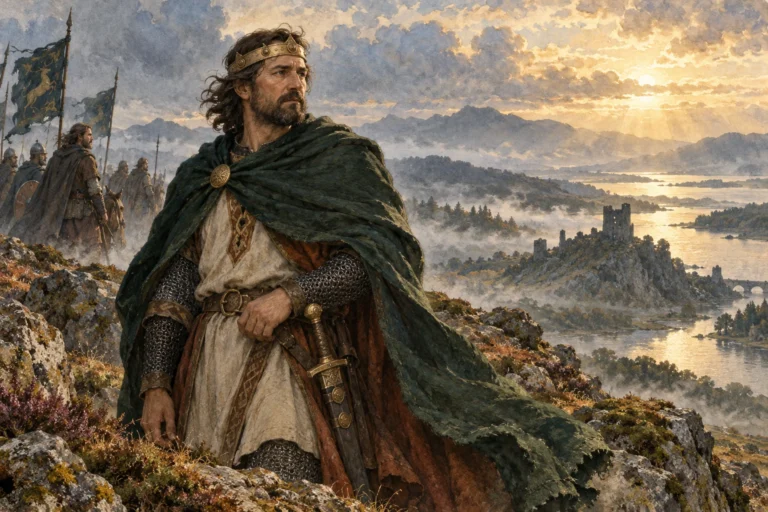
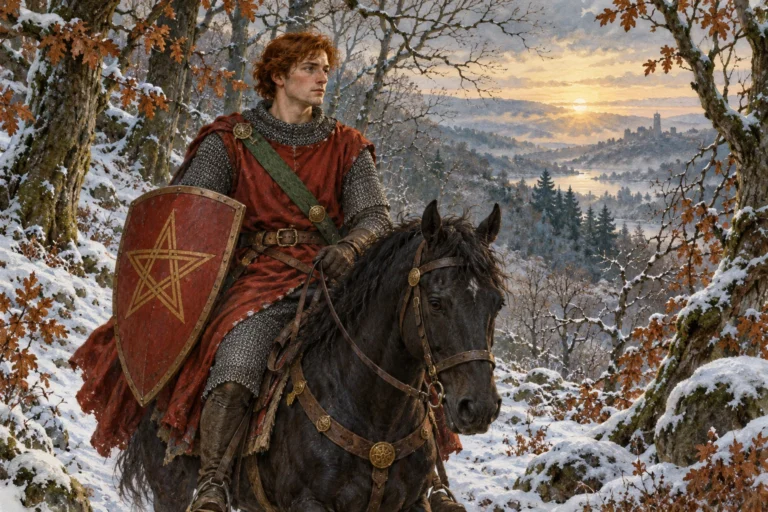
Culhwch’s stepmother laid a condition upon him: he would marry no woman but Olwen, daughter of the giant Yspaddaden. He had not seen Olwen, but the name alone set him travelling. His father advised him to seek help from his cousin Arthur. At Arthur’s court he asked for the king’s support, invoking a tremendous company of warriors and their remarkable gifts.
Arthur sent six companions with him. Among them were Cei, Bedwyr, the interpreter Gwrhyr, the guide Cynddelig, Gwalchmai and the magician Menw. Near the giant’s home they found the herdsman Custennin, whose own family had suffered under Yspaddaden. His last surviving son, Goreu, had been kept hidden.
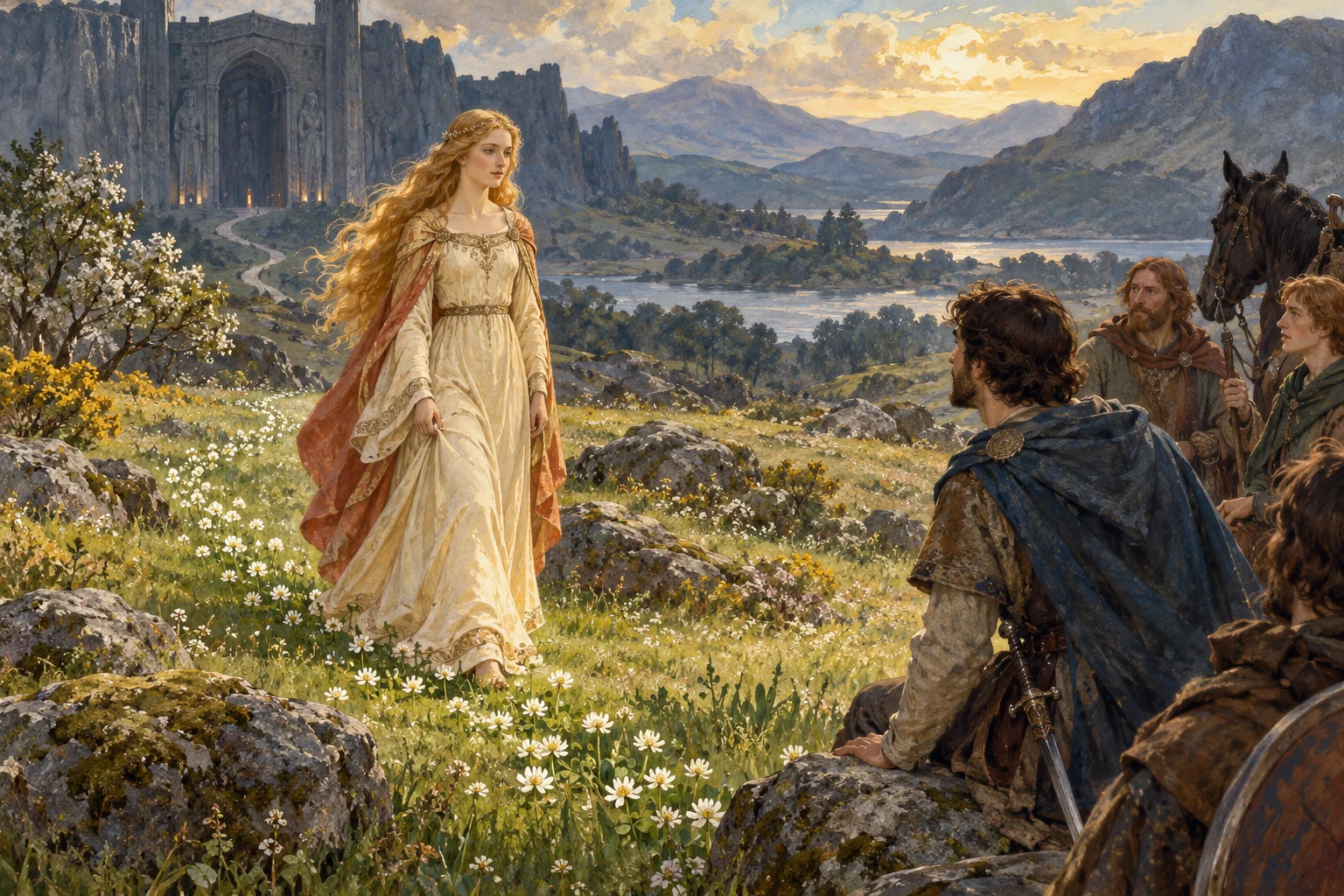
Olwen came to meet the strangers. White flowers sprang beneath her feet. She was willing to marry Culhwch, but would not leave without her father’s agreement: his life would end when she married. Yspaddaden responded to the visitors with violence and a long list of apparently impossible tasks. The wedding preparations alone would require wonders. To dress his hair, they must obtain the comb, scissors and razor carried between the ears of Twrch Trwyth.
That hunt required Mabon son of Modron, who had vanished when he was three nights old. No ordinary search could find him. Gwrhyr questioned animals of immense age: a blackbird, a stag, an owl and an eagle. Each remembered a world older than the last, but none knew the answer. At length the salmon of Llyn Llyw carried the searchers towards Gloucester, where a prisoner’s lament revealed Mabon’s confinement. Arthur’s company rescued him.
Other tasks demanded other kinds of help. Gwythyr saved ants from a fire; they later gathered the scattered seed the company needed. A cauldron was taken from Ireland by force. The tale’s helpers use cunning, generosity and terrible violence, rather than one simple heroic method.
Twrch Trwyth, a king transformed into a boar, resisted Arthur in Ireland and crossed into Wales with his young. The pursuit devastated the countryside. Warriors died, including Arthur’s son Gwydre. At the Severn the hunters secured the razor and scissors; only in Cornwall did they win the comb. The boar escaped into the sea. He was driven away, not killed.
When the company finally returned, Yspaddaden was shaved with the hard-won equipment. He acknowledged that Culhwch could have Olwen, but credited Arthur’s achievement rather than the young man’s. Goreu killed the giant and avenged his family. Culhwch and Olwen married. This retelling selects the main marriage, rescue and hunt episodes from a much longer tale. Guest, “Kilhwch and Olwen”.
Versions and variations
Guest’s long tale and Jacobs’s shorter telling
Joseph Jacobs’s “The Wooing of Olwen” compresses the company, the tasks and the hunt into a much shorter story. His source note explicitly identifies an abridgement of Lady Guest. It therefore belongs in the history of the tale’s retelling, but is not an independent oral witness. Both retain the giant’s violent end.
An earlier boar-hunt association
The marvels attached to the Historia Brittonum, §73 include Arthur’s dog Cabal and a paw-marked stone associated with a boar hunt. This is a related Arthurian motif, not an earlier surviving copy of the whole marriage quest.
Names in translation
Guest’s Kilhwch, Kai, Gwalchmai and Caledvwlch can appear in modern writing as Culhwch, Cei, Gwalchmai and Caledfwlch. Spelling differences alone do not establish different adventures. This entry keeps familiar modern forms while identifying the translation used.
Context and evidence
Arthur is an active organiser of a company with astonishing skills. The court resembles a gathering of named heroes more than the orderly Round Table of many later retellings. The story also leaves room for resistance within the company: Cei’s anger at Arthur’s mocking verse interrupts any impression of effortless fellowship.
The tale travels through Ireland, Wales and Cornwall. Its place-names are part of its narrative geography; they do not turn supernatural events into verified local history. The Irish cauldron raid may be compared with other cauldron stories, including Branwen, without assuming that every marvellous vessel is the same object.
Sources for this entry
- Anonymous Welsh storytellers; translated by Charlotte Guest, The Mabinogion. Nineteenth-century translation, collected edition; Project Gutenberg 5160. “Kilhwch and Olwen”, especially the helpers, Yspaddaden’s tasks, Mabon and Twrch Trwyth. Principal text for this condensed retelling. Read source · About this book
- Joseph Jacobs, Celtic Fairy Tales. 1892 collection; Project Gutenberg 7885. “The Wooing of Olwen” and Notes XIII. Dependent nineteenth-century abridgement. Read source · About this book
- Anonymous compiler, traditionally attributed to Nennius, Historia Brittonum (History of the Britons). Ninth-century compilation; Fordham transcription of Giles (1848), with §§56 and 73 supplied from the Camelot Project. Section 73, Cabal and the boar hunt. Related earlier marvel, not the complete tale. Read source · About this book
Research coverage
The named passages have been examined and compared. This is a first source-led guide, not a collation of every manuscript, translation, local telling or adaptation.
The Myths · Arthurian collection · Editorial approach
Further Reading