Local folklore · figure
Brownies
Supernatural workers whose help can transform a household, but whose terms are seldom those of an ordinary servant.
Research reviewed 17 October 2026.
Helpers with their own terms
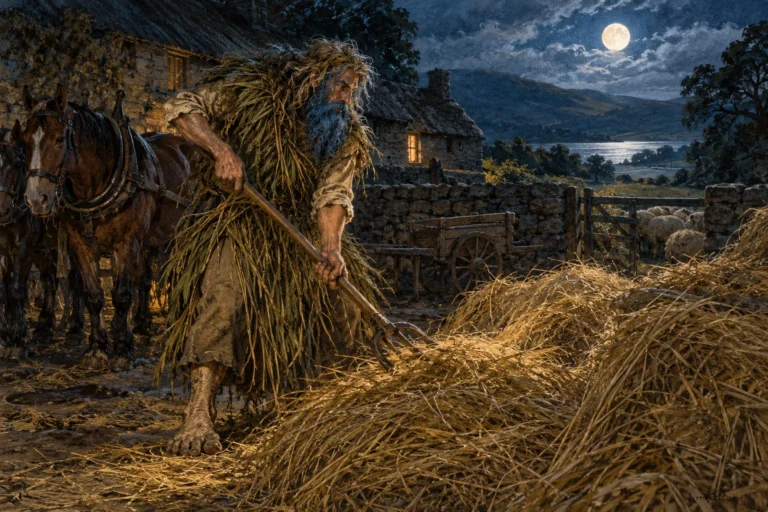
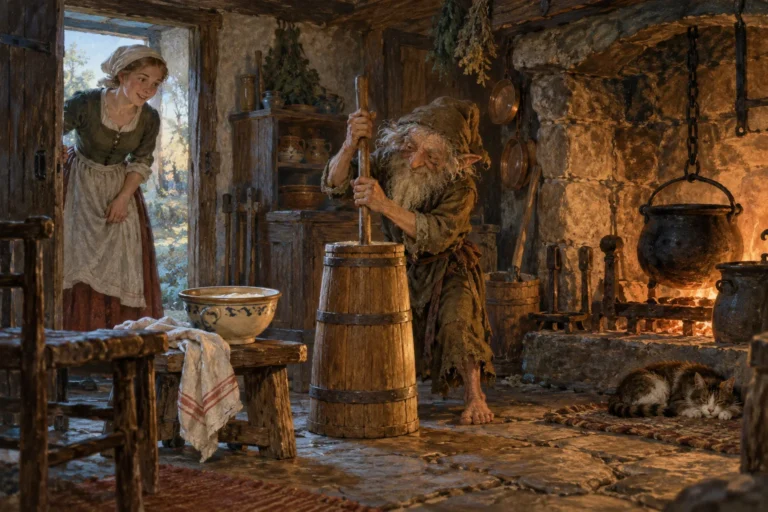
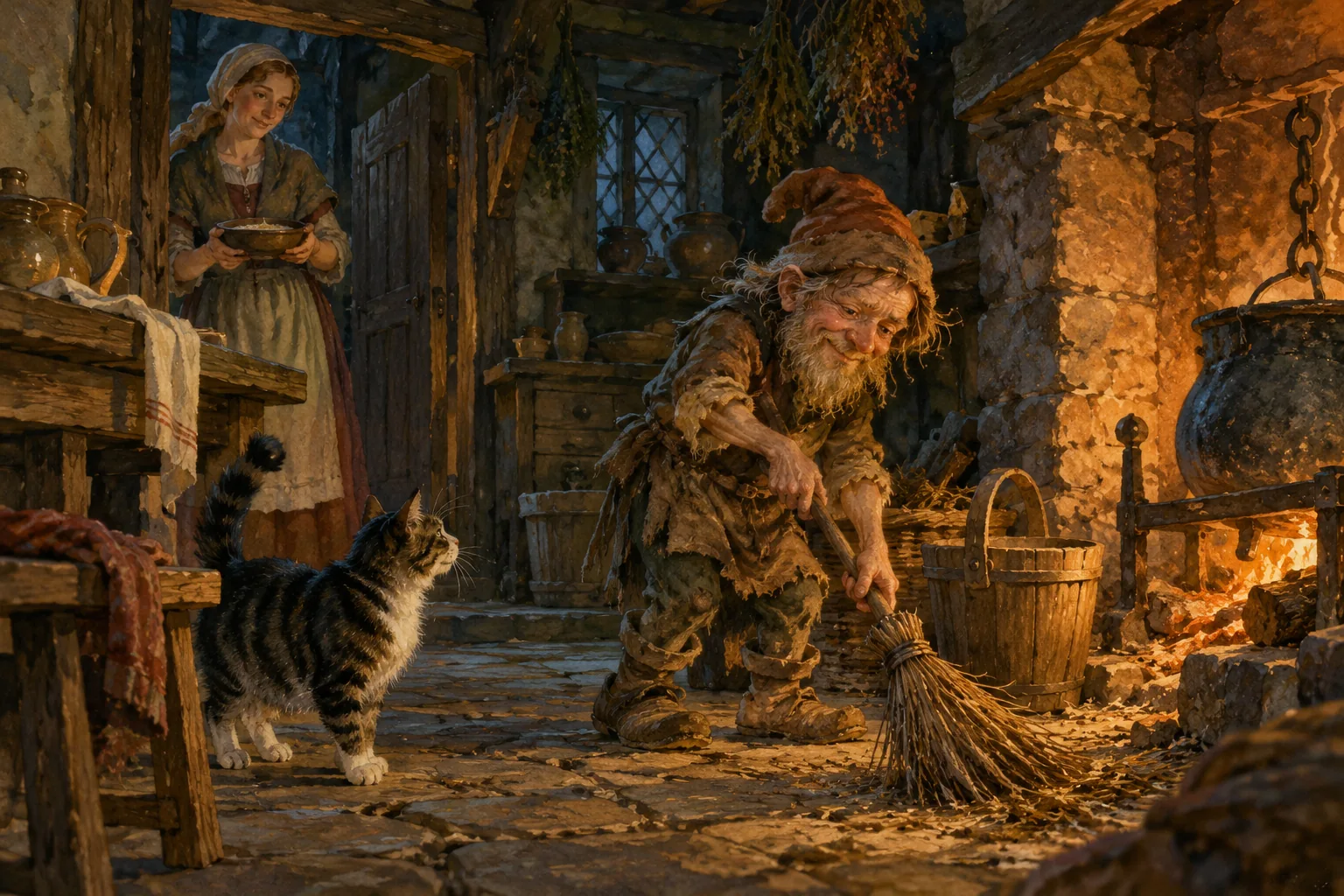
A brownie is a recurring kind of household or farm spirit, rather than one character with a single life story. The most useful starting point in this collection is Nicholson’s Aiken-drum, the Brownie of Blednoch. He offers skilled labour, requests brose and declines conventional possessions. His disappearance after receiving breeches gives the apparently minor gift lasting consequences.
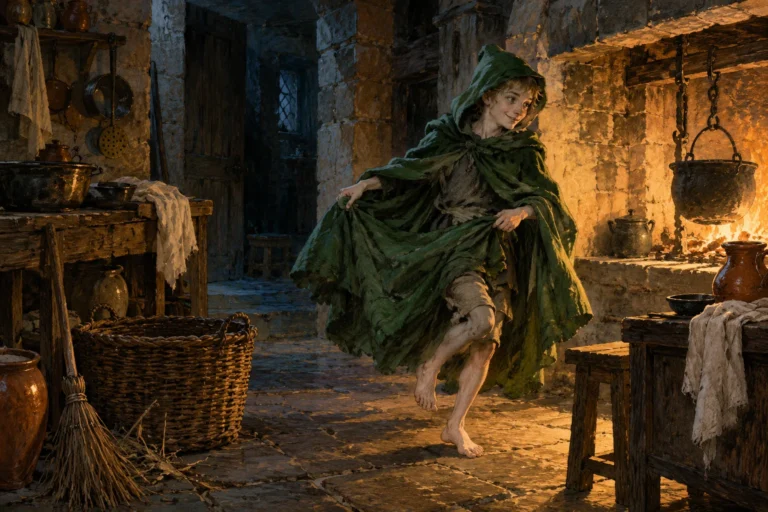
Appearance and behaviour vary. Aiken-drum’s startling body does not prevent him being helpful. Henderson’s Cauld Lad performs and undoes domestic work, yet can also be understood as a murdered boy’s ghost. Calling both “brownie-like” is a comparison made by collectors; it does not erase their different local identities.
Habetrot belongs beside these stories as a supernatural worker, but Henderson introduces her specifically as the fairy of spinning. She has her own companions and story. This guide does not rename her a brownie simply because she helps with household work.
Versions and variations
Poetry and later explanation
Nicholson leaves the meaning of the clothes uncertain. Grierson gives the Blednock story a clearer lesson about a brownie’s reluctance to accept payment. Readers should be able to see that interpretive change rather than encounter it as an ancient rule common to every account.
Related beings retain their names
The Fynoderee in Manx tradition, the bwbach in Welsh accounts and the púca in some Irish narratives can all perform useful work. These comparisons concern particular actions and stories. They are not evidence that the terms are interchangeable translations or that the traditions share one documented origin.
Context and evidence
Printed collections mix stories, explanations and attempts to classify spirits. Henderson explicitly calls the Cauld Lad brownie-like while preserving the local ghost explanation. Sikes acknowledges overlap between his Welsh categories. Those hesitations are valuable evidence about the collectors’ methods.
No historical individual or vanished species is established by these accounts. The evidence supports the circulation of stories and the ways editors described them. Follow the individual entries for the exact text, setting and point at which a helper’s relationship with a household breaks down.
Sources for this entry
- William Nicholson, The Poetical Works of William Nicholson. Fourth edition, Dalbeattie, 1897; poem transcribed by the Borgue community website. “The Brownie of Blednoch”, complete poem. Read source — The poem itself, rather than the website’s modern introduction, supplies the narrative followed here. About this book
- Elizabeth W. Grierson, Tales from Scottish Ballads. Linked text: London, A. & C. Black, 1930 reprint of the 1916 new edition; first published under an earlier title in 1906. “The Brownie of Blednock”. Read source — A developed literary prose retelling; not treated as a separately collected oral witness. About this book
- William Henderson, Notes on the Folk-Lore of the Northern Counties of England and the Borders. New edition, London: Folk-Lore Society, 1879. Chapter VII, Cauld Lad of Hilton. Read source — Collector’s comparison between a brownie-type helper and a local ghost tradition. About this book
- Wirt Sikes, British Goblins: Welsh Folk-Lore, Fairy Mythology, Legends and Traditions. London: Sampson Low, Marston, Searle & Rivington, 1880. Book I, chapter II, sections III and XI–XII. Read source — Comparison with Welsh household helpers and Sikes’s acknowledged overlaps. About this book
Research coverage
This guide draws on the named passages, not a complete survey of Scottish brownie traditions. Cross-country comparisons are limited to the linked, separately sourced entries.
The Myths · Scottish collection · Editorial approach
Further Reading