Local folklore · story
The Brownie of Blednoch
A strange worker asks only for a little food and transforms the farms around Blednoch. A gift of clothes brings his service to an end.
Also found as: Aiken-drum · Brownie of Blednock
Research reviewed 17 October 2026.
Read the story
This retelling follows William Nicholson’s poem, in the text attributed to the 1897 fourth edition of his collected poems.
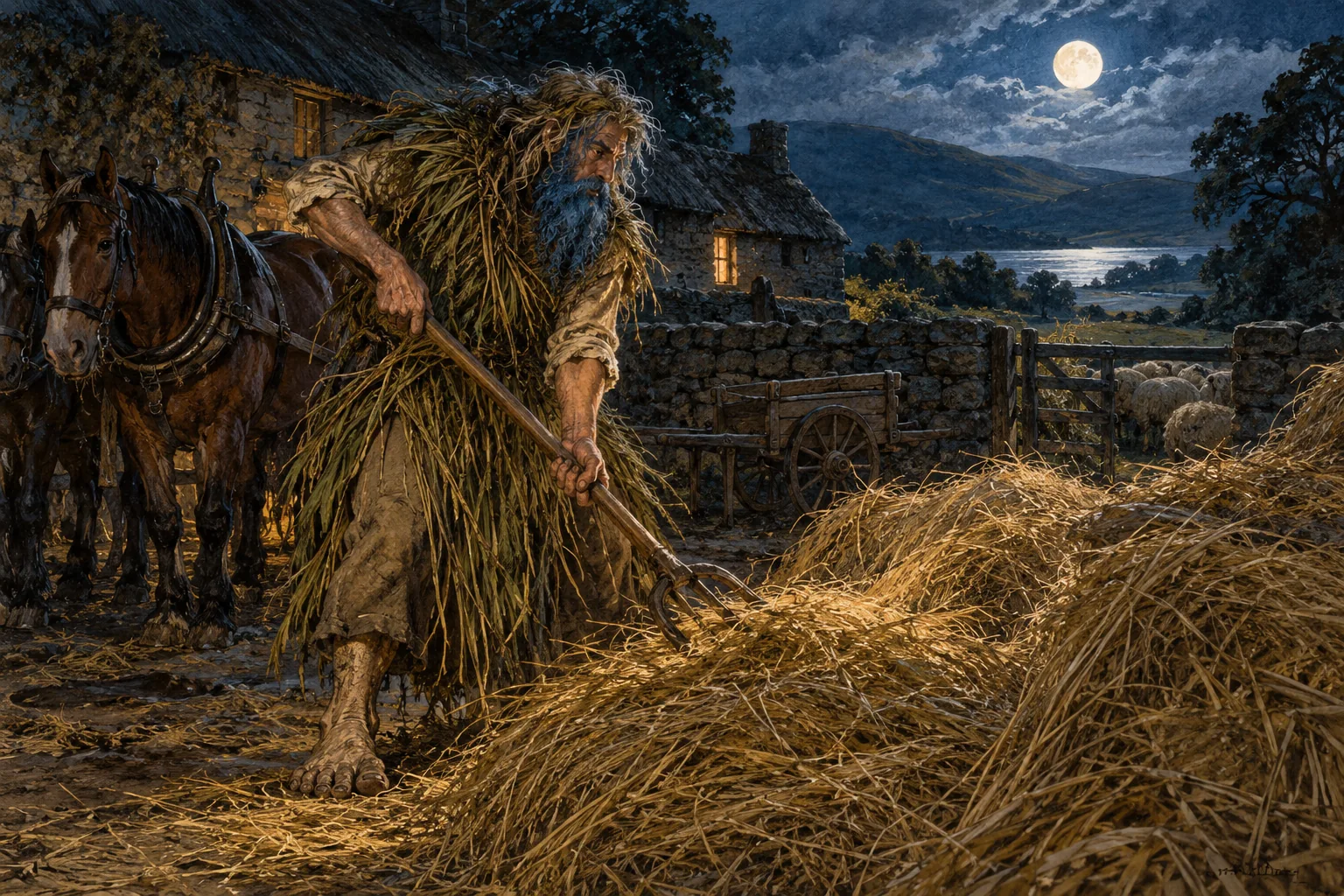
A stranger came to Blednoch with tangled hair, a blue beard, a covering of rushes and feet that frightened everyone who saw them. The villagers wondered what sort of creature had entered their midst. Someone brought a Bible, but it did not drive him away.
He called himself Aiken-drum. He had come from a strange land without the familiar sky and streams, and he wanted work. He offered to labour at the household and farming jobs that kept people busy from morning to night. He could handle horses, care for children, reap and thresh, and do work that would otherwise need many hands.
An older woman spoke in his favour. There was work enough still waiting, she said: why reject a helper because his appearance was unsettling? The stranger’s terms were modest. He wanted a little brose to eat. He did not ask for wages, possessions or clothes.
Soon Blednoch knew the value of its visitor. Tasks were finished while others slept. Work which might have overtaxed the ordinary household was done by moonlight. Aiken-drum was gone before the sun rose, leaving the results of his labour for the people who benefited from it.
Then a newly married woman decided that the worker ought to have something to wear. She left him a pair of her husband’s old breeches. The gift ended the arrangement. Aiken-drum disappeared, and all the useful work that people had come to expect stopped with him.
The poem does not settle exactly why the clothing drove him away. It leaves that puzzle to the learned. Its ending follows reports and traces of the departed worker through the wider landscape: a herdsman hears him, and marks in stone are connected with his presence. The labour has ended, but stories about Aiken-drum remain.
Versions and variations
Nicholson’s poem
The poem names Aiken-drum, describes his extraordinary appearance and preserves his own terms for service. It leaves the cause of his departure less certain than many summaries suggest. The clothing episode should not be reduced to a universal rule that every brownie must react in precisely the same way.
Grierson’s expanded prose story
Elizabeth W. Grierson’s “The Brownie of Blednock” supplies a developed village scene, Grannie Duncan and her granddaughter Jeannie. It turns the younger wife’s gift into a more explicit misunderstanding about paying a brownie. These details belong to Grierson’s literary treatment. They are not all present in Nicholson’s poem, and her version is not counted here as a second independent oral collection.
Across the sea and across the border
The Manx Fynoderee and the English Cauld Lad also have clothing episodes, but their reactions and circumstances differ. Compare the source notes on those entries. The shared gift is a useful connection, not proof that the characters are the same being.
Context and evidence
The name Blednoch belongs to the poem’s local landscape; Bladnoch is used for the place guide. The river names and later reports create a recognisable setting, but named places do not establish a historical supernatural worker.
Nicholson gives Aiken-drum a voice and an agreement with his employers. That makes the story more than a list of fairy prohibitions: it asks who sets the terms of labour, who benefits from it and how a supposedly generous gift can upset an existing relationship.
Sources for this entry
- William Nicholson, The Poetical Works of William Nicholson. Fourth edition, Dalbeattie, 1897; poem transcribed by the Borgue community website. “The Brownie of Blednoch”, complete poem. Read source — The poem itself, rather than the website’s modern introduction, supplies the narrative followed here. About this book
- Elizabeth W. Grierson, Tales from Scottish Ballads. Linked text: London, A. & C. Black, 1930 reprint of the 1916 new edition; first published under an earlier title in 1906. “The Brownie of Blednock”. Read source — A developed literary prose retelling; not treated as a separately collected oral witness. About this book
Research coverage
Nicholson’s complete poem and Grierson’s complete chapter were compared. Earlier impressions of Nicholson and independent oral records have not been collated. Grierson is identified as literary adaptation; her additions are not silently inserted into the poem’s plot.
The Myths · Scottish collection · Editorial approach
Further Reading