Northern Isles sea folklore · figure
The Selkie
Seal people cross the boundary between shore and sea in several different kinds of story. Stolen skins, divided families and dangerous encounters matter more than a single fixed set of supernatural rules.
Also found as: Selkie folk · Silkie · Seal folk · Seal people
Research reviewed 17 October 2026.
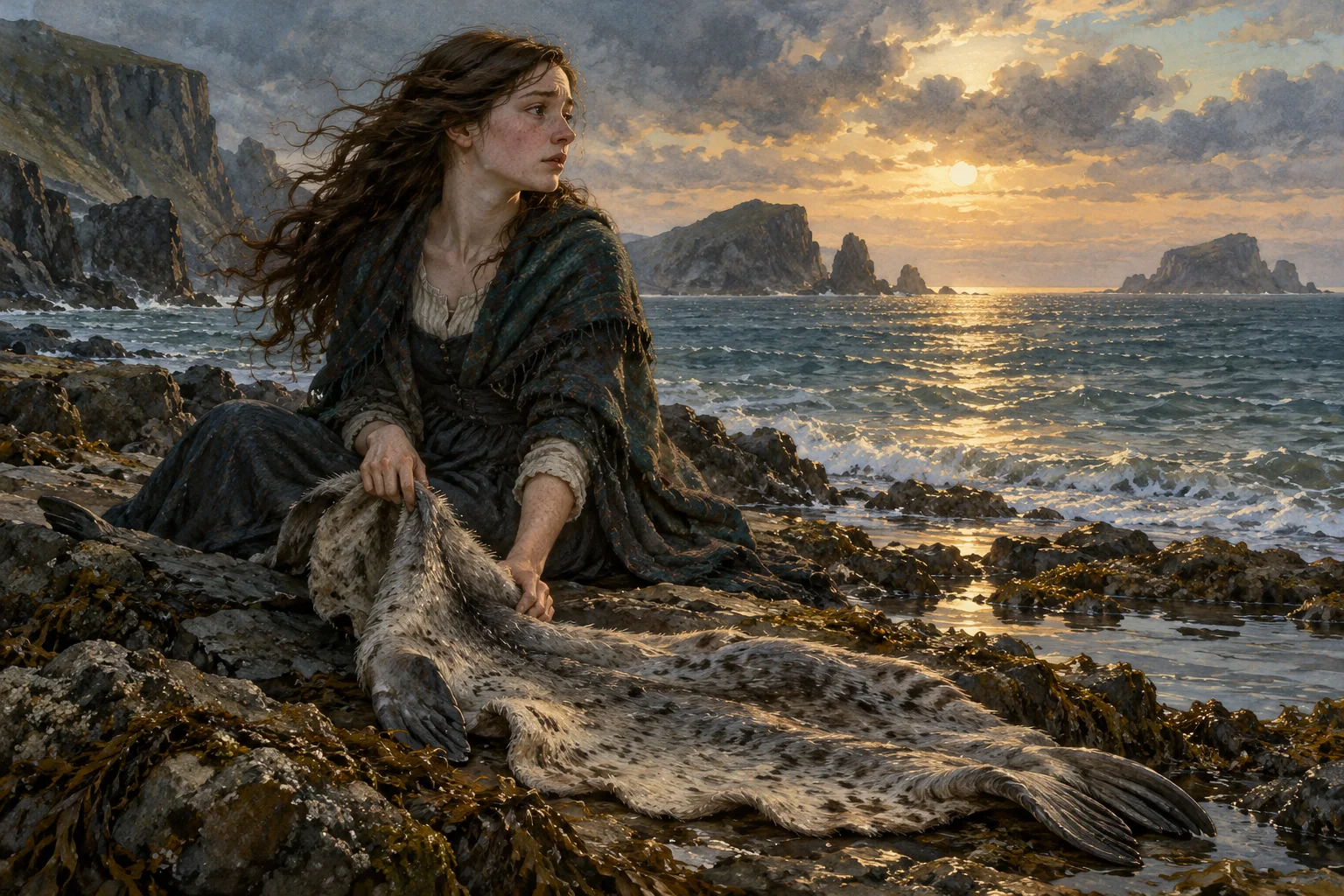
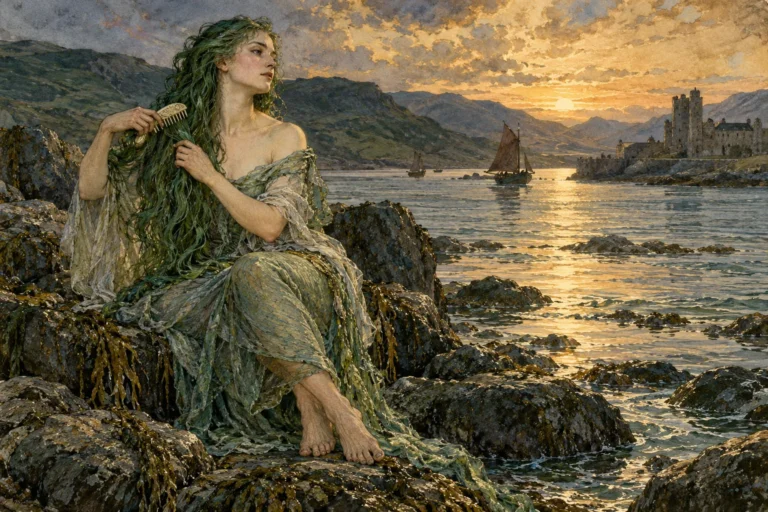
A selkie can be a seal in the water and a person on land. That simple change makes the shoreline a place where appearances cannot settle identity. The accounts examined here come chiefly from Orkney and Shetland settings, but their publication and their relationships extend beyond those islands. They should not be treated as evidence of a story owned exclusively by one nation.
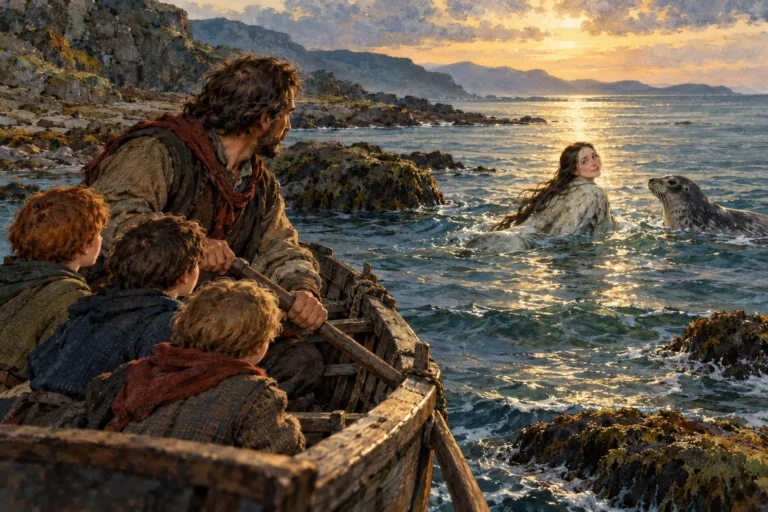
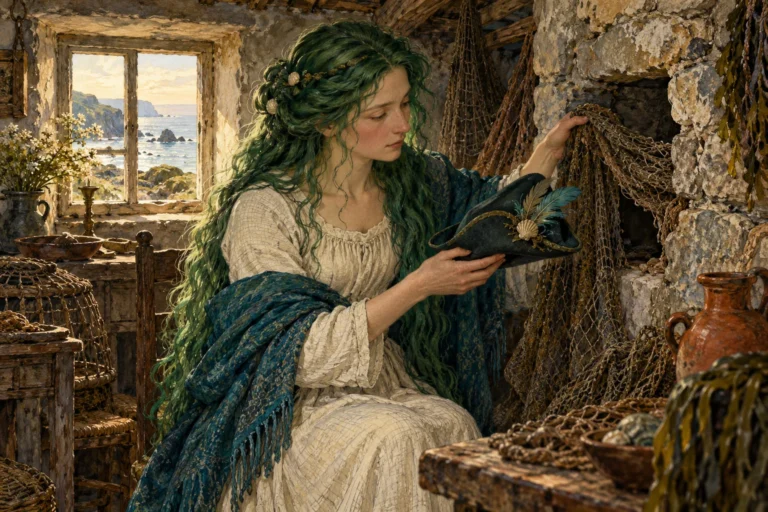
In The Goodman of Wastness, the sea people remove their seal skins to rest and play. A man takes one woman’s covering and refuses to give it back. Without it she cannot resume her life in the sea. Her marriage follows that captivity, even though the household later contains affection, hard work and seven children. Dennison’s published narrative allows those feelings to coexist rather than making a happy household proof that the original seizure was harmless.
The skin is therefore more than clothing. Whoever controls it controls whether the woman can leave. When her youngest daughter identifies its hiding place, the mother recovers a freedom that the household has withheld. Her children have heard songs unknown to their neighbours, a reminder that their mother has a past and a community beyond the family’s understanding. The story ends with her departure, not with the human husband recovering his possession.
Patrick Kennedy’s “The Silkie Wife” changes the family and the means of escape. Its fisher has two children with the woman whose skin he takes. Her sea companion eventually finds the covering and explains himself to the man on shore. He acknowledges the husband’s kindness in his own fashion while also naming the deprivation that made the marriage possible. The source credits Captain F. W. L. Thomas, but it does not give a named island storyteller for this passage.
Not every selkie narrative centres on a stolen skin or a woman detained ashore. In “The Great Silkie of Sule Skerry”, Child 113, a mother sings to a baby without knowing who its father is. A stranger appears and identifies himself as a man on land and a seal at sea. He offers gold and asks for his son. He intends to teach the child to swim, but predicts that the woman will marry a gunner whose first shot will kill both father and son.
That seven-stanza ballad gives the selkie a voice, a home and an anticipated death. He is not merely an attractive visitor or an animal disguise. The family bond makes a seal hunt potentially a killing of kin. The text ends with the prediction; adding a narrated shooting scene would turn a possible expansion into something the examined witness does not actually contain.
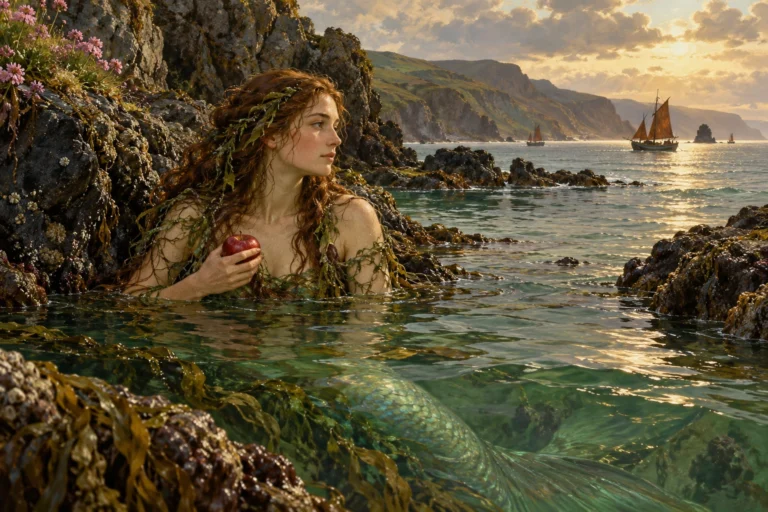
Names also require care. The Unst tale printed as “The Mermaid Wife” in Folk-Lore and Legends: Scotland nevertheless describes a removable sealskin and a woman who becomes a seal. A collector’s heading is not always a precise species label. Conversely, the concealed cap in the Irish Lady of Gollerus makes a useful comparison without requiring the merrow and selkie to become interchangeable names.
These accounts open several paths through the library: captivity and release, children of different worlds, a creature’s own account of its identity, and the way people treat animals they depend upon or hunt. They provide a starting collection of witnesses, not a complete set of rules that every island storyteller shared.
Versions and variations
Seal-wife stories are not all the same story. The Wastness account gives the mother a sustained search and a daughter who remembers her father’s hiding place. The Unst account in the same comparative transcription makes a child find the skin beneath a corn stack. Kennedy’s version instead gives the recovery to a male seal. These changes distribute knowledge and action differently among the mother, children and sea companion. They are worth recording even though the stories share the theft of a garment and an eventual departure.
A male selkie and a child. Child 113 does not describe a woman prevented from transforming by a missing skin. The visitor identifies himself, claims the baby and predicts their future deaths. Its seven stanzas do not supply the full earlier courtship or a detailed underwater kingdom. Details from fuller modern performances should be cited to those performances if they are added later.
Categories and circulation. The 1889 Unst narrative is headed “The Mermaid Wife” despite its seal transformation. Kennedy places his northern-island account inside a book called Legendary Fictions of the Irish Celts. Neither heading is sufficient reason to move a story to another country or change the being described. Place, narrative details, collector and edition each provide a different part of the record.
Present limits. These are distinct published accounts, but publication in different books does not automatically prove independent oral collection. Dennison’s full journal context and Child 113’s original source note remain to be checked directly. This guide consequently avoids naming an unexamined singer, asserting one original selkie story, or extending the examined descriptions into a universal Scottish belief.
Context and evidence
The selkie is presented here as a figure of folklore. The stories are evidence for what their printed witnesses narrate, not evidence that seals physically turn into people. The difference matters most when a named family or recognisable coast gives a legend the appearance of a local historical report.
Read the Scottish source register for the present evidence and the book guide for editions and their limitations. The Scotland directory connects these island traditions with the separate Border ballad cluster.
Sources for this entry
- Walter Traill Dennison; periodical edited by A. W. Cornelius Hallen, Orkney Folk-Lore.—II. Selkie Folk. The Scottish Antiquary; or, Northern Notes & Queries, volume VII (1893), item 495, pp.171–177; Edinburgh: T. and A. Constable. Goodman of Wastness narrative, pp.173–175, read through the D. L. Ashliman transcription headed The Goodman of Wastness. Read source — Chosen public-domain narrative. Original journal scan located but not successfully inspected; full article context is not claimed as examined. About this book
- Patrick Kennedy, collector/narrator; account credited to Captain F. W. L. Thomas, R.N., Legendary Fictions of the Irish Celts. First published London: Macmillan, 1866; linked Library Ireland text identifies the second edition, 1891. The Silkie Wife, complete story and opening attribution; first-edition pagination pp.122–124. Read source — Different northern-island seal-wife account; not a reprint of Dennison’s Wastness text and not proof of fully independent oral origins. About this book
- Francis James Child, editor, The English and Scottish Popular Ballads, volume II. Original volume issued 1885–1886; Internet Sacred Text Archive transcription of the ballad. No.113, The Great Silkie of Sule Skerry, complete seven-stanza text. Read source — Male seal-person and child narrative; the seven stanzas were read, but the original collection note was not independently examined. About this book
- Compiler signing C. J. T., Folk-Lore and Legends: Scotland. London: W. W. Gibbings, 1889; public-domain text reproduced in D. L. Ashliman’s comparative transcription. The Mermaid Wife, pp.86–88; complete Unst narrative. Read source — Printed seal-wife parallel. The borrowed source behind this anthology version has not been independently traced here; it is not claimed as a new field record. About this book
Research coverage
The Wastness transcription, Kennedy’s complete Silkie Wife, the Unst Mermaid Wife and all seven stanzas of Child 113 were examined. The complete original Dennison article and Child 113 source headnote were not inspected. No modern field recordings, Gaelic seal traditions, linguistic etymology or claim of comprehensive coverage is included.
The Myths · Scottish collection · Editorial approach
Further Reading