Northern English dragon legends · story
The Lambton Worm
A discarded catch grows into a monster on the River Wear. The heir who brought it home returns to face it, but the promise attached to his victory threatens his own family.
Also found as: The Worm of Lambton · John Lambton and the Worm
Research reviewed 17 October 2026.
Read the story
An original retelling based on William Henderson’s 1879 account. Henderson names Cuthbert Sharpe’s earlier collection as his principal source. The curse and combat belong to the legend, not to established family history.
While the household of Lambton went to Sunday worship, the young heir stayed beside the Wear with his fishing rod. He had little patience for prayers and, that morning, even less for fish. Nothing would bite. His angry curses followed the servants as they passed towards Brugeford chapel.
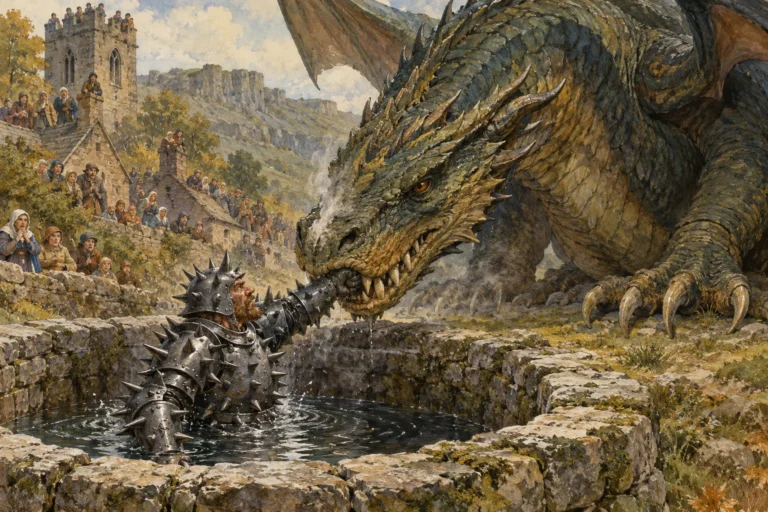
At last something pulled his line. He brought it ashore expecting a fish and found an ugly little creature instead. Disgusted, he tore it from the hook and dropped it into a nearby well. When a passing stranger asked about his luck, the young man invited him to look at what he had caught. The stranger peered down. It resembled a newt, but had nine holes along either side of its mouth. He had never seen its like, and thought it promised trouble.
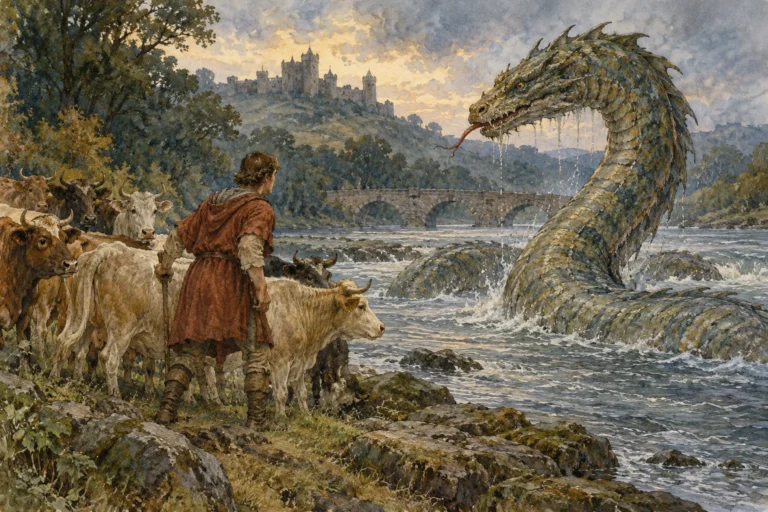
Forgotten in the well, the worm grew. Eventually it could no longer fit there. It emerged to find a larger home, spending its days coiled around a rock in the river and its nights about a neighbouring hill. Still it grew, until its body could circle that hill three times.
The countryside began to suffer. The worm took the milk from cows, attacked cattle and swallowed lambs. Fields and farms became places of danger. When it crossed towards Lambton Hall, the old lord’s household feared that nothing would survive. A steward suggested filling the great courtyard trough with milk. The worm drank it and withdrew. The same offering worked again the following day, and a terrible bargain settled into place: the milk of nine cows, every day, to keep the creature satisfied. A short measure sent it into a fury, wrenching trees out of the ground.
Other champions tried to kill it. Their swords could cut its body, but the divided parts joined together again. Fighting brought wounds and death to the men, and no lasting injury to the worm.
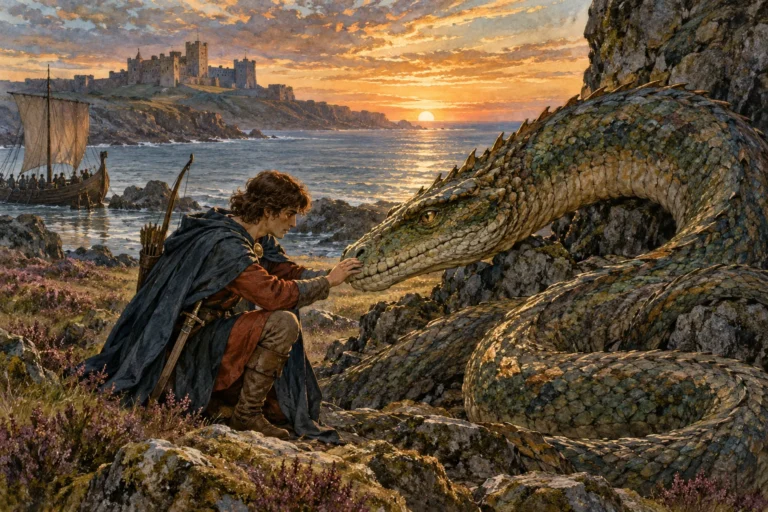
Meanwhile the young heir had repented of his former life and gone to war abroad. After seven years he returned to wasted lands, frightened people and a father worn down by grief. He recognised the disaster he had begun. He went to a wise woman and asked how to end it.
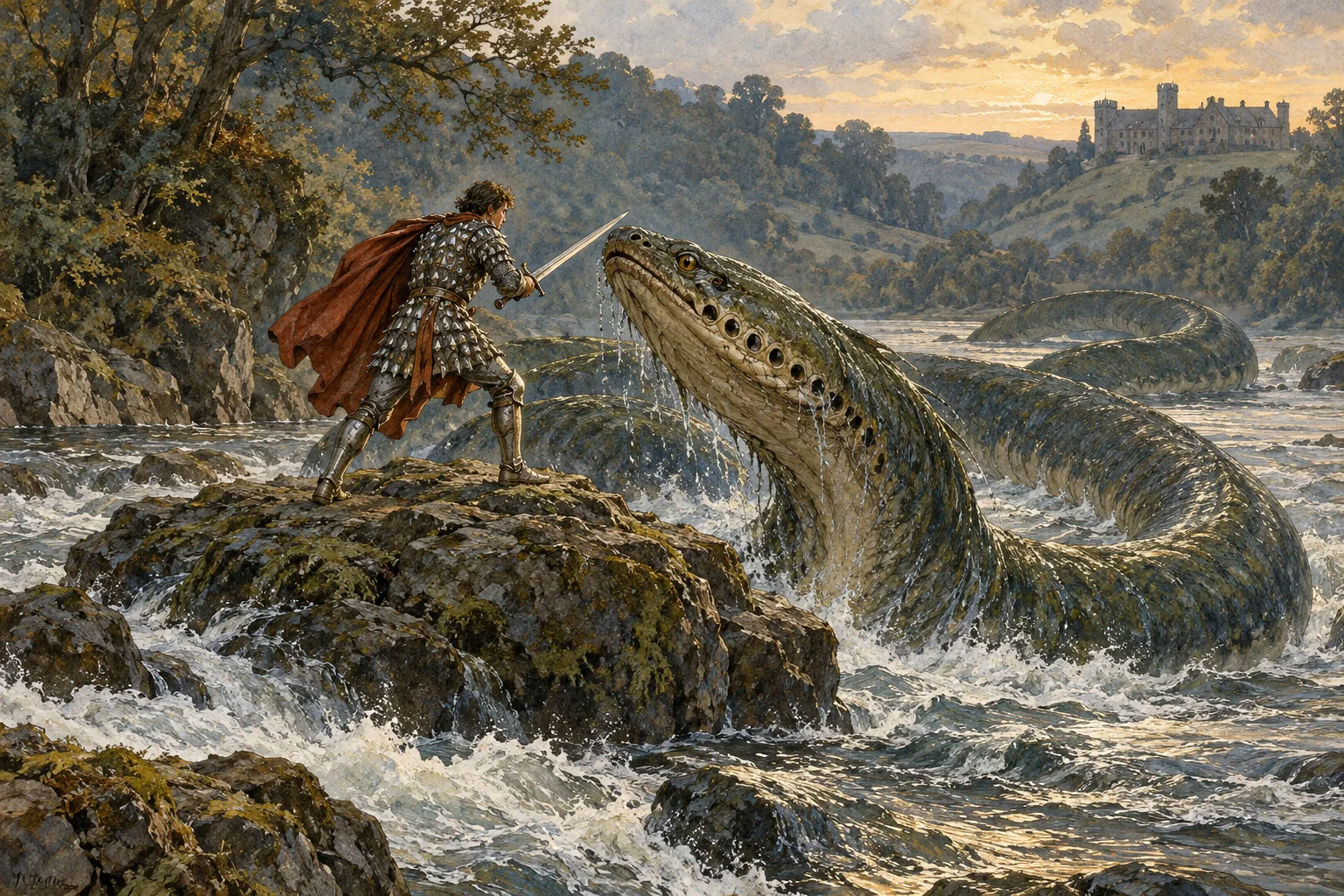
She first reproached him. Then, seeing that he meant to act, she told him to cover his armour with sharp spearheads and confront the worm from the rock in the river. There was another condition. If he won, he must kill the first living thing that met him on the way home. Break that promise, and for nine generations no lord of Lambton would die in his bed. He made the vow in the chapel. Henderson, Chapter VIII, the bargain and preparations.
The family planned to release his favourite hound when his horn announced victory. The dog would meet him first. With that arrangement made, the knight stepped onto the river rock and waited.
As the worm passed, he struck its head. It answered by wrapping itself around him. The more tightly it squeezed, the deeper the spikes entered its body. At last it weakened enough for his sword to divide it. This time the Wear carried the severed portion away before it could rejoin the rest. The river accomplished what the earlier champions had not: the worm was destroyed.
The knight blew his horn. Inside the hall, his father heard only that his son was alive. Forgetting the hound, the old man rushed out to embrace him.
The victor stopped. He could not kill his father. He sounded another blast; the servants released the dog, and he killed it instead. But the first meeting had already happened. The substituted sacrifice could not fulfil his oath.
So the country was freed from the worm, while the family inherited the price of its destruction. The legend says the curse endured for nine generations: a victory beside the Wear, followed by a long reckoning at home. Henderson, combat and broken vow.
Versions and variations
Henderson and Jacobs are connected texts. Henderson explicitly says he made free use of Cuthbert Sharpe’s Bishoprick Garland, assembled from accounts of older local residents. Jacobs subsequently identifies Henderson as his source and says that he rewrote the story. Their agreement therefore cannot count as two independent recordings of an ancient event. Henderson also supplies a separately identified family memory: his mother recalled her mother’s account of local anxiety about the last supposed generation of the curse. That is evidence of reported belief, not an eyewitness account of the worm. Henderson, Chapter VIII; Jacobs, note LXXXV.
The discarded catch and journey change. In Henderson, the heir throws the creature into the well before the stranger examines it. In Jacobs, the stranger warns him beforehand and tells him not to return it to the Wear. Henderson cautiously says some accounts make the foreign campaign a crusade to the Holy Land; Jacobs makes that destination definite. Our narrative preserves Henderson’s less specific journey. Jacobs, No. LXXXV, opening and departure.
The vow is differently staged. Henderson requires the first living creature encountered on the way home; Jacobs places the encounter at the hall’s threshold. Henderson’s dog is unnamed and killed by a thrust into its heart. Jacobs calls the hound Boris, specifies three horn blasts, and has its head cut off. In both, the father’s joyful mistake defeats the intended substitution. Henderson explicitly explains that severed pieces rejoin; this power is not stated as explicitly in Jacobs’s combat.
Small details need checking too. Jacobs’s comparative note gives the neighbouring Laidly Worm nine cows, but his actual Laidly story gives seven. We retain nine for Lambton and seven for Margaret. These documented differences matter more than treating every later repetition as a new oral version.
Context and evidence
The central danger is the heir’s responsibility for something he first dismisses. His courage repairs the harm to his neighbours, but the bargain leaves an impossible choice between a vow and his father. This reading follows the narrative’s structure; it does not prove that historical Lambton deaths resulted from a curse. Henderson’s pedigrees, reported relics and family memories are nineteenth-century arguments for local attachment, requiring separate historical assessment. Compare the different uses of milk and spiked armour in English dragons and worms, then read the Laidly Worm and the Dragon of Wantley.
Sources for this entry
- William Henderson, Notes on the Folk-Lore of the Northern Counties of England and the Borders. New edition, with many additional notes. London: published for the Folk-Lore Society by W. Satchell, Peyton and Co., 1879; first edition 1866.. Chapter VIII, 'Worms or Dragons', Lambton Worm account, beginning 'The Lambton Worm, partly from the romantic character of its history', through the reported relics; following Laidley Worm account.. Read source — Directly examined collector's narrative. Henderson explicitly borrows the Lambton account from Cuthbert Sharpe's Bishoprick Garland; his family recollection of belief in the curse is a separately identified addition. About this book
- Joseph Jacobs, More English Fairy Tales. New York: G. P. Putnam's Sons; London: D. Nutt, 1894.. No. LXXXV, 'The Lambton Worm', pp. 198–203.. Read source — Directly examined later literary retelling, used for specific comparisons rather than counted as an independent oral witness. About this book
- Joseph Jacobs, More English Fairy Tales: Notes and References. 1894 edition.. Note LXXXV, 'The Lambton Worm': Source, Parallels and Remarks.. Read source — Jacobs's explicit acknowledgement of rewriting Henderson; also checked against the actual Laidly Worm text where the note gives an inconsistent milk count. About this book
Research coverage
Two complete, dependent published accounts examined, together with their source statements. Sharpe's underlying collection, parish and family records, dialect songs, modern performances and a comprehensive oral-history survey remain unexamined. No date for a historical dragon battle is established.
The Myths · English collection · Editorial approach
Further Reading