Collected folklore · figure
The Púca
A changing supernatural presence in collected Irish tales: sometimes a terrifying ride, sometimes a helpful worker, and sometimes a dead person serving a penance.
Also found as: Puca · Pooka · Phouka
Research reviewed 17 October 2026.
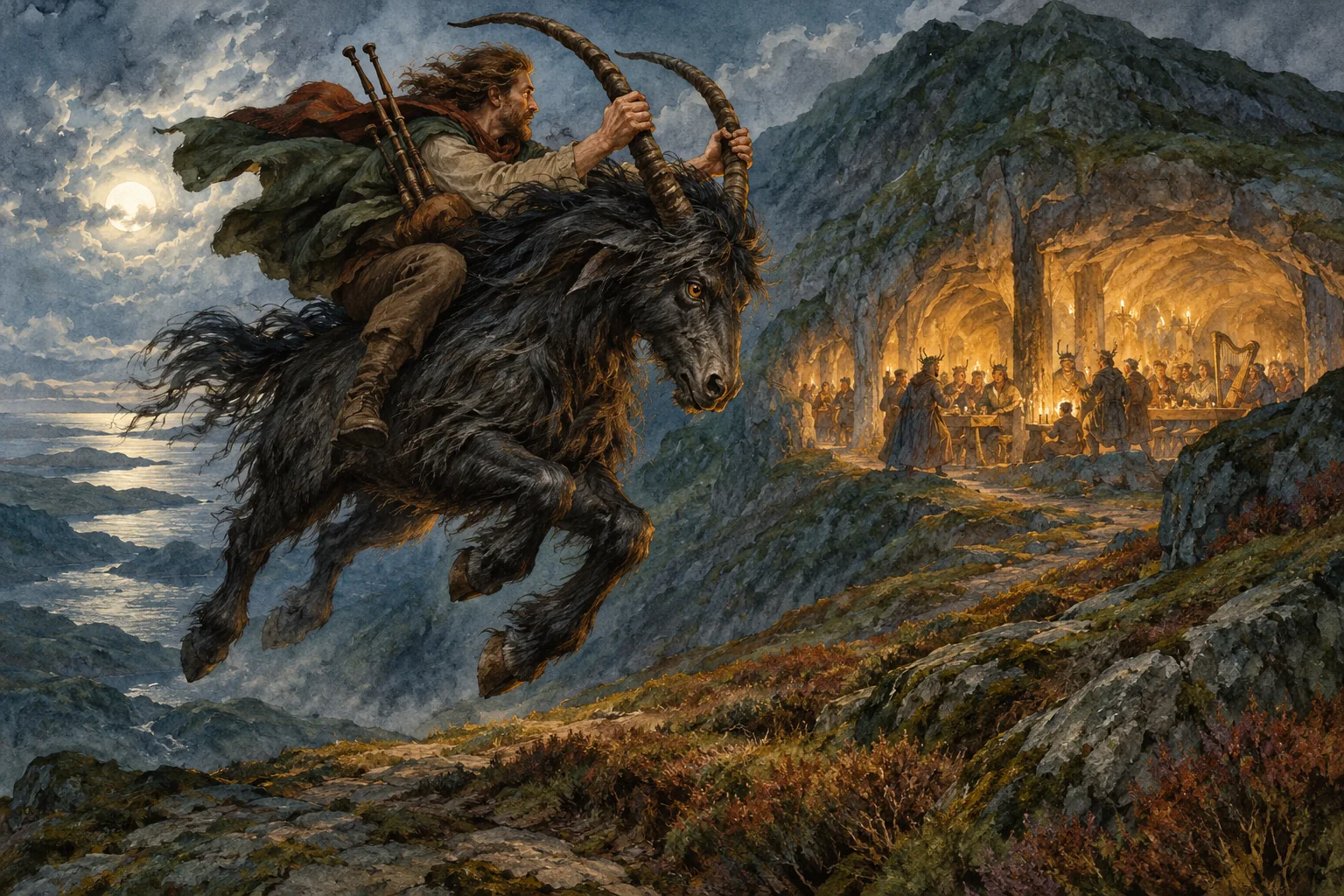
The púca is best approached through particular stories. The spellings puca, pooka and phouka occur in the printed sources used here, but spelling alone does not tell us whether two accounts describe the same kind of encounter. These narratives give the creature different bodies, occupations and explanations. A single fixed description would conceal much of what makes them interesting.
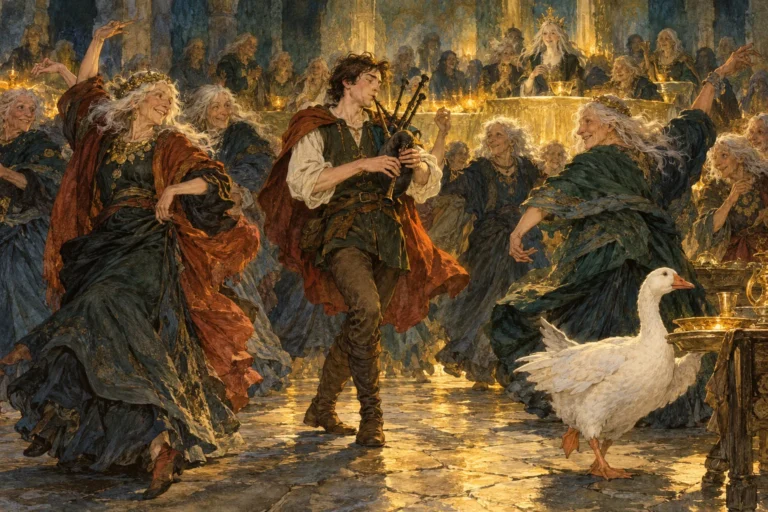
In Douglas Hyde’s Piper tale, the púca seizes a musician from Dunmore and carries him to a feast inside Croagh Patrick. It has long horns that the frightened rider can grip. Hyde does not identify it as a black horse. The danger is immediate, yet the journey leaves the piper with a lasting ability to play. His gold changes into leaves and the new pipes are ridiculous, but his old instrument produces wonderful music. The púca’s intervention cannot be reduced to either a simple punishment or an uncomplicated favour. Read Hyde, pp. 95–97.
The company at the feast calls it the púca of November. That seasonal detail belongs to this account. It should not be expanded into a claim that every story happens on the same night, or that all creatures bearing the name obey a common calendar. The tale also contains a Banshee, old women, an eaten gander restored to life and a priest’s penance. The púca moves among them without supplying an explanation of their relationships.
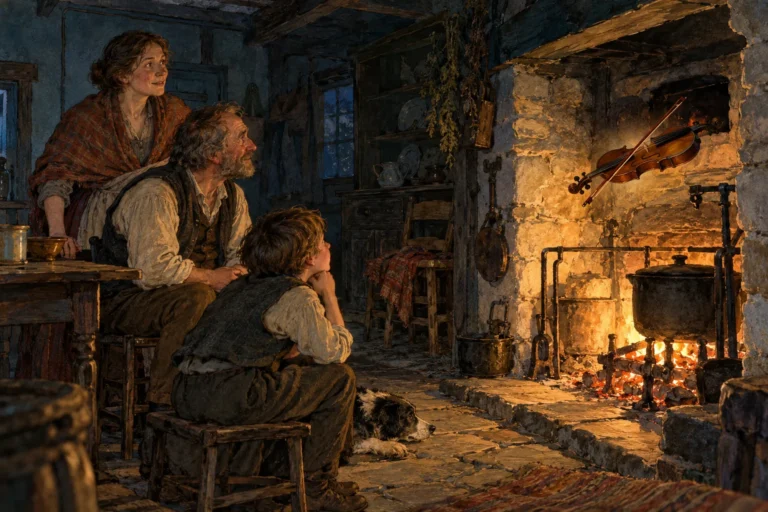
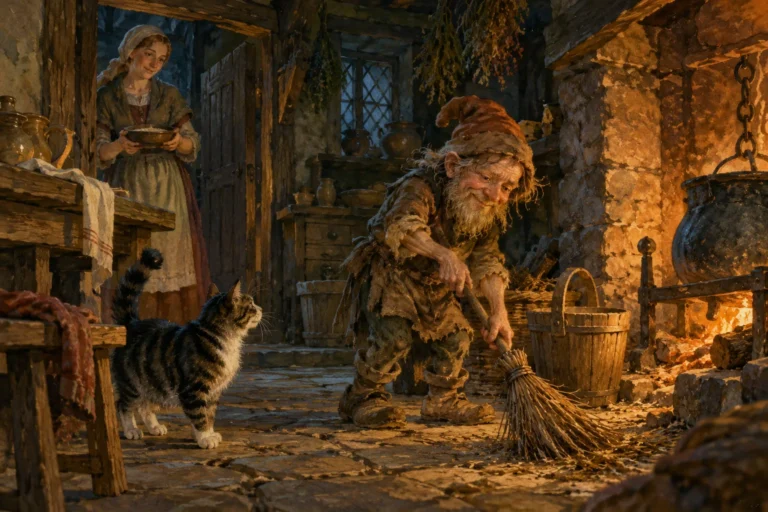
A very different role appears in Patrick Kennedy’s “The Kildare Pooka”, pp. 105–108. A large ass arrives at a country house and performs the servants’ work at night. It fetches water, washes and cleans while the people become accustomed to its labour. A boy discovers what is happening and speaks to the visitor. The creature says that it was once a lazy servant in that household and now has to work as a punishment after death.
The boy’s response is practical kindness. The visitor suffers in the cold, so a specially made coat is provided. The gift releases it from the obligation, and it leaves. The other servants lose the help on which they had come to rely. This account gives the púca a human past and a penitential purpose. Neither feature is explained as part of the Dunmore piper’s visitor.
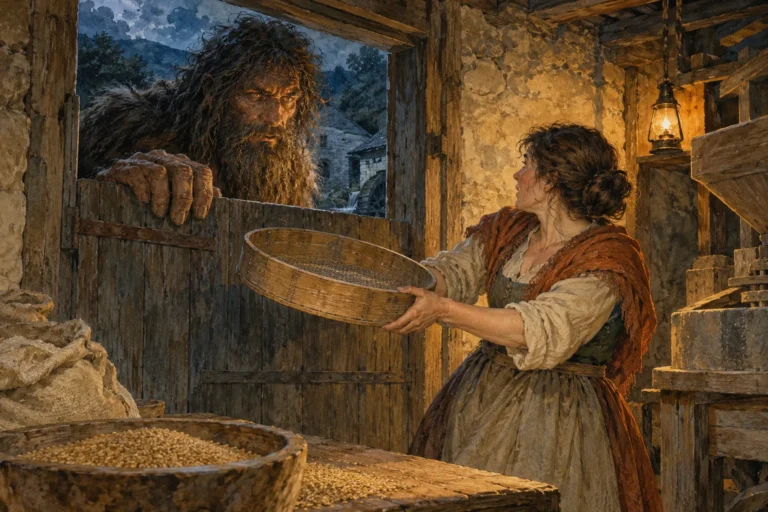
In Lady Wilde’s “Fairy Help. The Phouka.”, pp. 48–49, Phadrig encounters a supernatural presence that appears as a young bull. It later supervises a party of small workers at his father’s mill. Their labour makes the farmer prosperous. When Phadrig provides splendid clothing, the helper decides that a person dressed so well should no longer grind corn and departs. The household’s story nevertheless ends generously: Phadrig believes a valuable wedding gift has come from his old supernatural acquaintance.
Clothing ends the service in both household tales, but the reasons differ. Kennedy’s worker is freed from punishment; Wilde’s takes on the status suggested by the new suit. Wilde’s version does not identify the helper as the same dead servant, and Kennedy’s does not supply Phadrig’s wedding. Shared motifs make comparison worthwhile without authorising a merged life story.
Yeats’s short introduction, “The Pooka”, p. 94, gathers several animal forms and discusses possible connections with another supernatural horse. His uncertainty is part of the evidence. The useful starting point is a named text and its particular encounter. Comparisons can follow, but we should not assume that every threatening horse, night worker or fairy rider must be a púca.
Versions and variations
Three contrasts organise the accounts examined here. The piper’s visitor carries a person away; Kennedy’s comes to work in a house; Wilde’s works through a mill and a group of helpers. They differ in function as well as appearance.
The explanations also vary. Kennedy’s creature states that it is a dead human undergoing punishment. The other two narratives do not give that explanation. Importing it into them would create a consistency the sources do not possess. Likewise, the piper’s supernatural journey does not demonstrate that Kennedy’s helpful ass carries riders to mountain feasts.
Finally, gifts change relationships in different ways. Fine clothing ends the two workers’ service, but their departures have different rationales. In the Piper, misleading gifts accompany a durable musical skill. Such differences are more informative than a general label such as mischievous shapeshifter, which says little about what each story actually does.
The printed household narratives have distinct credited authors, but their full transmission relationship has not been established here. They are treated as separate accounts with a shared motif, without claiming that their oral origins are wholly independent. Later copies of the Piper are discussed on its story page, where copying and adaptation are distinguished from a different narrative.
Context and evidence
These sources document what collectors and editors printed, together with the limits of their attribution. They do not establish that a supernatural animal existed or that every person in Ireland understood the word in the same way. Kennedy partially conceals his locality; Wilde does not give a named teller or precise locality for the mill story.
No single origin or etymology is asserted here. Yeats’s suggestions and doubts are historical commentary, not settled linguistic evidence. A fuller guide would require additional regional records, their original language, collection circumstances and comparisons with later recordings.
Sources for this entry
- Douglas Hyde; W. B. Yeats, editor, Fairy and Folk Tales of the Irish Peasantry. First published 1888; linked text is an undated Walter Scott Publishing Co. reprint, London and Felling-on-Tyne. Project Gutenberg ebook 33887.. The Piper and the Puca, pp. 95–97. Read source — Named horned visitor, musical gift and mountain journey. About this book
- Patrick Kennedy; W. B. Yeats, editor, Fairy and Folk Tales of the Irish Peasantry. First published 1888; linked text is an undated Walter Scott Publishing Co. reprint, London and Felling-on-Tyne. Project Gutenberg ebook 33887.. The Kildare Pooka, pp. 105–108; anthology credits Kennedy's Legendary Fictions of the Irish Celts. Read source — Household ass, deceased servant's penance and clothing gift; full anthology text examined. About this book
- Lady Wilde, Ancient Legends, Mystic Charms, and Superstitions of Ireland, with Sketches of the Irish Past. New edition, London: Chatto & Windus, 1919; first published 1887. Project Gutenberg ebook 61436.. Fairy Help. The Phouka., pp. 48–49. Read source — Bull appearance, mill workers and fine-clothes departure; complete account examined. About this book
- W. B. Yeats, Fairy and Folk Tales of the Irish Peasantry. First published 1888; linked text is an undated Walter Scott Publishing Co. reprint, London and Felling-on-Tyne. Project Gutenberg ebook 33887.. The Pooka, p. 94. Read source — Editorial overview and explicitly uncertain comparison with the water-horse; not used as proof of an origin. About this book
Research coverage
Three complete named narratives and Yeats's introduction examined. This is a source-led introduction, not a census of regional beliefs. Irish-language manuscripts, all regional Schools' Collection material and later recorded testimony have not been comprehensively compared.
The Myths · Irish collection · Editorial approach
Further Reading