Collected folktales · story
Teig O’Kane and the Corpse
Forced to carry a corpse that will not release him, a wayward young man searches through hostile burial grounds before dawn.
Also found as: Teig O'Kane and the Corpse · Tadhg O Cáthán and the Corpse · Tomaus O Cahan and the Ghost
Research reviewed 17 October 2026.
Read the story
This original retelling follows Douglas Hyde’s “Teig O’Kane and the Corpse”, pp. 16–31, in Yeats’s anthology. Spellings of the burial grounds follow that printed story; they are not modern map identifications.
Teig O’Kane was the only son of a prosperous farmer in County Leitrim. He was handsome and able, but his father saw little benefit from either quality. Work lost out to drinking, gambling and nights away from home. At last the father confronted him about Mary, a young woman whom Teig had promised to marry.
Teig already loved Mary and intended to marry her in his own time. Being ordered to do it made him angry. His father threatened to leave the farm elsewhere if he refused to settle down. Teig went out, walking for hours with his pipe, still turning the quarrel over in his mind.
Near midnight he heard voices. A company of little men approached, carrying a corpse. Their elderly leader addressed him three times, asking whether it was fortunate that they had met him. Teig was too frightened to answer. His silence gave them their opportunity.
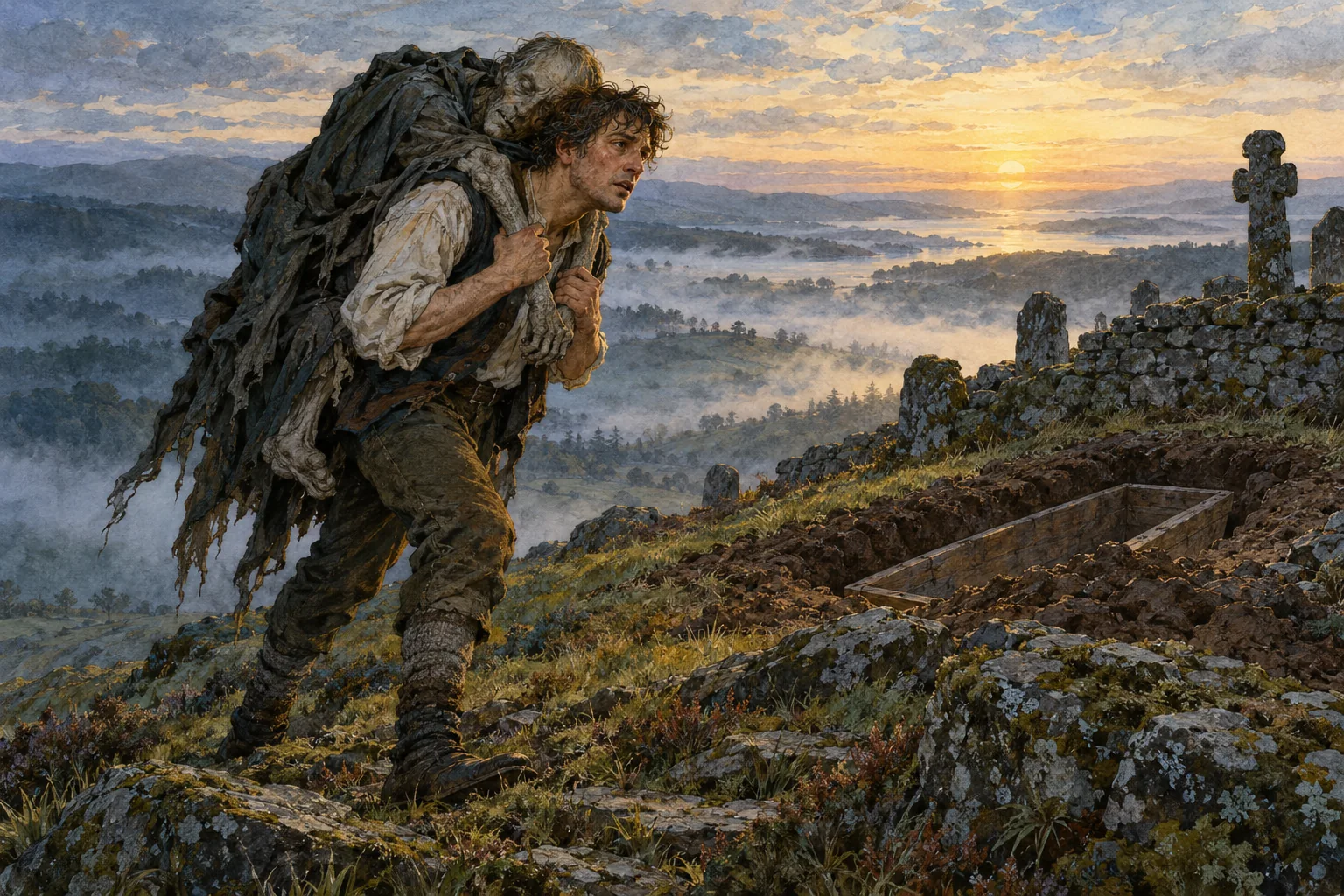
They told him to take the burden. He refused and tried to escape, but they tripped him and held him face down. The corpse was laid upon his back. Its arms closed around his neck and its legs gripped his body. When he struggled to shake it off, the dead thing held more tightly.
Teig prayed to the saints and promised to change his life. He would give up his wandering ways; he would marry Mary. The little men had another immediate requirement. He must bury the corpse before daylight. They named five burial grounds to try in turn: Teampoll-Démus, Carrick-fhad-vic-Orus, Teampoll-Ronan, Imlogue-Fada and Kill-Breedya.
The company accompanied him to the first churchyard, then stood back. Teig could not open the locked door. A voice from the burden told him where to find the key. Inside he obtained a light and discovered a spade beside the altar. If he could dig a grave, perhaps this dreadful night would end.
He lifted a flagstone and began. Before long the occupant rose to object. The dead man had no intention of surrendering his resting place and threatened Teig if he continued. Teig covered him again and carefully replaced what he had disturbed.
Another attempt brought up an angry old woman. She too refused to make room. Teig restored her grave as well. The church held the dead already assigned to it, and none welcomed the stranger clinging to his back.
The corpse directed him onwards with its bony hand. At Carrick-fhad-vic-Orus, a silent crowd of ghosts guarded the boundary. He could not force his way through them. With the night passing, he had to abandon that place without even beginning to dig.
At Teampoll-Ronan he met something he could not see. An invisible force struck and battered him, finally hurling him into a ditch far from the entrance. He dragged himself up with the burden still attached. Pain had not loosened its grip.
At Imlogue-Fada, coloured fire whirled around the burial ground. It grew into a surrounding band that he could not cross. Every promised refuge seemed to invent another way of rejecting him. There was only one name left.
He struggled towards Kill-Breedya, a bare hill, as morning approached. Here there was no crowd barring the wall and no ring of fire. A freshly opened grave waited with an empty coffin inside it. For the first time the corpse released him. It went down into the place prepared for it.
Teig needed no further instruction. With his bare hands he pulled earth into the grave, filled it and stamped it firmly down. The burden was buried. He was alone, exhausted and at liberty.
He reached an inn and slept through the day and the following night. Afterwards he hired a horse for the long journey home. Of all the people who might have asked where he had been, only his father heard the full story.
Within a fortnight Teig married Mary. The cards, the drunkenness and the solitary night journeys ceased. Whether anyone else would have believed the account mattered less to him than the memory of that weight. He had spent a night unable to put it down, and had no desire to risk carrying it again.
Versions and variations
Hyde’s later Legends of Saints & Sinners, pp. 219–242, gives the prose a more specific collection history. He says that he heard it from an old man from near Fenagh while the man was paying rent at Mohill, and wrote the prose from memory. The later printing is therefore not a second independently collected prose variant merely because it appears in another book.
The same volume supplies a different kind of witness: the verse “Tomaus O Cahan and the Ghost”. Hyde had recorded part of a recitation and later found a closely corresponding but incomplete text in a Nicholas O’Kearney manuscript. His printed poem takes its first twenty-three stanzas from O’Kearney and the remainder from his own version. Readers are seeing an editorial composite, not two complete ballads presented separately.
In the ballad, the corpse bargains with Tomaus and offers payment, including cattle. The journey is crowded with named dead people who object when their bones and resting places are disturbed. Family connections, claimed obligations and the question of where the body belongs become prominent. Its closing movement reaches the burial at Kill-Vreedya after a list of other places.
The prose instead frames the ordeal with Teig’s conduct towards his father and Mary. The little men impose the burden, and the conclusion measures his reform through marriage and changed behaviour. Its later graveyards also offer different obstacles: a wall of ghosts, an invisible assault and encircling fire. The ballad’s extended comic arguments with particular dead people cannot simply be inserted into that sequence as though Hyde printed them there.
Yeats introduces the prose among fairy stories because he interprets the apparitions through fairy enchantment. That is an editor’s explanation, not a discovery of the corpse’s historical identity. Compare Nera’s adventure for another perilous encounter with a dead body, while keeping the texts and their transmission distinct. Neither resemblance proves that one account directly descends from the other.
Context and evidence
The surviving evidence here concerns a story and the ways Hyde obtained and reshaped it. Writing prose from memory allows a readable account but does not preserve every word of an oral performance. The separately explained construction of the ballad makes the editorial process unusually visible.
Leitrim, Fenagh and Mohill have different functions: the first is the prose story’s setting, while the latter two help locate Hyde’s encounter with a teller. The cemetery names are left in their printed forms rather than matched speculatively to modern sites. No identity for the corpse, historical Teig, or record of the supernatural journey has been established. Hyde’s later introduction and ballad are essential companions to the familiar anthology version.
Sources for this entry
- Douglas Hyde; W. B. Yeats, editor, Fairy and Folk Tales of the Irish Peasantry. First published 1888; linked text is an undated Walter Scott Publishing Co. reprint, London and Felling-on-Tyne. Project Gutenberg ebook 33887.. Teig O'Kane (Tadhg O Cáthán) and the Corpse, pp. 16–31; Yeats's prefatory comment. Read source — Complete prose narrative used for the original retelling; editor's interpretation distinguished. About this book
- Douglas Hyde, Legends of Saints & Sinners: Collected and Translated from the Irish. London, Dublin and Belfast: Gresham Publishing Company; edition catalogued 1915, with illustrations by Noel L. Nisbet. Project Gutenberg ebook 45910.. Teig O'Kane and the Corpse, introduction and prose, pp. 219–238; Tomaus O Cahan and the Ghost, pp. 238–242. Read source — Later provenance statement and complete printed composite ballad; differences from prose examined. About this book
Research coverage
Both printed prose presentations, Hyde's provenance discussion and the complete printed composite ballad examined. O'Kearney's underlying manuscript and the separate oral fragment have not been independently collated. Tomaus is recorded as an associated verse form, not silently treated as the same wording or an established historical identity.
The Myths · Irish collection · Editorial approach
Further Reading