
Collected folktales · story
Guleesh
A young man joins a fairy ride to France, rescues an abducted princess and returns a year later to discover how her stolen voice can be restored.
Also found as: Guleesh na Guss Dhu · Guleesh of the Black Feet
Research reviewed 17 October 2026.
Read the story
This original retelling follows Douglas Hyde’s “Guleesh na Guss Dhu”, pp. 104–128. It retains the Rome episode and marks the point where Hyde deliberately withholds an embellished continuation.
Guleesh lived in County Mayo and had reached twenty-one without acquiring either the habits or the respectability his father wanted. Even his neglected feet had become part of his name. After another quarrel at home, he went outside and sat near the neighbouring rath. The moon shone over the fields. He wished he could leave familiar ground and see something of the world.
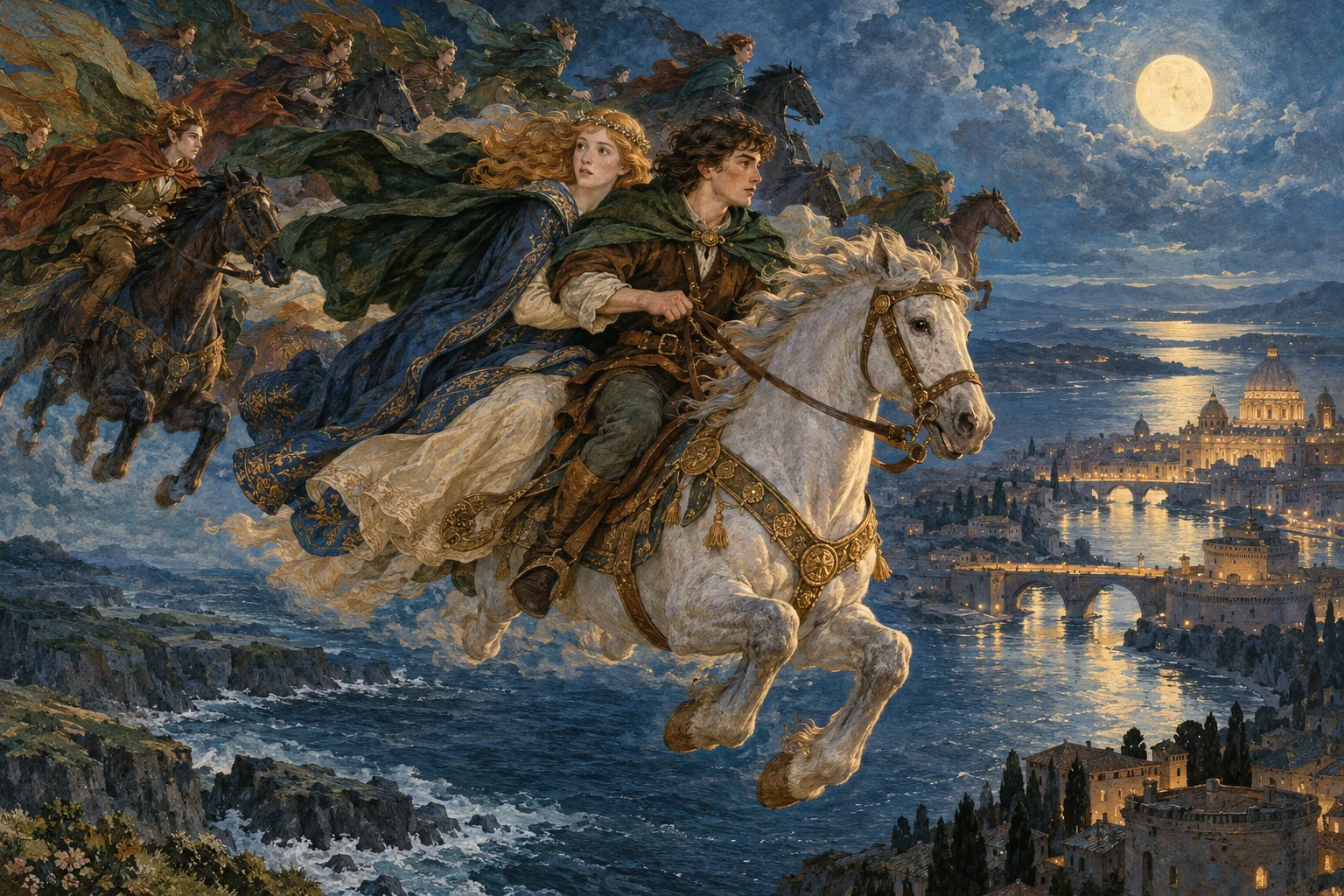
Then a whirlwind passed, carrying a crowd of small riders towards the mound. Guleesh followed. When they called for horses, bridles and saddles, he copied their words. A horse appeared beneath him, splendidly equipped, and he found himself among the company. With their shouted command they leapt across the sea.
The riders were travelling to France to steal a king’s daughter. They needed a living man to carry her, and Guleesh’s unexpected presence suited their purpose. But their route brought them first to Rome, where he insisted on an errand of his own. His parish priest had been suspended, and he wanted the Pope’s written permission for the priest to return to his duties.
One of the fairies helped him reach the Pope’s chamber. The Pope refused the demand until the invisible helper breathed fire and Guleesh threatened to burn the room. Confronted with that alarming persuasion, he supplied the document. Guleesh thanked him and returned to the riders.
In France, the princess was being forced into marriage. She had postponed it year after year, but now, at eighteen, she could delay no longer. The fairy company entered the festivities unseen. As she approached the altar they tripped her, cast their concealment over her and placed her behind Guleesh on his horse. The wedding company could no longer see her.
Guleesh pitied the unhappy young woman. As the riders rushed homewards he decided that, if he could help it, she would belong neither to the unwanted husband nor to the fairies. At the Irish rath he sprang down, held her firmly and claimed her in God’s name. The magnificent horses became ordinary sticks, plants and implements.
The fairies could not recover their captive. One struck her in spite, taking away her speech. When the company vanished, Guleesh was left with a rescued woman who could not tell him her name or answer his promises of help.
He brought her to the priest and produced the papal document. Restored to his duties, the priest gave the stranger a home and presented her as his niece. They called her Mary. Guleesh visited every day, learning to understand her gestures. The priest tried sending letters through travellers and merchants, but none brought an answer. Meanwhile Guleesh fell in love. Afraid that a successful letter would take her away, he even asked the priest to stop writing.
On the following November Eve, he returned to the rath. He waited for hours in the frost before the riders appeared. They recognised him and mocked him about his silent companion. One let slip that a herb growing beside his own door, boiled into a drink, would restore her voice. Then they were gone.
Guleesh searched beside the house and found the plant: seven branches, each bearing seven leaves, with white sap. Fearful of poisoning the princess, he tried the drink himself. It sent him into a long sleep, from which he woke refreshed. He then brought a portion to her.
She too slept deeply. When the priest eventually asked whether she had slept well, she answered him. After all their months of gestures, an ordinary spoken reply became the most extraordinary sound in the house.
Six months later the princess insisted on returning to her parents. Neither Guleesh’s pleading nor the priest’s could keep her. She sold jewellery to pay her way and set off alone; Guleesh, unable to bear the separation, followed.
Here Hyde interrupts his published account. He says he has altered and enlarged the following adventures too much to present them as faithful folklore, so he does not print them. He gives only their destination: the princess is restored, Guleesh wins her, and the story reaches its wedding and happy ending. The missing journey is not filled in here.
Versions and variations
Hyde’s provenance note, pp. 173–174, names Seamus O’Hart, also called Shamus O’Hart or James Hart, a gamekeeper from the Frenchpark area. Hyde had notes of his telling, rather than a complete verbatim transcript. He also heard Martin Brennan of Frenchpark give a shorter account with the same sequence of incidents. That statement records another telling; it does not supply a second complete text that readers can compare line by line.
Joseph Jacobs’s “Guleesh” and its source note explicitly acknowledge Hyde. Jacobs removes the journey to Rome because he considers it unnecessary to the main adventure, and drops the explanation of Guleesh’s black-footed name. His ending moves from the restored voice and growing affection towards marriage, without Hyde’s separate departure for France. These are consequential editorial changes: the priest’s reinstatement disappears, and the princess’s insistence on going home receives less space. Jacobs is an adaptation, not a newly collected oral witness.
A distinct comparison is Letitia Maclintock’s “Jamie Freel and the Young Lady”, pp. 52–59. Jamie, a working son who supports his widowed mother in Donegal, joins a Halloween expedition from a ruined castle. The abducted woman comes from a house in Dublin’s Stephen’s Green. Her captors leave an enchanted substitute behind, and she loses hearing as well as speech. The cure is stolen from the fairies’ glass, rather than gathered as a herb. Jamie accompanies her home, where a ring and a bodily mark help establish her identity. Her parents’ belief that they buried her is part of the difficulty.
Both rescue tales turn on a return to fairy company and an overheard remedy, but they have different households, journeys and endings. Neither should be silently used to complete the other. Hyde’s withheld continuation is a further limit: its broad happy ending survives in his printed summary, but its embellished episodes are not evidence for the tellers’ versions.
Context and evidence
This is a collected folktale with named nineteenth-century transmission, not a documented report of a French royal disappearance. The Pope, king and princess are not identified historically. Their presence gives the adventure a wide geographical reach without establishing a date or a particular court.
The distinction between setting and collection place matters: Mayo belongs to the story’s opening, while Frenchpark belongs to Hyde’s account of its tellers. The unnamed rath should not be pinned to a convenient surviving monument. Compare the dangerous hospitality of Nera’s adventure as a related theme, while keeping its medieval source history separate from Hyde’s collected tale. Read Hyde’s text and source discussion.
Sources for this entry
- Douglas Hyde, Beside the Fire: A Collection of Irish Gaelic Folk Stories. London: David Nutt, 1910; first published 1890. Project Gutenberg ebook 60782.. Guleesh na Guss Dhu, pp. 104–128; Where the Stories Came From, pp. 173–174. Read source — Principal narrative and collector's account of O'Hart, Brennan and the omitted embellished continuation. About this book
- Joseph Jacobs, Celtic Fairy Tales. London: David Nutt, 1892; illustrated by John D. Batten. Project Gutenberg ebook 7885.. II, Guleesh; Notes and References, II. Read source — Acknowledged adaptation compared with Hyde; not treated as an independent oral witness. About this book
- Letitia Maclintock; W. B. Yeats, editor, Fairy and Folk Tales of the Irish Peasantry. First published 1888; linked text is an undated Walter Scott Publishing Co. reprint, London and Felling-on-Tyne. Project Gutenberg ebook 33887.. Jamie Freel and the Young Lady: A Donegal Tale, pp. 52–59. Read source — Separate rescue tale used as a documented narrative parallel, not a replacement ending for Guleesh. About this book
Research coverage
Hyde, Jacobs and Maclintock's printed accounts examined. Hyde's two named tellers are distinguished from the one printed narrative. The original Irish publication, all manuscript notes and later oral records have not been collated; the omitted continuation is not reconstructed.
The Myths · Irish collection · Editorial approach