Irish fairy folklore · figure
The Clurichaun
A solitary fairy associated in different printed accounts with wine cellars, troublesome household attachments and shoemaking. The name overlaps with leprechaun traditions, but collectors do not draw the boundaries consistently.
Also found as: Cluricaune · Cluricawne · Naggeneen
Research reviewed 17 October 2026.
The clurichaun is easier to recognise through particular stories than through a single list of characteristics. In Croker’s collection, a tiny drinker occupies a gentleman’s cellar, while another tale applies the name to a shoemaker discovered beside a horse. His Cluricaune note, pp.79–80, treats several regional names as corresponding forms. The familiar idea of an entirely separate species of drunken fairy is therefore too tidy for these sources.
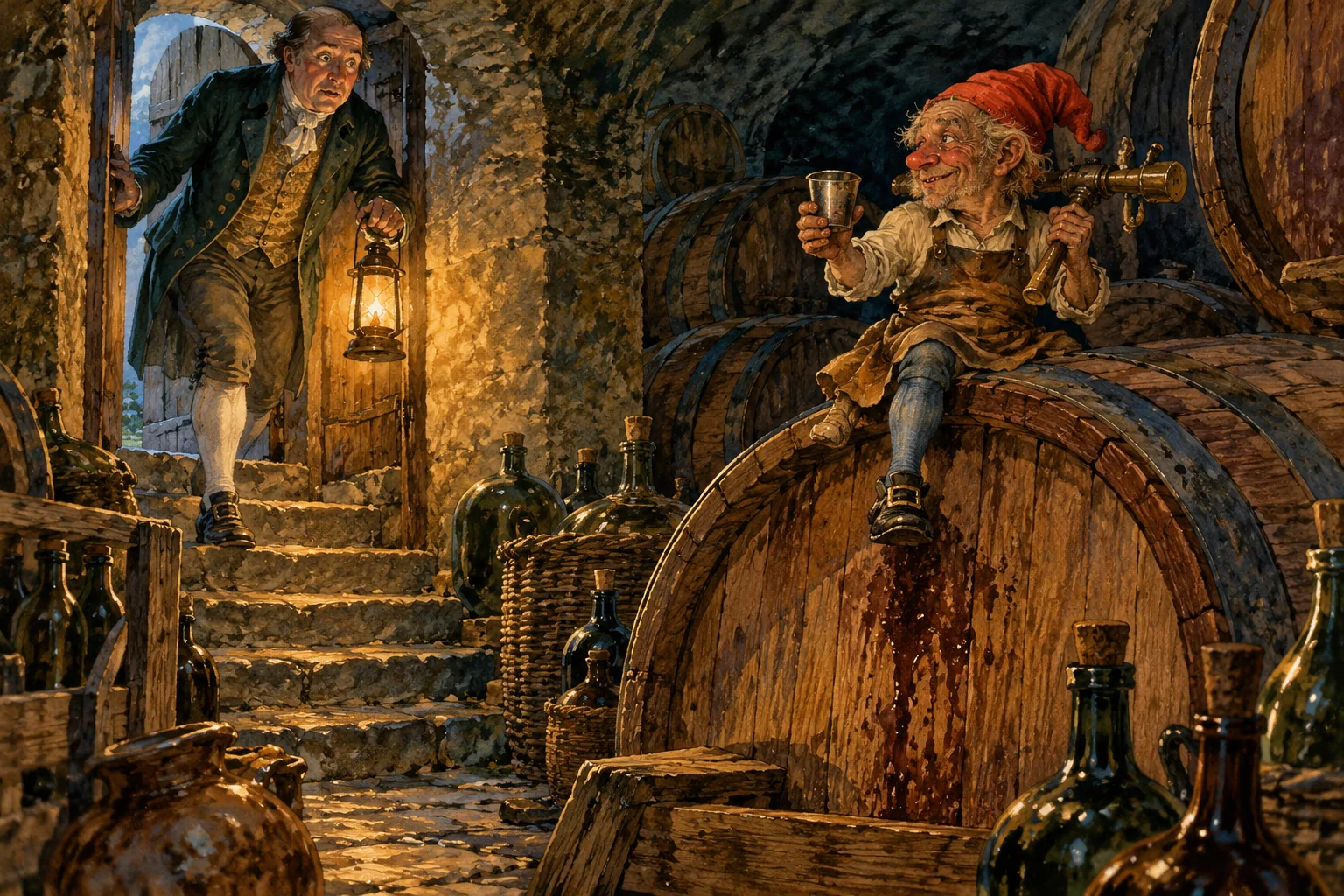
The most vivid individual is Naggeneen in “The Haunted Cellar”. Justin MacCarthy of Ballinacarthy is a generous host whose wine cellar alarms a succession of servants. Young Jack Leary, promoted from the stables to become butler, enters the underground vault expecting only to fetch wine. Laughter, rattling bottles and apparently moving casks turn the errand into a terrifying ordeal. The employer who expects courage from a servant must eventually investigate for himself.
MacCarthy finds a figure only about six inches high sitting astride a cask of old port. The little man wears a red nightcap, leather apron, pale blue stockings and buckled shoes. A spigot rests on his shoulder. His withered face and richly coloured nose make him look less like an elegant court fairy than a small, disreputable resident of the household’s wine supply.
Moving house seems an obvious escape until Naggeneen asks about the arrangements. Surely MacCarthy does not intend to leave his own Cluricaune behind? The attachment is to the household, not simply to a particular hole in the ground. MacCarthy stays and fetches his own wine. After his death, diminishing prosperity leaves the spirit in shabby circumstances too. The ending connects the fairy’s condition with the fortunes of the people around him. Croker’s complete account gives the episode its comic resignation.
“The Little Shoe” supplies a different emphasis. Molly Cogon tells Mr Coote a story she heard from her father about her grandfather. Checking his tired mare after a day hauling turf, the grandfather hears tapping and whistling and discovers a little craftsman on the horse’s girth. He catches him and demands money. The captive asks him to wait while he gets the purse. The grandfather loosens his grip, and the fairy escapes, leaving a tiny shoe. Molly says her mother had handled that shoe, but she herself never saw it. The narrator preserves the chain of family testimony; the text does not produce an object readers can examine.
A later collector, D. R. McAnally, offers another arrangement in “The Leprechawn”, especially pp.139–142. His general description makes the being much larger than Naggeneen, around three feet tall. He assigns “Cluricawne” specifically to Monaghan and gives this regional figure a red swallow-tailed coat, green waistcoat, white breeches, black stockings and a tall, brimless cap. His book’s preface claims extensive travel and conversations with country people, but these particular descriptions do not identify individual informants.
McAnally also recounts a Clare household’s mistake in offering a resident fairy food left by a dog. The offended visitor retaliates by replacing the contents of the wine casks with seawater. He calls the being a leprechaun. It belongs in the comparison because of the household and cellar setting, without being silently renamed to fit a modern category.
Read together, these accounts connect food, drink, work, hospitality and unequal bargains. They also show why the unnamed stranger in Bottle Hill should retain his anonymity. A small uncanny man offering a dangerous gift is not automatically a clurichaun, and a collector’s section heading does not establish a universal fairy family tree.
Versions and variations
Croker’s Cork designation. The 1844 section note, pp.79–80, associates “Cluricaune” with Cork and compares it with names used in Kerry, Tipperary, Leinster and Ulster. The same section accommodates Naggeneen’s drinking and the little shoemaker. That arrangement is evidence of Croker’s classification. It does not mean every storyteller accepted all his proposed equivalents, or that his speculative etymologies have been confirmed.
McAnally’s Monaghan designation. In Irish Wonders, “The Leprechawn”, pp.139–142, “Cluricawne” is attached to Monaghan. The clothing, height and regional distribution differ from Croker’s account. McAnally places the descriptions within a broad leprechaun discussion, including household service, mischief and offended hospitality. This is a distinct published collector treatment. His general statement that he travelled and heard stories does not supply a named speaker or collection date for each assertion, and complete independence from earlier books cannot be assumed.
Different kinds of evidence inside the stories. The MacCarthy tale presents a named householder and a named spirit, with comic narrative access to their conversation. The shoe tale openly gives a chain of report: Molly heard her father describe her grandfather’s encounter; her mother supposedly handled the shoe; Molly had not seen it. Treating both as equally direct eyewitness statements would discard a distinction the second text carefully preserves.
Useful boundaries. Drinking, solitary behaviour and shoemaking overlap in these editions, but the group of singers in Knockgrafton is not labelled a company of clurichauns. Nor is Bottle Hill’s stranger identified as one. This guide records those limits rather than assigning every small fairy to a single type.
Context and evidence
The sources examined here are nineteenth-century collections and their later editions. Their narrators preserve or reconstruct local speech, stage encounters and arrange beings into categories. They are valuable evidence for published folklore and the ways it was presented; they are not field recordings or proof of supernatural residents. McAnally’s preface and Croker’s section note should be read alongside the tales.
No claim is made that the name has always meant the same thing across Ireland. A wider account would need Irish-language forms, identifiable oral records and a careful history of how later writers separated clurichauns from leprechauns.
Sources for this entry
- Thomas Crofton Croker, collection, Fairy Legends and Traditions of the South of Ireland. Seventh edition, June 1906; Thomas Wright, editor; Library Ireland transcription. The Haunted Cellar, complete story; also 1844 edition IX, pp.63–69. Read source — Croker’s named cellar spirit Naggeneen and the MacCarthy household. About this book
- Thomas Crofton Croker, collection, Fairy Legends and Traditions of the South of Ireland. Seventh edition, June 1906; Thomas Wright, editor; Library Ireland transcription. The Little Shoe, complete story; also 1844 edition XI, pp.77–79. Read source — Explicitly mediated family account concerning a shoemaking Cluricaune. About this book
- Thomas Crofton Croker, collection, Fairy Legends and Traditions of the South of Ireland. Philadelphia: Lea and Blanchard, 1844, A New Edition. Cluricaune section note, pp.79–80. Read source — Croker’s regional names and category comparisons; not a universal traditional taxonomy. About this book
- D. R. McAnally, Jr., Irish Wonders. First published 1888; linked Gutenberg text reproduces the undated Weathervane Books, New York reprint and 1888 copyright. Preface; The Leprechawn, especially pp.139–142: Clare household anecdote and Monaghan Cluricawne. Read source — Separate collector’s published treatment, with claimed travel collection but no named informant for these passages. About this book
- Thomas Crofton Croker, collection; contribution attributed to William Maginn, Fairy Legends and Traditions of the South of Ireland. Seventh edition, June 1906; Thomas Wright, editor; Library Ireland transcription. The Legend of Bottle Hill, complete story. Read source — Chosen narrative; does not identify the stranger as a clurichaun. About this book
Research coverage
Croker’s complete Haunted Cellar and Little Shoe, his 1844 category note, and McAnally’s preface and relevant Leprechawn passages have been examined. These provide two published collector treatments, not two proven independent oral witnesses. Irish-language etymology, individual Dúchas records and the history of the modern clurichaun/leprechaun distinction remain uncollated.
The Myths · Irish collection · Editorial approach
Further Reading