Irish fairy folklore · story
Daniel O’Rourke
After a landlord’s feast, Daniel O’Rourke takes a wrong turn into a journey involving an offended eagle, an inhospitable man in the moon and a flock of wild geese.
Also found as: Daniel O'Rourke · Dan O’Rourke’s Journey to the Moon
Research reviewed 17 October 2026.
Read the story
This retelling follows “Daniel O’Rourke” in the 1906 edition of Croker’s collection. It keeps the story’s waking ending and its deliberately improbable sequence. The contribution is attributed to William Maginn in the sources discussed below.
Daniel O’Rourke had travelled farther than anyone would expect of a man from the country near Bantry. At least, that was what he said. Ask him about the moon and he could describe the person living there. Ask about an eagle’s manners and he had something sharper to offer than admiration.
It had begun with a celebration. The landlord’s son was home from abroad, and the tenants were invited to feast. Daniel remembered generous hospitality and admitted drinking, although he was much less willing to admit how thoroughly it had affected him. He eventually left the company and set out into the night.
He meant to call on Molly Cronohan, a woman reputed to know about fairies, because one of his heifers seemed bewitched. Instead, at the ford of Ballyashenogh, he missed the stepping stones and fell into the water. By the time he struggled out, nothing around him looked familiar.
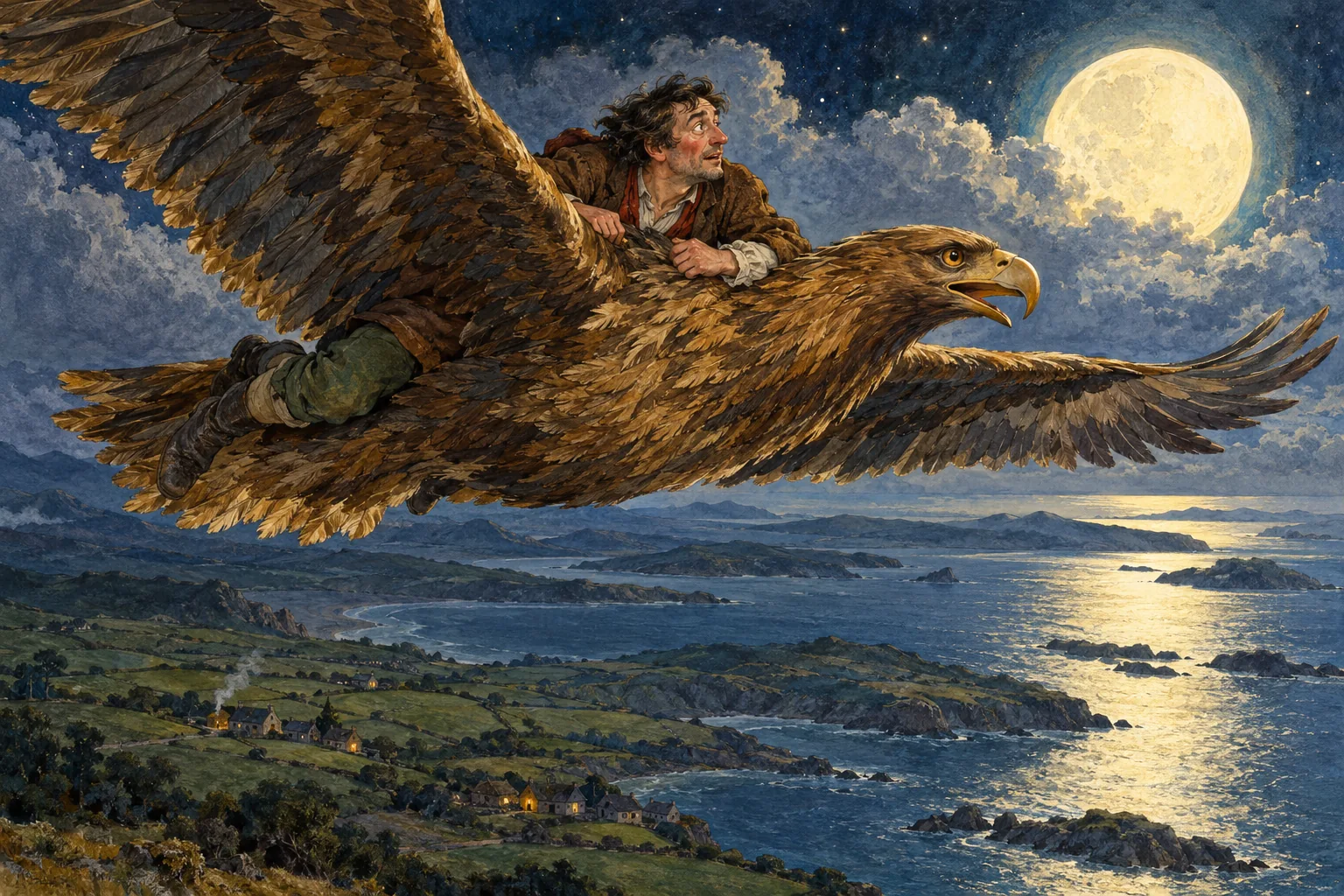
He wandered through boggy ground, growing colder and more bewildered, until he sat on a stone. An eagle landed nearby and addressed him by name. The bird offered to carry him home, explaining that Daniel’s good behaviour towards birds deserved help. It was an odd offer, but the stone beneath Daniel was sinking. Remaining where he was seemed less promising than trusting the eagle.
He climbed on, and the bird rose. Soon Daniel could see the country below, including the home he wanted so badly to reach. He asked to be put down. The eagle refused: there were people with guns about, and landing would be dangerous. They went higher.
The familiar earth dwindled. The bird carried him all the way to the moon, where a reaping hook projected from its surface. Daniel was ordered to take hold of it. He protested, but the eagle threatened to shake him off. Clinging to the hook seemed the better of two terrible choices.
Only when Daniel was securely stranded did his rescuer explain the journey. Daniel had robbed the eagle’s nest the previous year. This was repayment. The bird flew away laughing, leaving him hanging against the moon with no means of getting down.
A door opened, and the man in the moon appeared. Daniel hoped that anyone living so far from company would welcome a visitor. He explained his predicament and asked to come inside. But the moon’s inhabitant wanted no stranger at his door. He ordered Daniel away and went back into the house.
Daniel could not obey. There was nowhere to stand and nothing within reach except the hook. When the man returned, he was carrying a cleaver. He chopped through the support and sent Daniel tumbling into the darkness, still holding the broken piece.
A flock of wild geese crossed his path. They had come from a bog Daniel knew, and one gander offered its leg as a handhold. He caught it and travelled with the flock, grateful for another escape and anxious to discover where he was being taken.
They flew out over the sea, with Cape Clear off to one side. Daniel asked about their destination. Arabia, said the gander. To Daniel, that was another alarming distance from home. He wanted Ireland, dry ground and an end to explanations given only after he was already in the air.
Below them appeared a ship. Daniel begged to be dropped aboard it. The gander warned that they were not directly above the vessel, but Daniel insisted on taking his chance. He released his grip. The ship slipped away from his falling body, and he plunged into the sea.
Down he went until he reached the bottom. Even there he found no peace. A whale struck the water with its tail, sending a tremendous wash over him. Through the roaring came a familiar human voice, angrily ordering him to get up.
Daniel opened his eyes. His wife Judy stood over him with a tub of water. He was lying beneath the walls of Carrigaphooka, and the sea, the whale and the distant moon had disappeared. Whatever explanation anyone else preferred, he had learned one practical lesson. He would never choose that place for another night’s rest.
Versions and variations
The longer frame and the later anthology. The 1906 Croker text places a narrator’s meeting with Daniel on 25 June 1813, during a journey towards the Dursey caves after Glengarriff. It includes Daniel’s nostalgia for former landlords, his landlord’s returning son and the proposed visit to Molly Cronohan about a bewitched heifer. “Daniel O’Rourke” in Humours of Irish Life, pp.1–8, trims these parts. It retains the airborne adventures and the waking scene with Judy. Those omissions make the tale move more quickly while reducing its local journey and landlord–tenant setting. The anthology identifies its source as Croker’s collection; this is an abridgement, not another oral witness.
Who contributed the story? The anthology explicitly credits Dr Maginn. In William Bates’s Maclise Portrait-Gallery, chapter IX, pp.49–52, Bates reports that Maginn’s brother possessed a copy of Fairy Legends annotated from the doctor’s own statements. “Daniel O’Rourke” was one of four contributions listed. That supports a qualified Maginn attribution without pretending that all subsequent editorial alterations can be assigned to him. Croker remains the name of the collection; Maginn’s reported contribution should not disappear beneath it.
A journey, a dream and a trick. Both accounts examined preserve Judy and the thrown water at the end. Neither needs a new ending in which Daniel stays on the moon. The eagle first presents itself as a benefactor, then reveals its grievance; the moon’s inhabitant refuses hospitality, and the helpful gander cannot make Daniel accept its advice. These reversals make the traveller’s own account the joke. The dated opening resembles an encounter report, but its literary form alone cannot authenticate an interview or establish that Daniel was a historical witness.
Context and evidence
Although printed among fairy traditions, this story spends much of its time far from a fairy hill. The wrong road, the deceptive helper and the return to an ordinary household connect its absurd voyage with other tales of dangerous encounters. Croker’s text also surrounds the adventure with recognisable domestic concerns: a sick animal, a landlord’s feast and a wife trying to wake her husband.
It can be read beside Oisín’s return from Tír na nÓg or Máel Dúin’s voyage as a contrast in tone and storytelling purpose. That comparison does not make those works direct sources for Maginn’s contribution.
Sources for this entry
- Thomas Crofton Croker, collection; contribution attributed to William Maginn, Fairy Legends and Traditions of the South of Ireland. Seventh edition, June 1906; Thomas Wright, editor; Library Ireland transcription. Daniel O’Rourke, complete story. Read source — Chosen narrative. Attribution is supported by Bates’s reported testimony and the later Humours anthology. About this book
- Charles L. Graves, editor/introduction; Daniel O’Rourke credited to Dr William Maginn, Humours of Irish Life. New York: Frederick A. Stokes Company, catalogued 1915; the transcribed title page is undated. Introduction on Croker and Maginn; Daniel O’Rourke, pp.1–8. Read source — Abridged reprint explicitly drawn from Croker’s collection, not an independent field account. About this book
- William Bates, The Maclise Portrait-Gallery. London: Chatto & Windus, 1883. IX: Crofton Croker, pp.49–52; paragraph beginning ‘My friend, the Rev. Charles Arthur Maginn’. Read source — Reports the contributor list recorded by Maginn’s brother; evidence of attribution, not an oral tale variant.
- University of Pennsylvania Libraries, Online Books Page, Charles L. Graves: author catalogue. Online bibliographic record, consulted 17 October 2026. Humours of Irish Life, Frederick A. Stokes Company, 1915. Read source — Supports the catalogue date; the transcribed title page itself supplies no year.
Research coverage
The complete 1906 story, the complete Humours anthology version and Bates’s attribution passage have been read. The 1844 printing was consulted in selected passages, not collated line by line. No contemporary interview record or separate named oral performance has been established. The 1825 first printing and later dramatic adaptations remain uncollated.
The Myths · Irish collection · Editorial approach
Further Reading