Ulster Cycle · story
Cú Chulainn and Connla
A child crosses the sea to find his father, forbidden to give his name or refuse a challenge. In the early account, Emer recognises the danger before Cú Chulainn strikes.
Also found as: Aided Óenfir Aífe · The Death of Aífe’s Only Son · The Death of Conla · The Only Son of Aoife · Conlaoch
Research reviewed 17 October 2026.
Read the story
An original retelling of “The Death of Conla”, translated by Kuno Meyer in 1904, as presented with the Irish text by University College Cork’s Irish Sagas Online. The later account used by Lady Gregory differs sharply over who causes the tragedy.
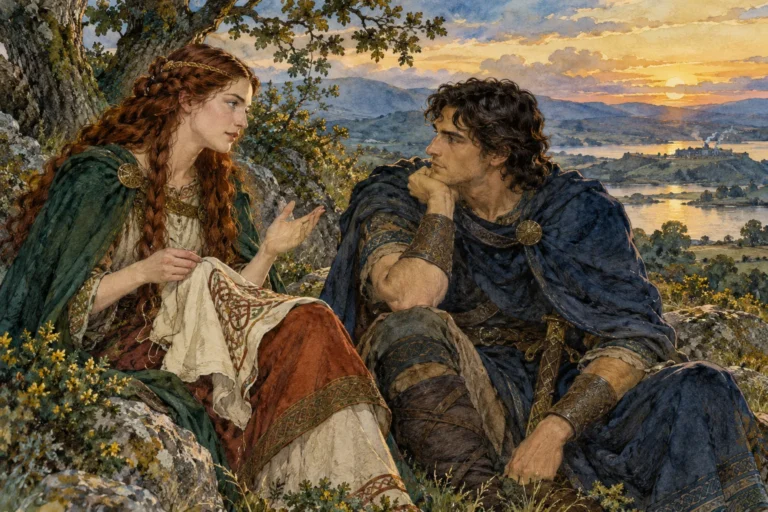
Before leaving Aífe, Cú Chulainn gave her a gold ring. She was carrying his child. When their son had grown large enough for the ring to fit, she was to send him to Ireland to find his father. Cú Chulainn added three instructions: nobody was to turn the boy from his road; he must not reveal his identity to any single man; and he must never refuse a challenge.
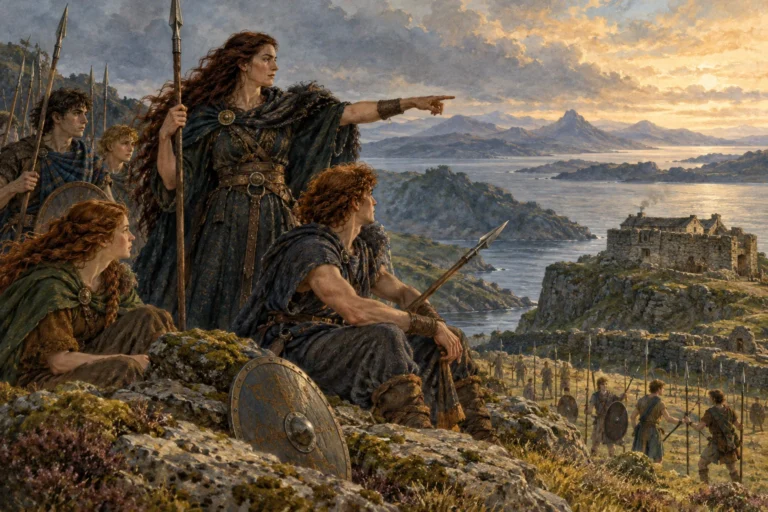
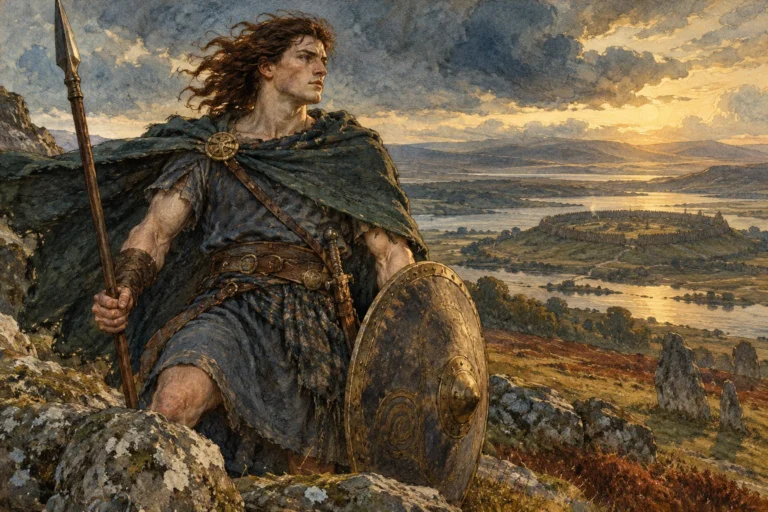
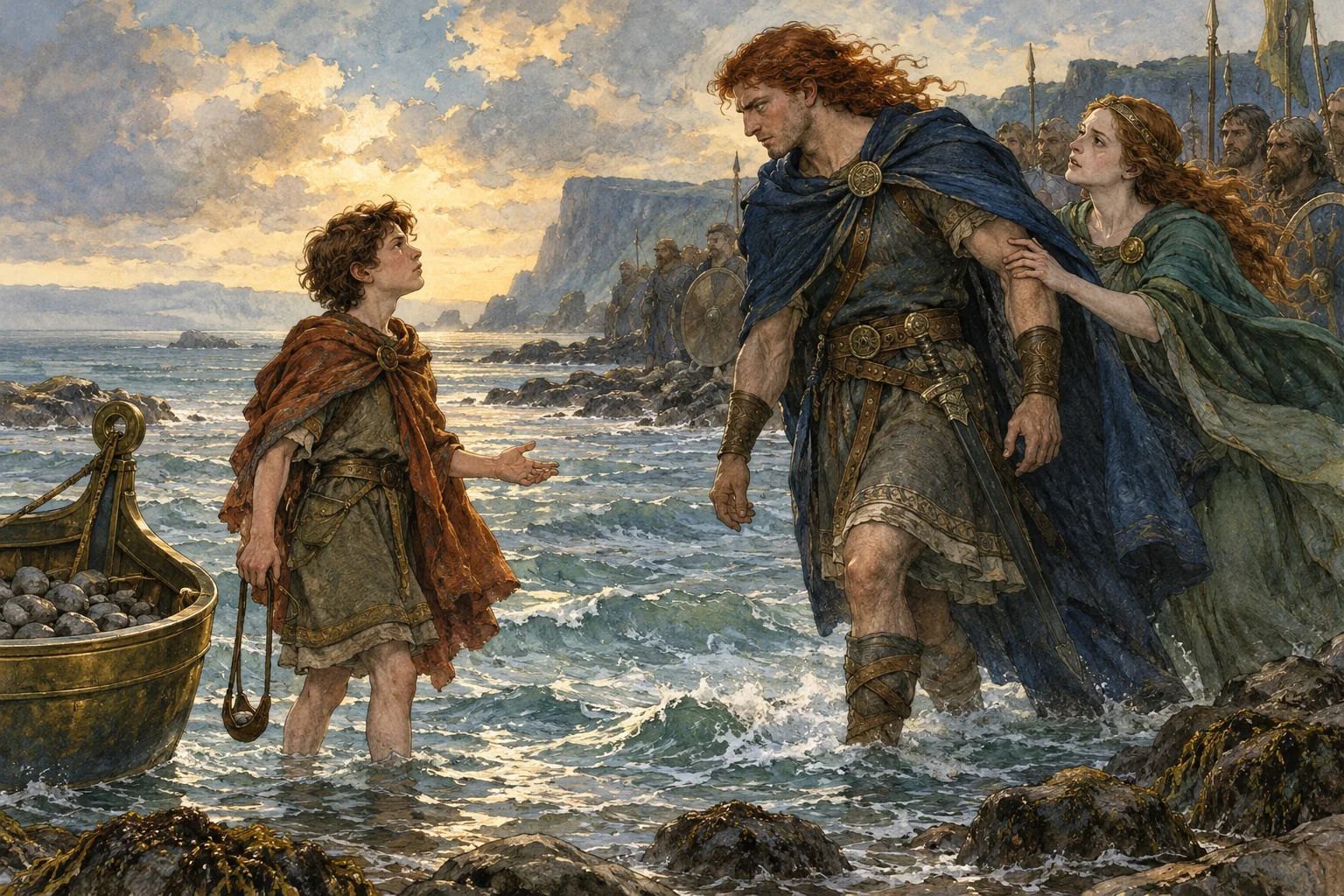
Seven years later, the boy came over the sea in a small bronze boat, carrying a heap of stones for his sling. The men of Ulster were gathered on the shore. They watched him bring birds down without killing them and then send them flying again. His skill was a wonder, but Conchobar saw it as a warning. If this was what a child from that country could do, what might its grown warriors accomplish?
The king sent Condere to meet him and prevent him landing. Condere offered the protection of Ulster if the stranger would identify himself. The boy refused. He could answer eloquently and defend his actions, but he would not give the one answer that might release him from danger. Condere returned to the gathering without overcoming that refusal.
Conall Cernach went next. He would not let Ulster’s honour be diminished while he lived. The boy sent a sling-stone into the air with such a tremendous sound that Conall fell backwards. Before the warrior could recover, the child bound his arms with a shield-strap. The watching company had been humiliated by someone too young to be counted among its fighting men. Meyer, sections 1–7.
Now Cú Chulainn prepared to go down to him. Emer put her arm around her husband’s neck and begged him to listen. The stranger was his son, she warned; fighting him would be the killing of his own child. She named Connla, Aífe’s only son, and tried to stop the meeting before it became another contest.
Cú Chulainn rejected her counsel. Even if the boy were his son, he said, Ulster’s honour required him to act. When he confronted the stranger, the child pointed towards a way out of the prohibition: why had two men not come together, so that he could identify himself to them? Cú Chulainn did not pursue the opening. He demanded a name and threatened death.
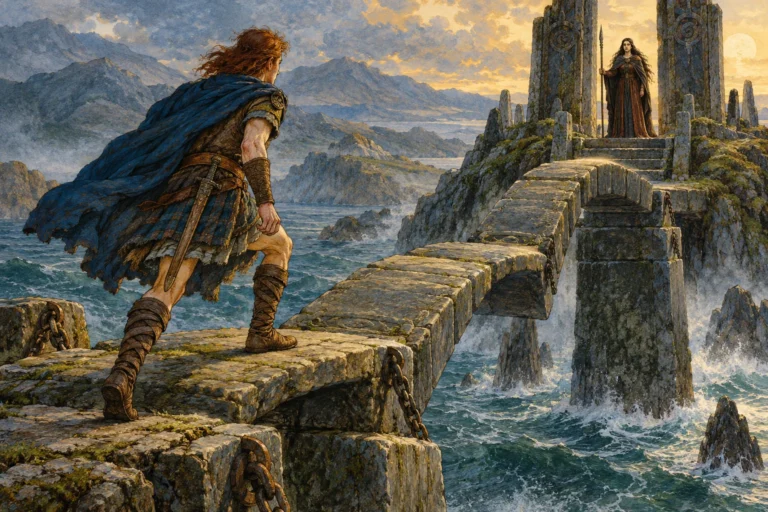
They exchanged blows. The boy cut Cú Chulainn’s hair with a measured sword-stroke. Wrestling followed, and then a struggle in the sea, where the child twice forced the older warrior under water. Finally Cú Chulainn used the gae bolga, the weapon whose use Scáthach had taught to him alone. It struck the boy through the water. Connla understood that this was the skill his own teaching had never included. Sections 8–12.
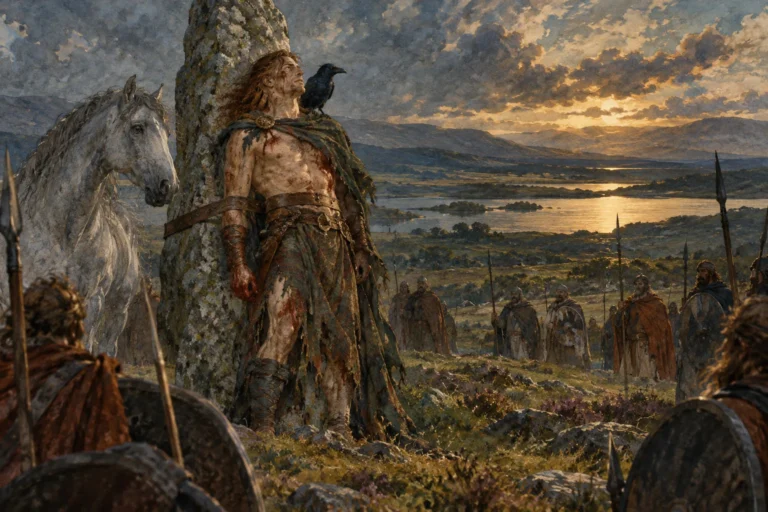
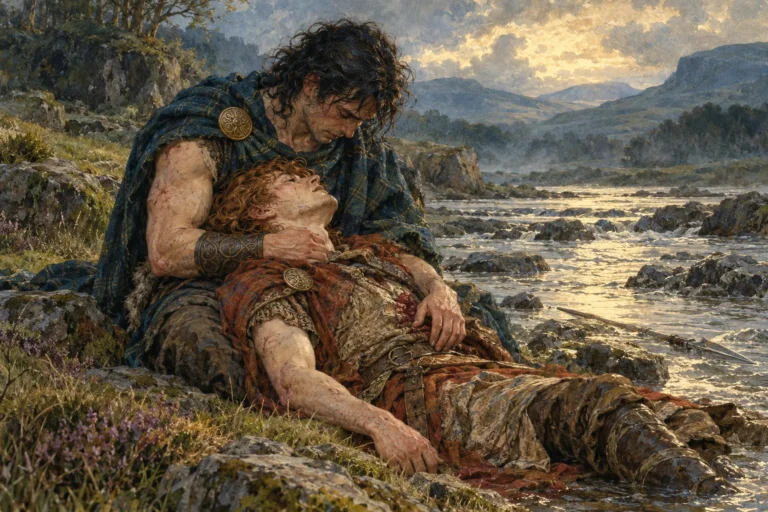
Cú Chulainn carried him before the Ulstermen and acknowledged him as his son. The dying child imagined what he might have achieved beside them if only he had been allowed to grow. He asked to be shown the famous warriors, embraced them in farewell, then took leave of his father and died. They made his grave. The honour they had defended had cost them the child who came seeking kinship. Sections 12–13.
Versions and variations
Who gives the commands? In Meyer’s early account, Cú Chulainn himself imposes the restrictions when leaving Aífe. The Wooing of Emer also assigns them to him. Gregory’s “Only Son of Aoife” makes Aoife impose them in anger after learning that Cú Chulainn has married Emer. Her account consequently makes revenge by the mother central to a tragedy that the early account traces back to the father’s instructions. Meyer, section 1; Wooing, p. 302; Gregory, pp. 313–314.
Knowledge before the fight. Emer explicitly warns Cú Chulainn in Meyer, and he says he would kill the boy even if the warning were true. The boy also remarks that he could have identified himself to two visitors. Gregory omits this exchange and Emer’s intervention. Her Conlaoch recognises his father from the hero-light during combat and deliberately sends his own spear aside; Cú Chulainn learns the identity after dealing the fatal wound, when the boy shows the ring. This is a major change in responsibility, not simply a more detailed recognition scene. Sections 8–10; Gregory, pp. 315–317.
Arrival and death. Meyer’s seven-year-old arrives in a bronze skiff at Trácht Éise and dies after farewells. Gregory’s young warrior lands with armed followers at Baile’s Strand near Dundealgan; Cú Chulainn ends his suffering with a sword. Gregory names Keating, Brooke, Curtin and Gaelic ballads as sources, and acknowledges Scottish Gaelic material. Her synthesis is not a translation of Meyer’s 1904 publication, which appeared after her book. Gregory’s notes, pp. 359–360.
Context and evidence
The early tale makes the tension between kinship and public honour painfully explicit. Reading it simply as an accidental failure of recognition removes Emer’s warning and the father’s answer. The wording of a prohibition also matters: the restriction on speaking to one man leaves an opening that the encounter never uses. These are interpretations of the examined narrative, not evidence that the combat happened. Gregory’s coastal setting belongs to the legendary landscape around Dundalk; this entry does not identify a proven historical battlefield. Continue through Emer, Scáthach and the Wooing of Emer, which supplies the earlier relationship with Aífe.
Sources for this entry
- Anonymous; translated by Kuno Meyer; Irish text edited by A. G. van Hamel, Aided Óenfir Aífe / The Death of Conla. Meyer, Ériu 1 (1904), pp. 114–121; van Hamel, Compert Con Culainn and Other Stories (1933), pp. 11–15; parallel online presentation by Irish Sagas Online. §1: commands; §§2–7: arrival and first challenges; §§8–9: Emer’s warning; §§10–11: combat; §§12–13: farewell and death. Read source — Principal early narrative; English translation as presented by the online edition, including its marked editorial clarifications.
- Lady Augusta Gregory, Cuchulain of Muirthemne. London: John Murray, 1902. XVIII, “The Only Son of Aoife”, pp. 313–319. Read source — Examined later literary synthesis with different blame, recognition and death scenes. About this book
- Anonymous; translated by Kuno Meyer, The Wooing of Emer. The Archaeological Review 1 (1888); CELT T301021. p. 302: Aífe’s pregnancy, ring, Connla’s name and the three instructions. Read source — Related medieval narrative corroborating that Cú Chulainn gives the commands.
- Lady Augusta Gregory, Cuchulain of Muirthemne: Notes. London: John Murray, 1902. Source-list preamble and “Only Son of Aoife”, pp. 359–360. Read source — Documents use of Scottish Gaelic versions and names Keating, Brooke, Curtin and Gaelic ballads. About this book
Research coverage
Compared the complete early tale in Meyer’s translation, the Connla passage in the long Wooing of Emer, and Gregory’s complete later synthesis. Gregory’s underlying Irish and Scottish ballads and each prose source have not all been separately collated. Trácht Éise and Gregory’s Baile’s Strand are preserved as source-specific settings; no historical duel or exact modern landing point is claimed.
The Myths · Irish collection · Editorial approach
Further Reading