Mythological Cycle · story
Nuada and the First Battle of Mag Tuired
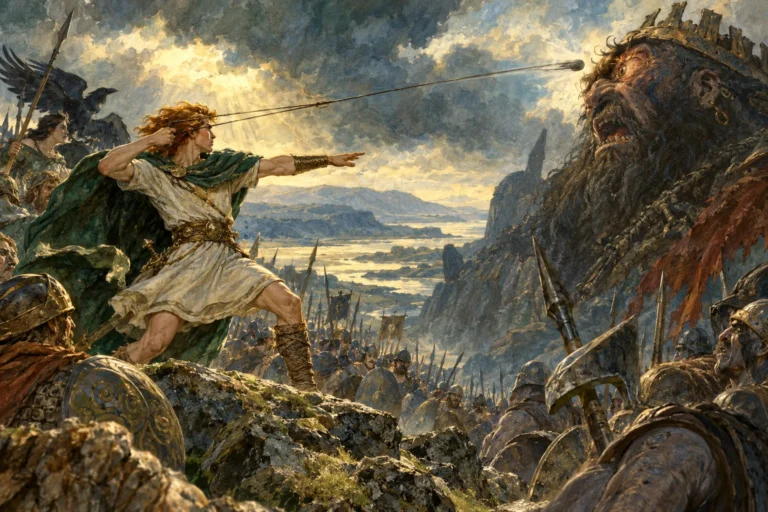
An offer to divide Ireland fails, and Nuada leads the Tuatha Dé against the Fir Bolg. Victory costs him his arm, while the surviving opponents force a settlement of their own.
Also found as: The First Battle of Moytura · Cath Maige Tuired Cunga · The Battle of Southern Mag Tuired · Nuada of the Silver Hand · Núadu Airgetlám
Research reviewed 17 October 2026.
Read the story
Version followed: the main story follows John Fraser’s translation of the First Battle (1916). A separately labelled coda below uses Stokes for the silver hand. These are different texts, not successive chapters of a single original.
When strangers reached Ireland, Eochaid son of Erc dreamed of black birds coming from the sea. They fought his people and overcame them, although one lost a wing. His interpreter recognised a warning of an invading host. The Tuatha Dé had arrived under Nuada, and the Fir Bolg had to decide how to meet them.
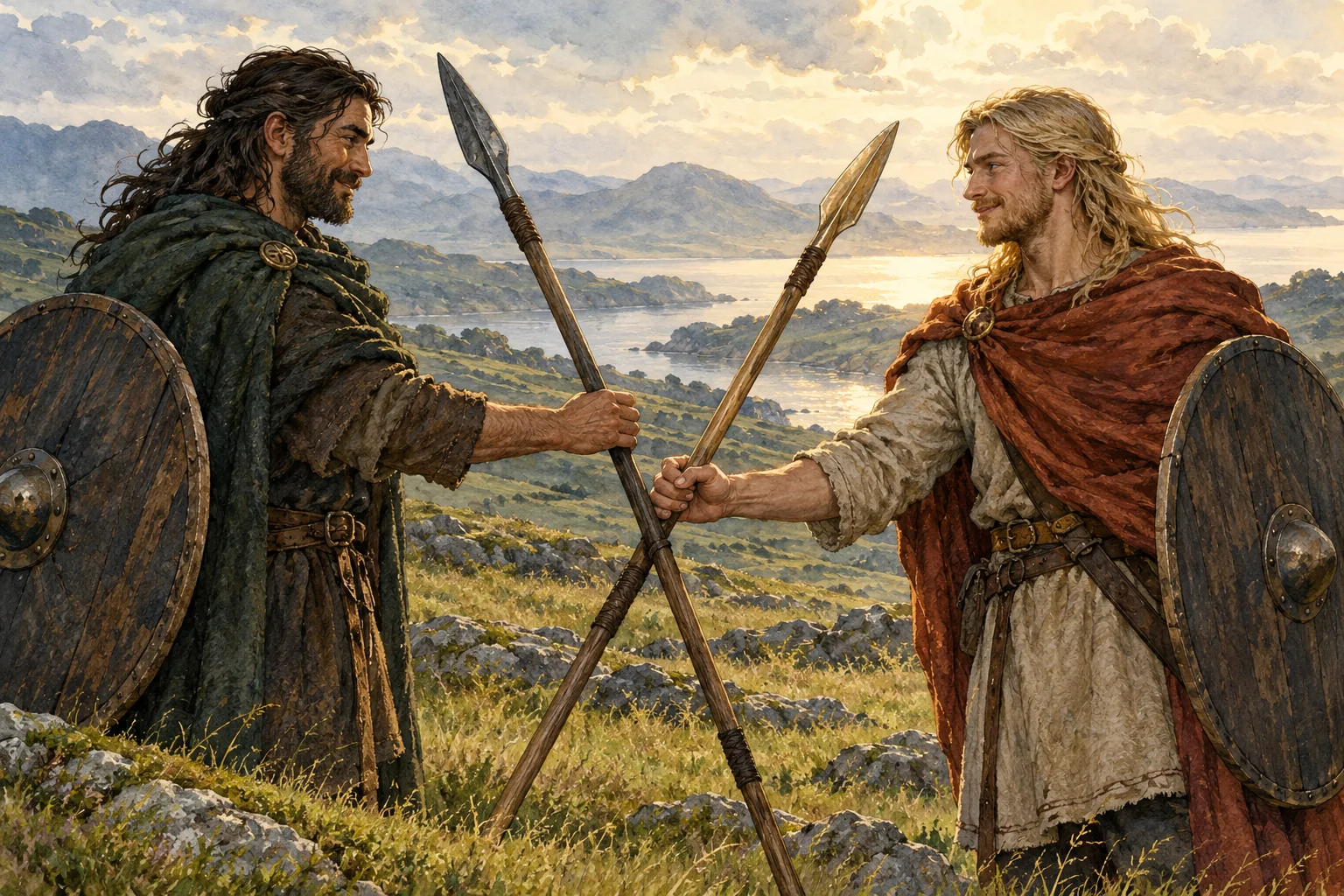
From Tara they sent Sreng, a formidable warrior, to discover the newcomers’ intentions. Bres came out to speak for the Tuatha Dé. At first both men watched from behind their shields, each troubled by the other’s unfamiliar weapons. When they spoke, their shared language brought them closer. They exchanged weapons and made a personal agreement of friendship.
Bres demanded half of Ireland for his people; otherwise there would be war. Sreng carried the offer home and advised accepting it. The Fir Bolg refused, fearing that conceding half would lead to the loss of everything. The Tuatha Dé moved west and chose ground from which to face them.
Nuada sent another embassy, but the demand was rejected again. The two armies agreed to delay while they prepared. A hurling contest between groups of young warriors became a deadly encounter. Physicians prepared healing places on both sides. When the fighting began, the Fir Bolg had the better of the first day, and both armies returned to their camps with losses to count.
The battle grew through repeated clashes. The Dagda fought at the front, while Nuada stood among his guards and champions. At last Sreng faced the king. They struck one another again and again, breaking through shields and armour. Sreng’s sword cut away part of Nuada’s shield and severed his right arm at the shoulder.
Nuada called for help. Aengaba of Norway came between him and Sreng, and the Dagda joined the defence. Soldiers and physicians carried their wounded king away. The fighting continued without him.
Eochaid, exhausted and overcome by thirst, left the field to seek water. The Tuatha Dé’s magic concealed the streams from him. He reached the strand of Eothail, where the sons of Nemed caught him. They fought until Eochaid and his three chief opponents lay dead. On the main field, Sreng continued the struggle until both sides were too worn down to press it.
The surviving Fir Bolg buried their relatives, friends and foster-brothers. Three hundred gathered to decide whether to leave Ireland, accept a division or fight again. They chose resistance, and Sreng challenged Nuada once more.
Nuada said an equal contest now required Sreng to bind his own right hand. Sreng refused: the earlier fight had been fair, and Nuada’s wound imposed no such condition upon him. The Tuatha Dé offered another settlement. Sreng could choose a province for his people. He chose Connacht, and the surviving Fir Bolg gathered around him there. The war ended in a division after all.
The silver hand: a separate textual coda
Fraser’s closing paragraph passes briefly through Bres’s kingship to Nuada’s return after his hand is replaced. The fuller healing episode used here comes from Stokes’s Second Battle, §§33–35: Dian Cécht fits Nuada with a moving silver hand, then Miach restores living flesh. Dian Cécht’s jealousy leads him to kill his son. That later saga supplies the familiar silver-hand episode; it should not be presented as though Fraser narrated it in the same detail.
Versions and variations
Gregory compresses the battle
Gregory gives the conflict four days, briefly reports Eochaid’s death, and moves directly to an offer of Connacht for Sreng’s survivors. Fraser’s longer account includes the wounded Nuada’s renewed challenge and the argument that Sreng should bind his own hand. It also lets the Fir Bolg debate their remaining choices after burying the dead. Those scenes give more space to the defeated people’s decision. Gregory, Book One, chapter I; Fraser, final council and single-combat passages.
Bres does not have one continuous fate
The closing paragraph of Fraser’s First Battle says that the king Bres rules for seven years and dies after a drink while hunting. In Stokes’s Second Battle, the displaced Bres lives on, helps bring the Fomorians against the Tuatha Dé, and is spared after their defeat in return for agricultural knowledge. These sequences cannot simply be joined without acknowledging the disagreement. Fraser, final paragraph; Stokes, Bres’s departure and §§149–161.
Winning a country and recovering a kingship
Gregory separates the first battle from Nuada’s loss of kingship and the healers’ story across successive chapters. Her presentation encourages a continuous reading, but her book predates Fraser’s publication and should not be described as an adaptation of that edition. The shared incidents show related traditions; they do not prove a direct line from Fraser to Gregory.
This entry therefore stops its main story at the settlement and labels the healing coda’s different source. The later battle led by Lugh has its own page and its own comparison.
Context and evidence
The First Battle’s place-name Cunga distinguishes its setting near Cong from the northern Mag Tuired associated with the Second Battle. Gregory’s own place list makes that distinction. Neither a familiar place-name nor a surviving prehistoric monument proves that the narrative’s supernatural war occurred. Gregory, Notes V, The Place Names: Magh Tuireadh.
The wounded ruler’s eligibility is a condition of these stories. It should not be turned without further evidence into a universal rule for every Irish king, period or community. Likewise the narrator’s genealogies and invasion sequence belong to the literary account, not to an established migration history.
Sources for this entry
- Anonymous; edited and translated by John Fraser, The First Battle of Moytura / Cath Maige Tuired Cunga. Ériu 8 (1916), pp. 1–63; online transcription at Celtic Texts. From the arrival of the Tuatha Dé through Sreng’s settlement; final paragraph on Bres and Nuada. Read source — Named basis of the First Battle retelling; webpage paragraph numbering is unreliable, so passage locators are supplied..
- Lady Gregory, Gods and Fighting Men. 1905 edition; first published 1904. Part One, Book One, chapters I–III; Notes III, Authorities; Notes IV, Magh Tuireadh. Read source — Literary adaptation; compare each chapter and its source notes rather than treating the collection as an independent oral recording.. About this book
- Anonymous; edited and translated by Whitley Stokes, The Second Battle of Moytura / Cath Maige Tuired. Revue Celtique 12 (1891), pp. 52–130, 306–308; CELT T300011. §§14, 33–35; Bres’s departure; §§149–161. Read source — Separate saga used for the silver-hand coda, Dagda episodes and comparison of narrative sequences..
Research coverage
Fraser’s online First Battle transcription, Gregory’s corresponding sequence and Stokes’s relevant Second Battle passages have been compared. The 1916 printed Irish text and apparatus have not been collated against the web transcription. Lebor Gabála recensions, later editions and local battle-site traditions require separate review.
The Myths · Irish collection · Editorial approach
Further Reading