Norfolk town traditions · place
Swaffham and the Pedlar
The Norfolk town where a treasure tale becomes a story about a church, a benefactor and the ways a community remembers him.
Also found as: Swaffham · The pedlar’s church
Research reviewed 18 October 2026.
Home at both ends of the journey
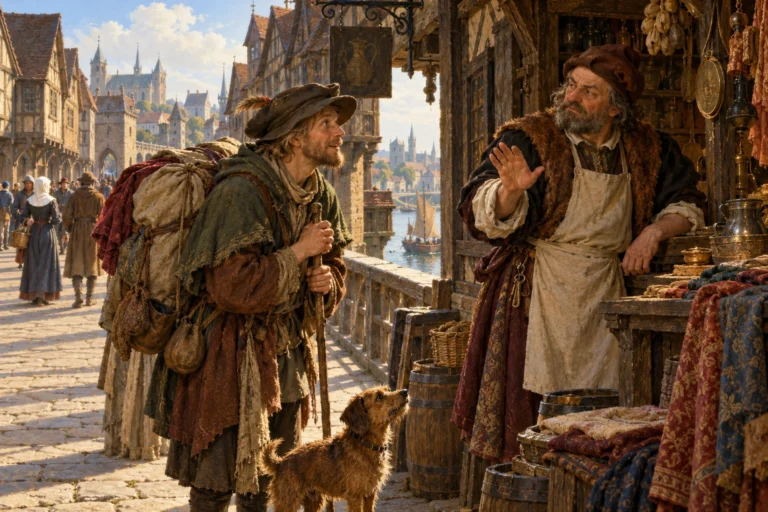
The Pedlar of Swaffham begins and ends in the same town. London Bridge supplies the crucial conversation, but the treasure lies at the traveller’s own home. The journey changes what he knows about a familiar place.
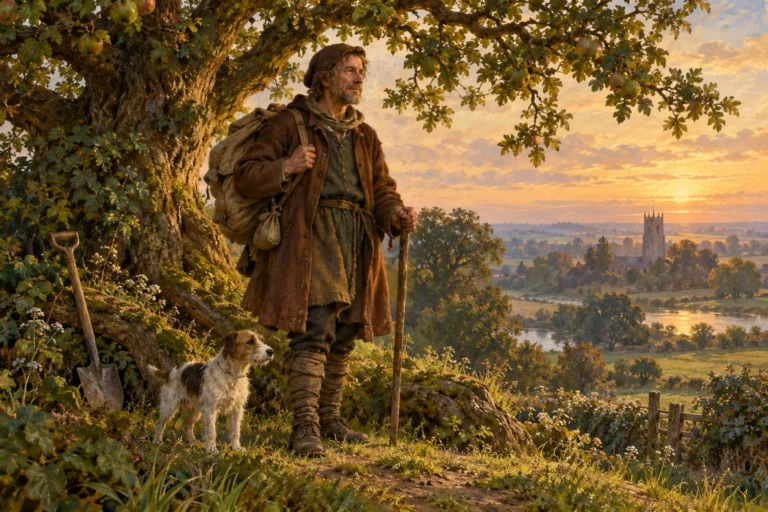
In the shorter Jacobs version, a great oak stands in the orchard behind the pedlar’s house. In the fuller county-history account, the named John Chapman finds two pots, the second revealed by an inscription on the first. Neither examined text establishes a securely identified surviving orchard.
The church provides a public ending to this private discovery. The longer legend makes Chapman fund a north aisle and steeple. The simpler retelling says he rebuilt the church. Those claims should be compared with the building’s history rather than treated as equivalent architectural descriptions.
The church and the town’s memorials
Swaffham Parish Church dates its present building from 1454 and connects John Chapman with its rebuilding as a churchwarden. Its account identifies carvings of the pedlar and dog. These support a history of remembrance, not the recovery of dream-directed treasure.
The older county history records and debates the representations, suggesting that a trader’s image could act as a pun on the surname Chapman. Its discussion is valuable because it shows that the popular explanation was already being questioned, rather than accepted by every antiquarian.
Historic England’s photographic archive records Harry Carter’s town sign depicting the pedlar. The sign gives the legend a place in public space beyond the church. It is evidence of commemoration, not an independent witness to Chapman’s journey.
Following the place without inventing a site
The firmest way into the local cluster is through the church, the printed history and the town’s representations of its benefactor. A supposed exact treasure spot would need further documentary support before being presented as a located historical site.
The long and short tellings also offer different explanations of generosity. One moves quickly from poverty to a rebuilt church. The other lingers over secrecy, a second discovery and a decision to pay for specific work. Reading them together shows how a local legend can expand around a known building.
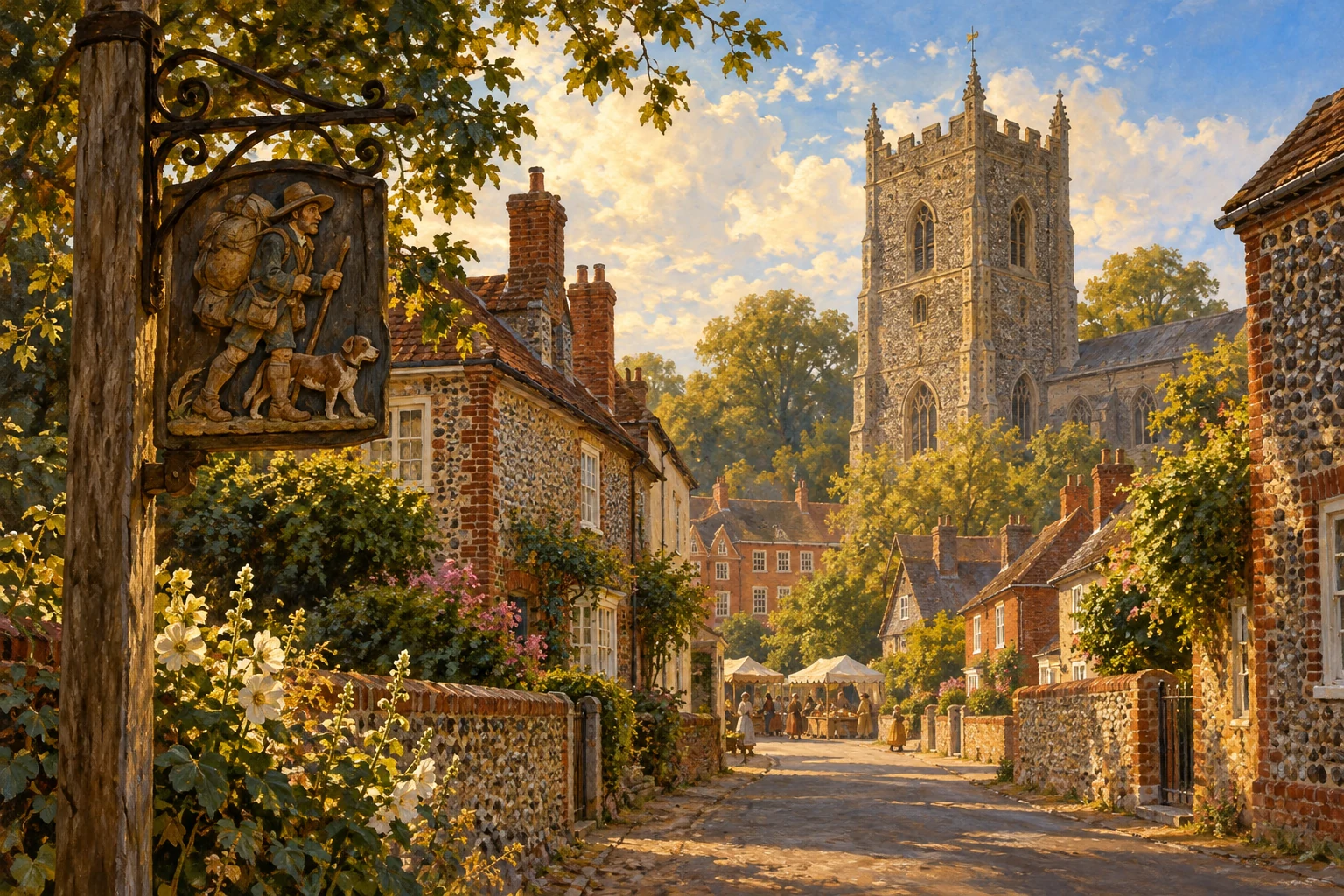
The illustration evokes a Norfolk town and a pedlar sign. It is not a measured view of the church or a reproduction of Carter’s carving. The source links lead to the actual heritage account and archive description.
Sources for this entry
- Joseph Jacobs, More English Fairy Tales. 1894. LXIII, “The Pedlar of Swaffham”, and its source note. Read source — Retelling credited to Alfred Nutt from de la Pryme’s diary; compared with the longer Norfolk account. About this book
- Francis Blomefield, continued by Charles Parkin, An Essay Towards a Topographical History of the County of Norfolk, volume VI. London: William Miller, 1807. Swaffham, especially pp. 211–213: Chapman, Dugdale’s letter and the church carvings. Read source — Printed account of two treasure pots, historical benefaction and competing interpretations of the carvings. Original archival documents were not inspected. About this book
- Swaffham Parish Church, Our Heritage. Parish account; consulted 18 October 2026. Church rebuilding and John Chapman. Read source — The parish’s account of its building and carvings; not evidence for dream-directed treasure.
- Historic England Archive, Swaffham town sign. Photograph AA47/04441; catalogue consulted 18 October 2026. Description of Harry Carter’s pedlar sign. Read source — Evidence for public commemoration of the legend, not its historical events.
Research coverage
The two printed narrative forms, parish heritage account and Historic England photograph catalogue were examined. No exact orchard, recovered hoard or contemporary account of the dream has been established.
The Myths · English collection · Editorial approach
Further Reading