Norfolk local legend · figure
John Chapman: the Pedlar of Swaffham
A church benefactor remembered through a travelling pedlar’s dream. The historical Chapman, the treasure finder and the carved memorials require different kinds of evidence.
Also found as: John Chapman · The Swaffham pedlar
Research reviewed 18 October 2026.
The man in the legend
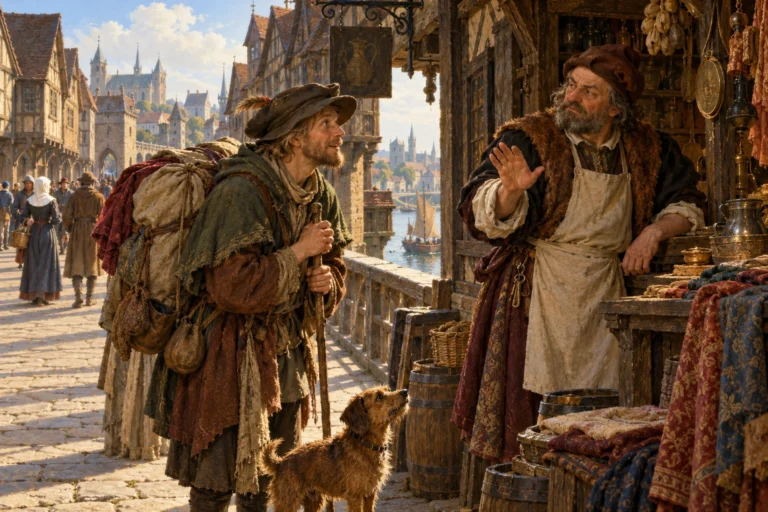
The longer Swaffham treasure story names its hero John Chapman. He travels to London because of a dream, hears a shopkeeper describe treasure at his own home, and returns to find it. A second discovery follows when a visitor translates an inscription on the first pot.
Chapman keeps his money secret until the town plans work on its church. He then offers to fund the north aisle and a steeple. In the story, private good fortune becomes a public gift, explaining why an apparently humble pedlar deserves a place in the building’s memory.
The shorter 1894 version in More English Fairy Tales leaves the pedlar unnamed and has only one discovery. A figure guide should therefore keep the named county-history account separate from details added or simplified in later retellings.
Records, representations and disagreements
The benefactor
The county history identifies Chapman as a churchwarden in 1462 and treats his contribution to the north aisle as secure, referring to the parish’s Black Book. That is a printed historical assertion based on a named record. The original book has not been inspected here, so the entry does not pretend to have independently transcribed a fifteenth-century payment.
The dream’s documentary trail
The same volume prints the tradition in a letter from William Dugdale to Roger Twysden, dated 29 January 1652–3. This helps establish an early written circulation of the story. It does not make Dugdale an eyewitness to a fifteenth-century dream or discovery. Jacobs’s later text follows a different cited route through de la Pryme and Alfred Nutt.
Pedlar, merchant or a visual pun?
The county historian questions whether the carvings must depict a poor itinerant trader. Their dress and the surname Chapman encourage an alternative reading: a merchant or a pictorial pun on a name. The accompanying animal is also disputed in the antiquarian discussion. These are competing interpretations, not proof that the popular reading is impossible.
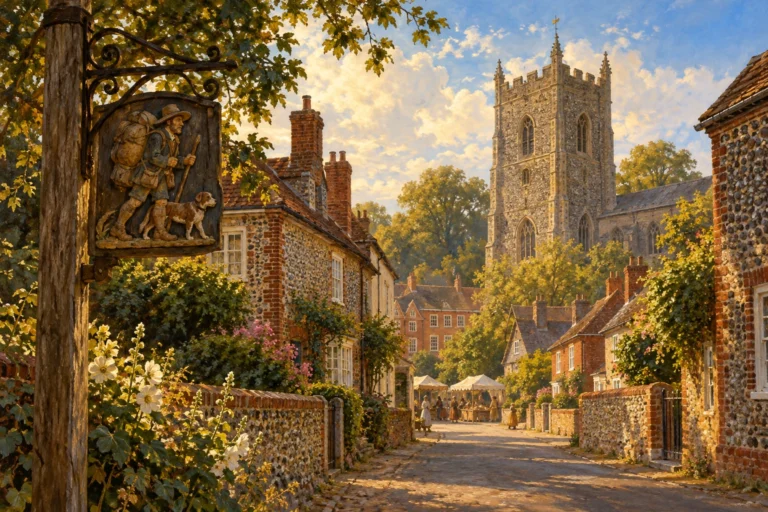
The parish’s current heritage account identifies carved representations of Chapman with a muzzled dog and describes him as a churchwarden during rebuilding. It tentatively associates a facing woman with his wife. The uncertainty in that identification should remain visible; a carving is not automatically a labelled family portrait.
What is supported?
There is a substantial local tradition connecting Chapman with the church and its benefaction. There is also a printed treasure legend with more than one ending. The evidence examined here does not verify a hoard, an oak in a particular orchard or a journey made under the direction of a dream.
A town can remember a donor through a story which makes his generosity easier to picture. The pack, dog and long walk give the benefactor a human scale. That observation explains an effect of the legend, rather than proving when or why it was invented.
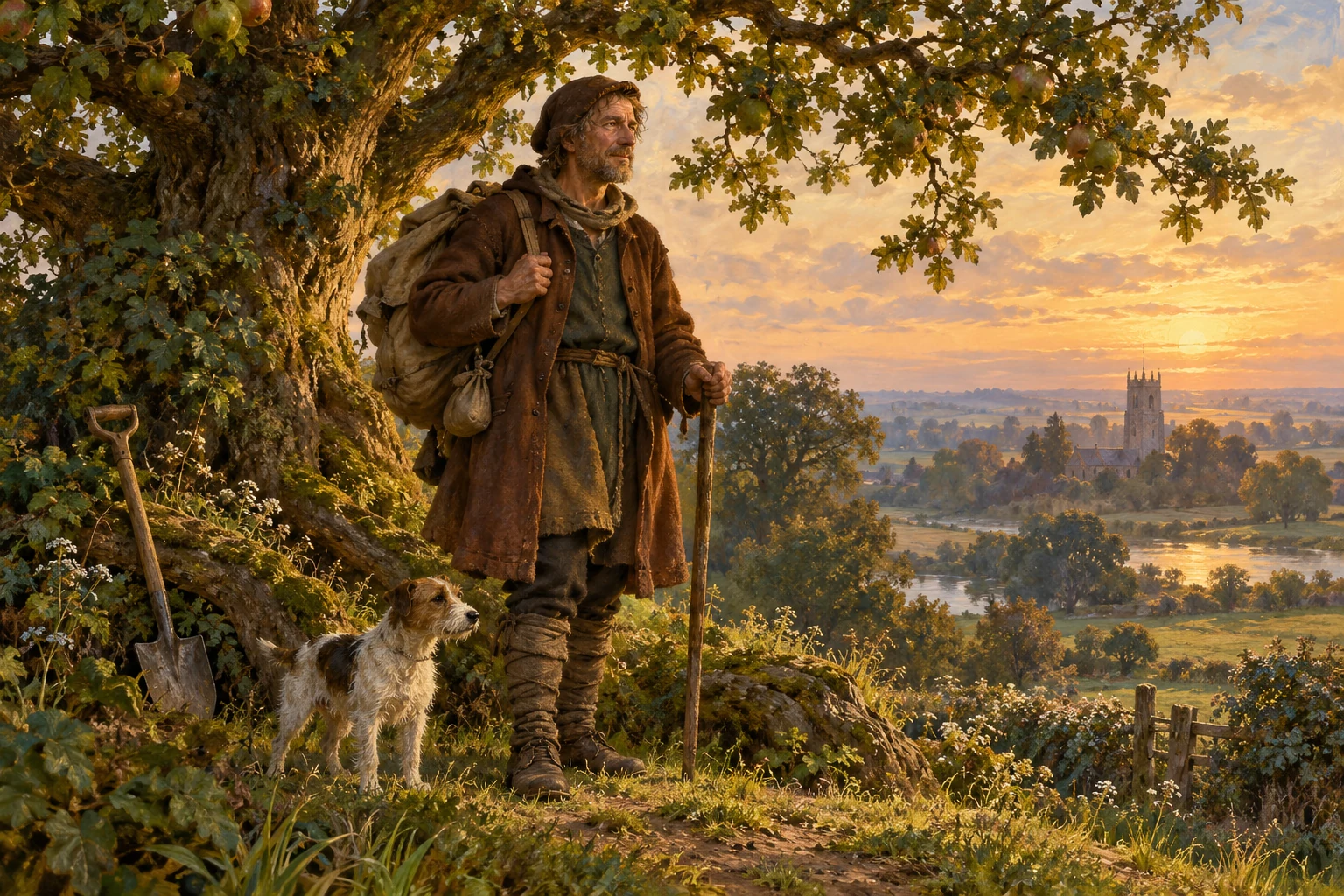
The illustration is an imagined portrait of the legendary traveller. It does not reconstruct Chapman’s face or claim to reproduce a surviving contemporary likeness.
Sources for this entry
- Francis Blomefield, continued by Charles Parkin, An Essay Towards a Topographical History of the County of Norfolk, volume VI. London: William Miller, 1807. Swaffham, especially pp. 211–213: Chapman, Dugdale’s letter and the church carvings. Read source — Printed account of two treasure pots, historical benefaction and competing interpretations of the carvings. Original archival documents were not inspected. About this book
- Joseph Jacobs, More English Fairy Tales. 1894. LXIII, “The Pedlar of Swaffham”, and its source note. Read source — Retelling credited to Alfred Nutt from de la Pryme’s diary; compared with the longer Norfolk account. About this book
- Swaffham Parish Church, Our Heritage. Parish account; consulted 18 October 2026. Church rebuilding and John Chapman. Read source — The parish’s account of its building and carvings; not evidence for dream-directed treasure.
Research coverage
The Swaffham passage of the county history, Jacobs’s story and note, and the parish heritage account were read. Original parish records, the Dugdale letter and any surviving account of a treasure excavation remain outside the evidence examined.
The Myths · English collection · Editorial approach
Further Reading