Islay fairy traditions · place
Kilchoman and the Rhinns of Islay
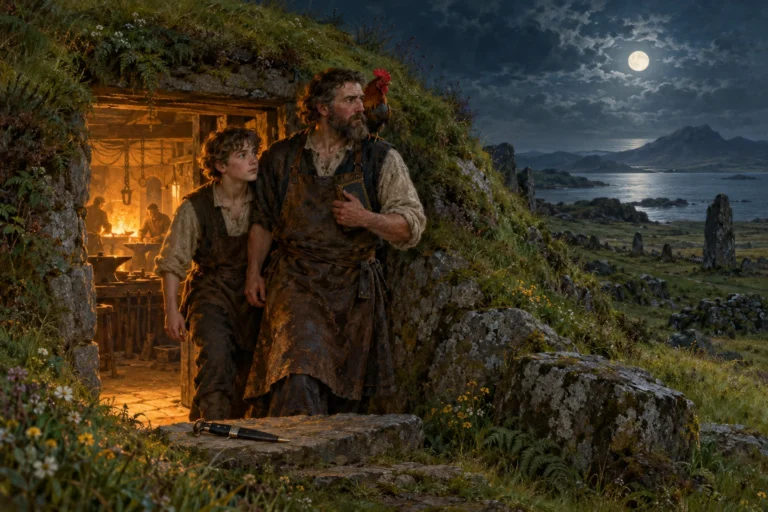
Campbell’s fairy-smith narrative points towards Kilchoman. The church and carved stones have their own documented history, separate from the rescue inside the hill.
Also found as: Cill Chomain · Caonis gall
Research reviewed 18 October 2026.
The smith’s remembered landscape
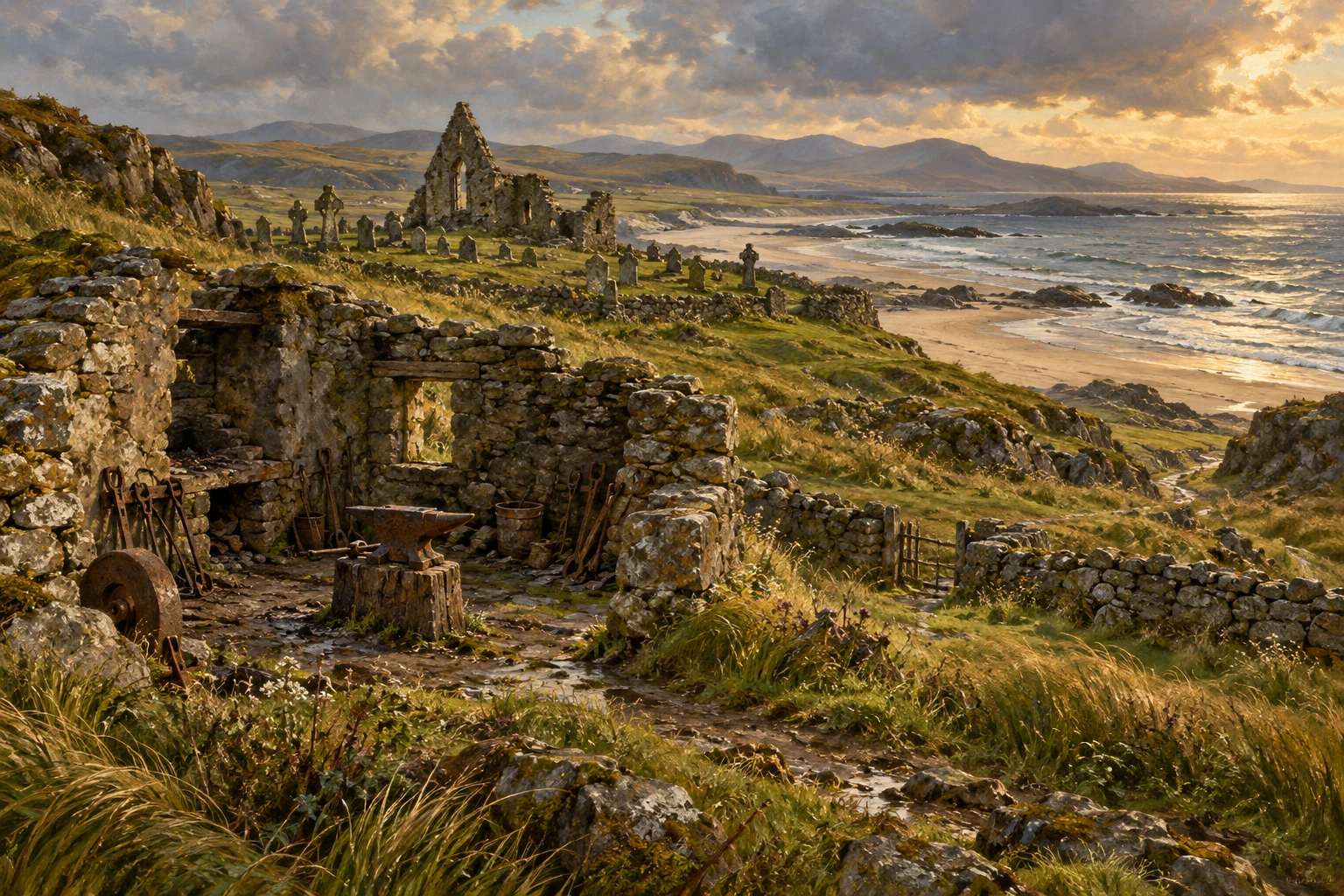
At the end of The Smith and the Fairies, Campbell says the walls of the celebrated craftsman’s house and workplace were still standing near Kilchoman parish church, at a place he spells Caonis gall. His account associates the smith with a particularly fine Islay sword.
Earlier in the story the smith is called MacEachern and lives at Crossbrig. The fairy hill is named Brorra-cheill. These names belong to the printed witness, but the passage does not give a modern survey that securely joins all three locations. This guide therefore retains the names without assigning an invented pin to the fairy entrance.
Campbell considers a real smith a possible starting point for the legend. That suggestion is worth distinguishing from the story’s supernatural events. A remembered craftsman, a surviving wall and a fairy rescue are three different claims requiring different evidence.
Other Islay fairy hills
In his comparative notes, Campbell recalls a dancing-woman rescue associated with Bencnock on Islay and a similar incident at Cnock-donn. The central device is a weapon left across the entrance while the captive is brought out. Those place references do not establish that the MacEachern story happened at either hill.
The notes also range beyond Islay, including Mrs MacTavish’s material from Lorn and Craignish. A collection can gather related traditions over a wide area. It would be misleading to present every incident on these pages as a local Kilchoman tale.
The church and the evidence
Historic Environment Scotland records the Cill Chomain Cross and medieval carved stones in Kilchoman burial ground. Its description says the present parish church was erected in 1827 on the site of an earlier building, and that the medieval parish served the Rhinns of Islay.
That record establishes the historical importance of the church landscape. It does not identify MacEachern’s workshop, date the smith or corroborate the fairy encounter. The illustration’s workshop is therefore a literary allusion, not an archaeological reconstruction.
A stronger historical identification would need documentary and material work beyond this entry: securely located ruins, evidence for their use, and records connecting a named craftsman with them. Campbell’s report is the place to start that enquiry, not its conclusion.
Sources for this entry
- J. F. Campbell, Popular Tales of the West Highlands, volume II. Consulted 1890 edition transcription. XXVIII, “The Smith and the Fairies”, pp. 57–65, including comparative notes. Read source — The MacEachern narrative sent by the Rev. Thomas Pattieson; Mrs MacTavish’s rescue and spinning accounts and John MacLean’s Kintyre variant. About this book
- Historic Environment Scotland, Kilchoman Church, Cill Chomain Cross & tombstones. Scheduled monument record SM2337; consulted 18 October 2026. Description of church site, medieval stones and parish. Read source — Evidence for the church and carved stones; not evidence that a fairy rescue occurred.
Research coverage
Campbell’s narrative and notes were examined alongside the monument record for Kilchoman. No archaeological site has been equated with the fairy forge, and no current survival claim is made for the walls described in the nineteenth-century book.
The Myths · Scottish collection · Editorial approach
Further Reading