figure · Britain · shared tradition
Guinevere
Arthur’s queen appears as a valued member of a Welsh court, a demanding lover in French romance and a woman making consequential choices in Malory’s ending.
Also found as: Gwenhwyfar · Guenever · Guanhumara. Research reviewed 18 October 2026.
Look beyond one love triangle
In Culhwch and Olwen, Gwenhwyfar is among the people and possessions Arthur excludes from his promise to give the suitor whatever he asks. That passage does not tell a Lancelot love story. It also reflects a narrative world in which a husband states the terms of the gift. The queen’s presence should not be used to import the plot of a later work.
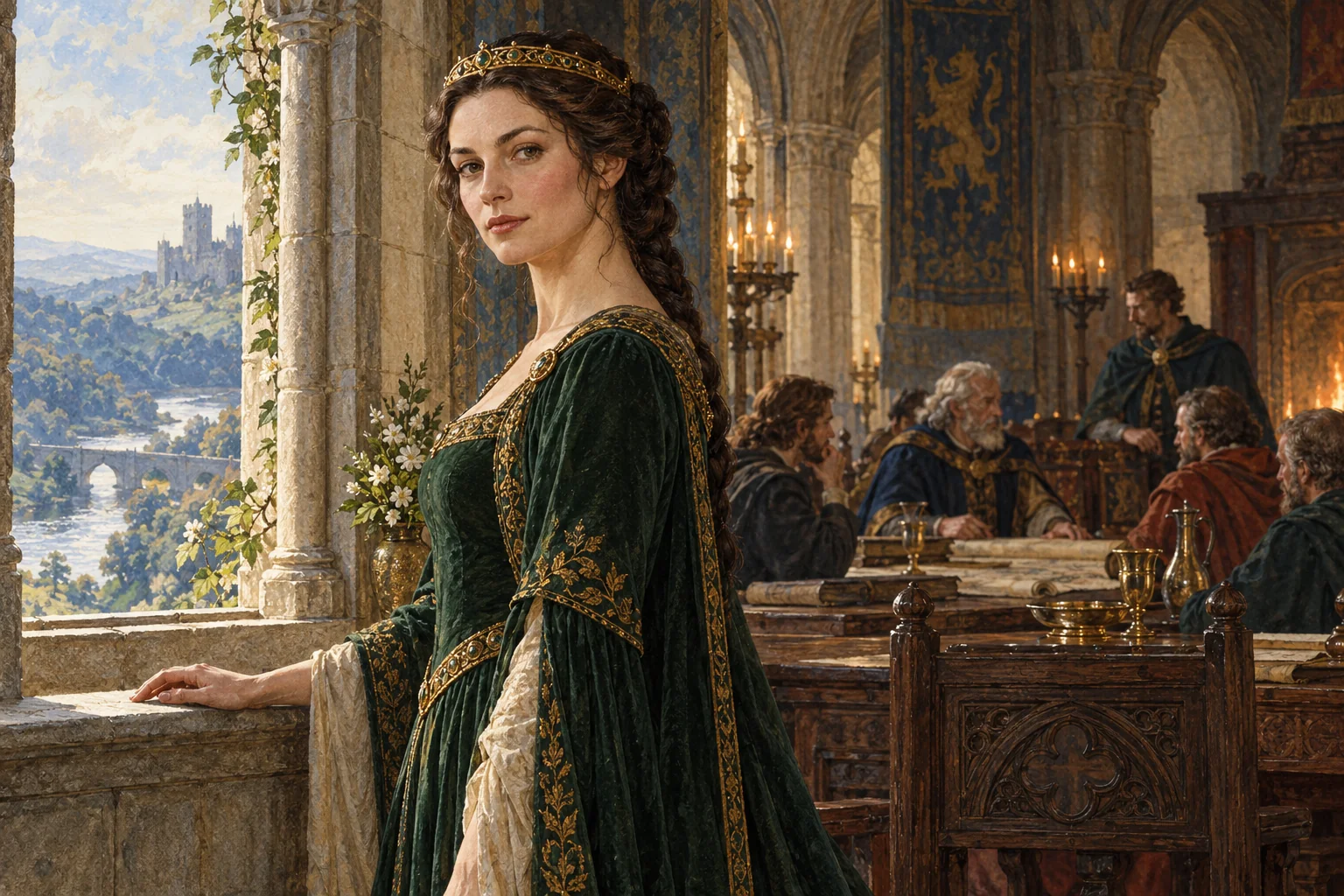
Malory makes Guinevere the daughter of Leodegrance. Arthur chooses to marry her despite Merlin’s warning about her future love for Lancelot. Her father sends the Round Table and its company as part of the marriage arrangements. The queen’s arrival is therefore bound to the formation of Arthur’s fellowship, as well as to the conflict that eventually damages it.
In Chrétien’s Lancelot, or The Knight of the Cart, Guinevere judges the lover who has endured humiliation and danger for her. She initially refuses him a warm welcome because he hesitated briefly before stepping into the shameful cart. When she explains, the apparently inexplicable rejection becomes a demanding test of devotion. This is a particular romance’s model of love, not an objective measure of how a real queen behaved.
Versions and variations
Refusing Mordred and choosing a different ending
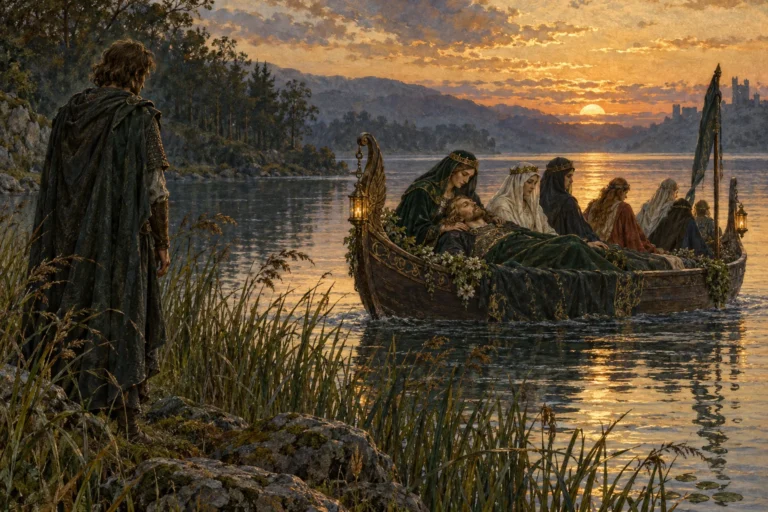
Malory’s final book reports Guinevere’s refusal to marry Mordred and her defence in the Tower of London. After Arthur’s fall she becomes a nun at Almesbury, the text’s form of Amesbury. When Lancelot finds her, she refuses to resume their relationship and sends him away. She even refuses his request for a final kiss. Her penitence is expressed through decisions, not merely through disappearance from the story.
A different religious retreat in Geoffrey
Geoffrey’s Guanhumara withdraws to the religious community of Julius the Martyr at the City of Legions, associated with Caerleon. This is not Malory’s Amesbury. Retellings should identify which setting they follow.
The claimed grave
The Glastonbury monks’ 1191 claim included Guinevere as well as Arthur. The place guide explains the medieval claim without treating it as secure identification of either person.
Context and evidence
Guinevere is often described only through the men around her. Reading the named passages separately reveals a more complicated set of roles, while also exposing the limits imposed on her by their authors. Her own attribution of the catastrophe to her love in Malory is a character’s penitential judgement; the story also contains war, divided loyalties and Mordred’s decisions.
This profile does not yet cover every abduction narrative, the False Guinevere episode, the full French prose cycles or Welsh triadic material. Those require separate source comparisons.
Sources for this entry
- Anonymous Welsh storytellers; translated by Charlotte Guest, The Mabinogion. Nineteenth-century translation, collected edition; Project Gutenberg 5160. “Kilhwch and Olwen”, Arthur’s reserved gifts. Gwenhwyfar in the Welsh tale. Read source · About this book
- Thomas Malory, Le Morte Darthur, volume I. Caxton book-and-chapter arrangement, first printed 1485; Project Gutenberg 1251. Book III, chapters 1–2. Marriage and the Round Table. Read source · About this book
- Chrétien de Troyes; translated by William Wistar Comfort, Four Arthurian Romances. 1914 translation; includes Lancelot, or The Knight of the Cart, a late-twelfth-century romance completed by Godefroi de Leigni. Lancelot: cart episode and the queen’s explanation of her cold reception. Love and the two-step hesitation. Read source · About this book
- Thomas Malory, Le Morte Darthur, volume II. Caxton book-and-chapter arrangement, first printed 1485; Project Gutenberg 1252. Book XXI, chapters 7–10. Religious life, refusal of Mordred and final meeting. Read source · About this book
- Geoffrey of Monmouth, History of the Kings of Britain, Book XI. Composed c.1136–38; Giles collection (1848). Book XI, chapter 1. Religious retreat at the City of Legions. Read source · About this book
Research coverage
The named passages have been examined and compared. This is a first source-led guide, not a collation of every manuscript, translation, local telling or adaptation.
The Myths · Arthurian collection · Editorial approach
Further Reading