place · Wales
Caerleon
A Roman town beside the Usk and the setting of Geoffrey’s magnificent Arthurian festival: two histories that should be read together without being merged.
Also found as: City of Legions · Isca · Caerleon Roman Amphitheatre · Usk. Research reviewed 18 October 2026.
A court in Geoffrey
Geoffrey’s Book IX brings Arthur to the City of Legions on the Usk for a great Pentecost celebration. The narrative fills the city with rulers, churchmen and distinguished guests. Crowning ceremonies, worship, feasting and games display the order and splendour of Arthur’s realm. Book IX.12–15.
This is not Arthur’s initial accession in the same work: Geoffrey places that at Silchester in IX.1. Nor should every crowning ceremony be mistaken for the one moment when a king first becomes king. The distinction matters when matching a story to a place.
The city reappears near Geoffrey’s ending. Guanhumara withdraws to the community associated with Julius the Martyr. Malory’s queen later retreats to a different place, Amesbury. Compare Guinevere’s versions.
Associations and distinctions
The Roman amphitheatre
Cadw dates Caerleon’s amphitheatre to about AD 90, as part of the Roman military settlement of Isca. It accommodated thousands of spectators. Its physical form and Roman function are established on a different basis from Arthur’s literary festival. Monument description.
Was the arena the Round Table?
A circular or oval gathering place can invite an Arthurian association, but shape is not identification. Geoffrey’s festival passage does not describe a Round Table in the amphitheatre. Wace’s later Roman de Brut supplies a Round Table passage explaining how the knights avoided disputes over rank. The texts should not be credited with details they do not contain.
Context and evidence
Caerleon is a strong example of why this library gives places their own pages. A reader can explore the surviving Roman monument and the medieval writer’s imagined court without treating one as proof of the other.
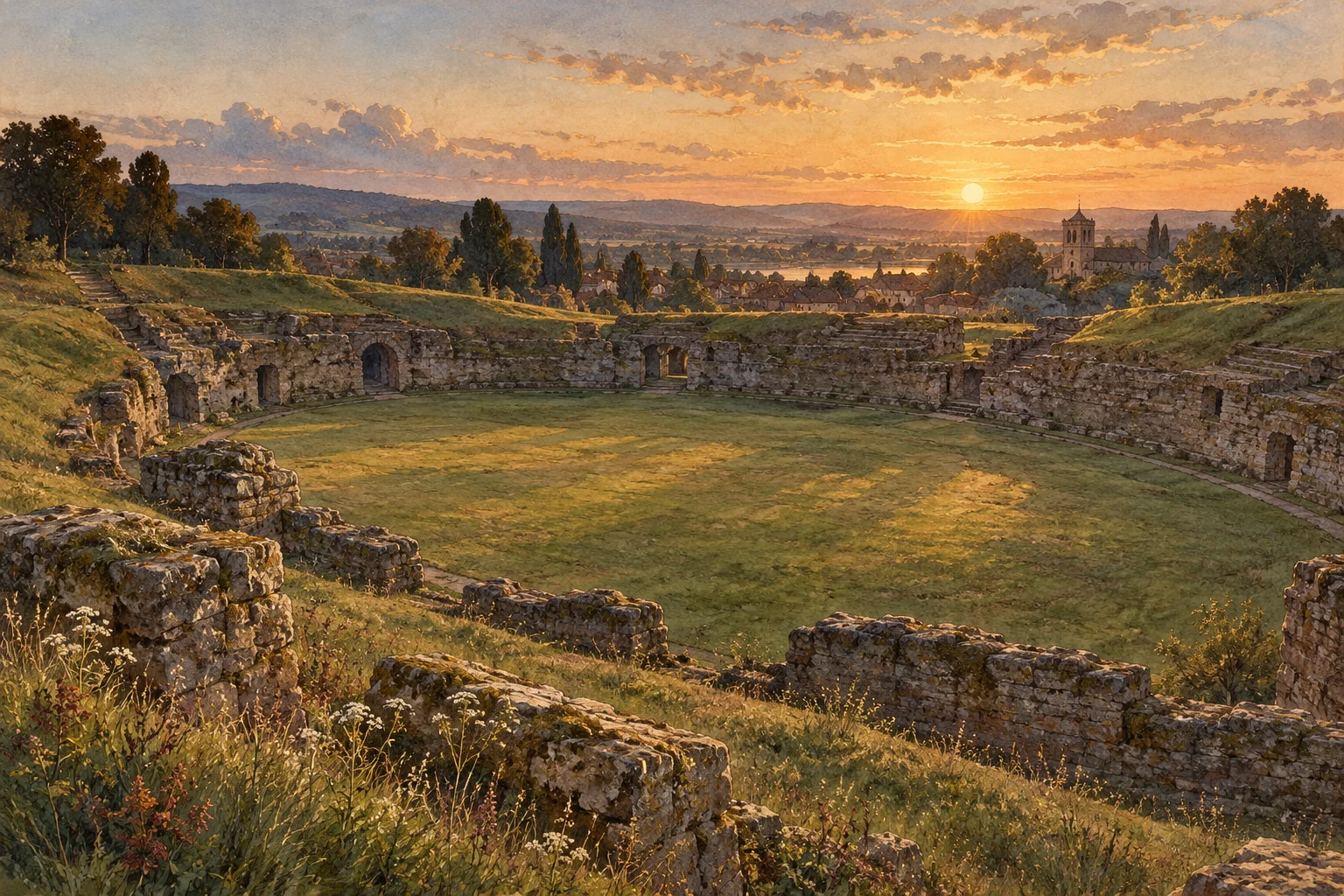
This entry follows Geoffrey’s named city, the relevant Wace passage and Cadw’s monument account. It does not attempt a catalogue of all later Caerleon, Camelot or Round Table traditions. The illustration presents the landscape and remains as an artistic interpretation.
Sources for this entry
- Geoffrey of Monmouth, History of the Kings of Britain, Book IX. Composed c.1136–38; Giles collection (1848). Book IX, chapters 1 and 12–15. Initial accession contrasted with the later festival. Read source · About this book
- Geoffrey of Monmouth, History of the Kings of Britain, Book XI. Composed c.1136–38; Giles collection (1848). Book XI, chapter 1. Guinevere’s religious retreat. Read source · About this book
- Wace; translated by Eugene Mason, Arthurian Chronicles: Roman de Brut. Wace completed his French poem in 1155; Mason translation, with introduction by Lucy Allen Paton (1912). Round Table passage. Precedence at the literary table. Read source · About this book
- Cadw, Caerleon Roman Amphitheatre. Monument interpretation, consulted 18 October 2026. Roman date and function of the amphitheatre. Monument evidence; literary claims checked against the texts. Read source
Research coverage
The named passages have been examined and compared. This is a first source-led guide, not a collation of every manuscript, translation, local telling or adaptation.
The Myths · Arthurian collection · Editorial approach
Further Reading