story · England
Gawain and the Green Knight
A New Year’s challenge leads Gawain into two overlapping tests: keeping an appointment with death and keeping a promise to his host.
Also found as: Sir Gawain and the Green Knight · The Greene Knight · Bertilak · Bernlak · Sir Bredbeddle. Research reviewed 18 October 2026.
Read the story
A year and a day
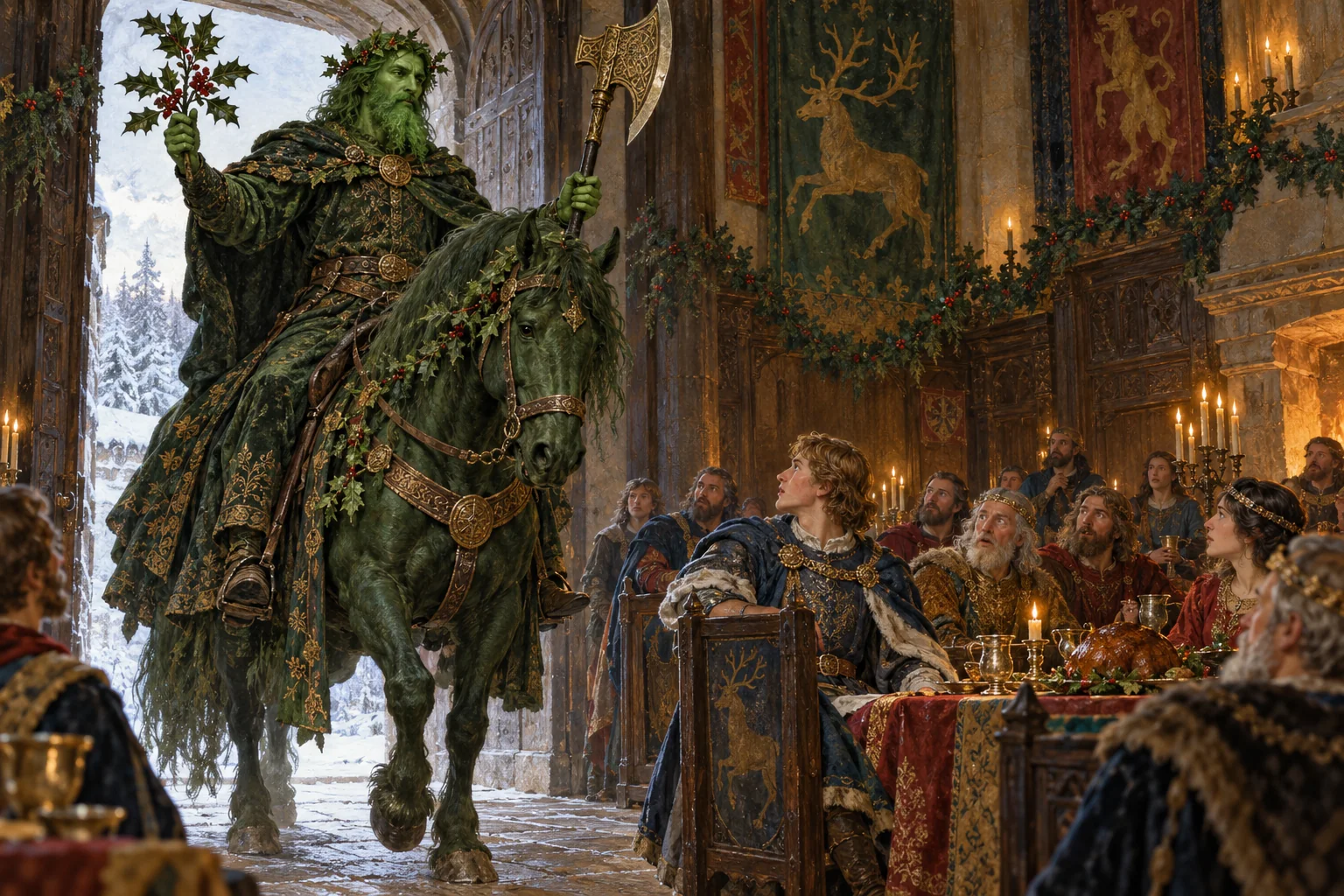
Arthur’s court was celebrating New Year when a green rider entered on a green horse. He carried a holly branch and a formidable axe. He offered a game: someone might strike him once, provided that person would seek him out a year and a day later and receive a return blow.
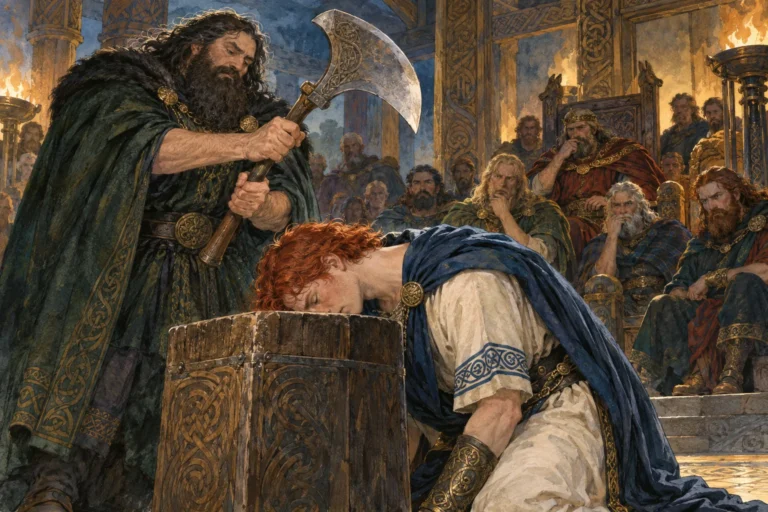
When Arthur prepared to accept, his nephew Gawain asked to take the challenge. Gawain struck off the stranger’s head. The visitor calmly picked it up; the severed head repeated the appointment at the Green Chapel. Then horse and rider departed, leaving the court with a promise whose consequences lay a year away.
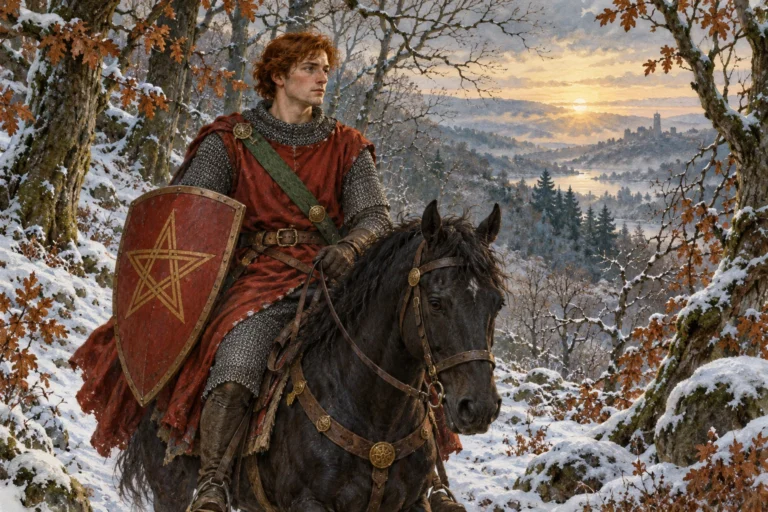
As the appointed time approached, Gawain rode out through winter on his horse Gringalet. After hardship in the wilderness, he found a welcoming castle. Its lord offered shelter and assured him that the Green Chapel was close enough to reach when necessary. Meanwhile they would play a game of their own. Whatever the lord won while hunting would be exchanged for whatever Gawain gained inside the castle.
For three days the lord hunted deer, boar and fox. His wife visited Gawain’s chamber and pressed him with invitations that tested both courtesy and loyalty. Gawain resisted her advances but accepted kisses: one, then two, then three. Each evening he passed those kisses to his host in exchange for the hunt’s spoils.
On the third day the lady offered him a green girdle said to protect its wearer from death. Facing the Green Knight’s axe, Gawain could not refuse that hope. He promised to keep the gift secret. When the evening exchange came, he gave the kisses but concealed the girdle.
The Green Chapel proved to be a threatening hollow in the landscape. At the first descent of the axe Gawain flinched; he stood firm at the second feint. The third stroke made only a small wound. The Green Knight then explained the pattern: the two honest exchanges earned no injury; the concealed girdle earned the nick. He was Gawain’s host, called Bernlak de Hautdesert in Weston’s version.
Morgan had arranged the marvel to test Arthur’s proud court and frighten Guinevere. Gawain was ashamed of his failure, though his host treated the desire to remain alive with understanding. He returned to Camelot wearing the girdle as a reminder. The court answered his sorrow with fellowship, adopting green baldrics themselves. Weston’s 1898 prose rendering.
Versions and variations
A later English reworking
The later The Greene Knight, as described in Thomas Hahn’s introduction, calls the challenger Sir Bredbeddle. It reduces the repeated hunting and exchange structure and changes the magical organiser to the wife’s mother. The relationship is a substantial rewriting, not merely a spelling variant. This comparison uses Hahn’s introduction and Weston’s notes; the later poem has not been fully collated here.
Compare the Irish beheading tests
In Bricriu’s Feast, Cú Chulainn distinguishes himself by returning to face a promised blow. The Irish entry separates its different test episodes and Gregory’s later arrangement. The shared challenge provides a valuable comparison, but does not by itself demonstrate that the English poet copied a particular surviving Irish text.
A host with several spellings
Bertilak is a familiar modern form of the host’s name; Weston uses Bernlak. The version followed here is a prose rendering of the anonymous Middle English poem, not a Malory episode.
Context and evidence
The two games make Gawain’s courage inseparable from his conduct as a guest. He can face an axe and still struggle to keep an inconvenient bargain. His own severe judgement, his host’s qualified forgiveness and the court’s solidarity offer different responses to the same failure.
Our illustration shows the arrival at court. Its green rider belongs to the poem’s marvel, not to a claimed portrait of a historical knight. A real cave or chapel should not be labelled the original setting without examining the particular local identification.
Sources for this entry
- Anonymous poet; translated and retold by Jessie L. Weston, Sir Gawain and the Green Knight. 1898 prose rendering of the Middle English poem; Project Gutenberg 66084. Complete prose narrative; notes on the later “Greene Knight”. Principal retelling and spelling of Bernlak. Read source · About this book
- Thomas Hahn, The Greene Knight: Introduction. In Sir Gawain: Eleven Romances and Tales (1995), TEAMS. Introduction, relationship to Sir Gawain and the Green Knight. Comparison of the later poem through its scholarly introduction. Read source · About this book
Research coverage
The named passages have been examined and compared. This is a first source-led guide, not a collation of every manuscript, translation, local telling or adaptation.
The Myths · Arthurian collection · Editorial approach
Further Reading