story · Wales
Merlin and the dragons
A threatened boy overturns the king’s advisers by revealing what lies beneath an unfinished tower. Earlier and later accounts disagree about his name and the dragons’ hiding place.
Also found as: The red and white dragons · Vortigern’s tower · Dinas Emrys dragons. Research reviewed 18 October 2026.
Read the story
What the foundations concealed
Vortigern wanted a stronghold that would protect him from his enemies. Yet his builders could make no lasting progress: the work failed, and the king’s advisers offered a terrible explanation. The foundations required the blood of a boy without a father.
Messengers searching for such a child heard another boy taunt Merlin about his parentage. They brought Merlin and his mother before Vortigern. The advisers had offered the king a victim; Merlin offered him a test. If they understood why the building failed, they should be able to say what lay beneath it. None could answer.
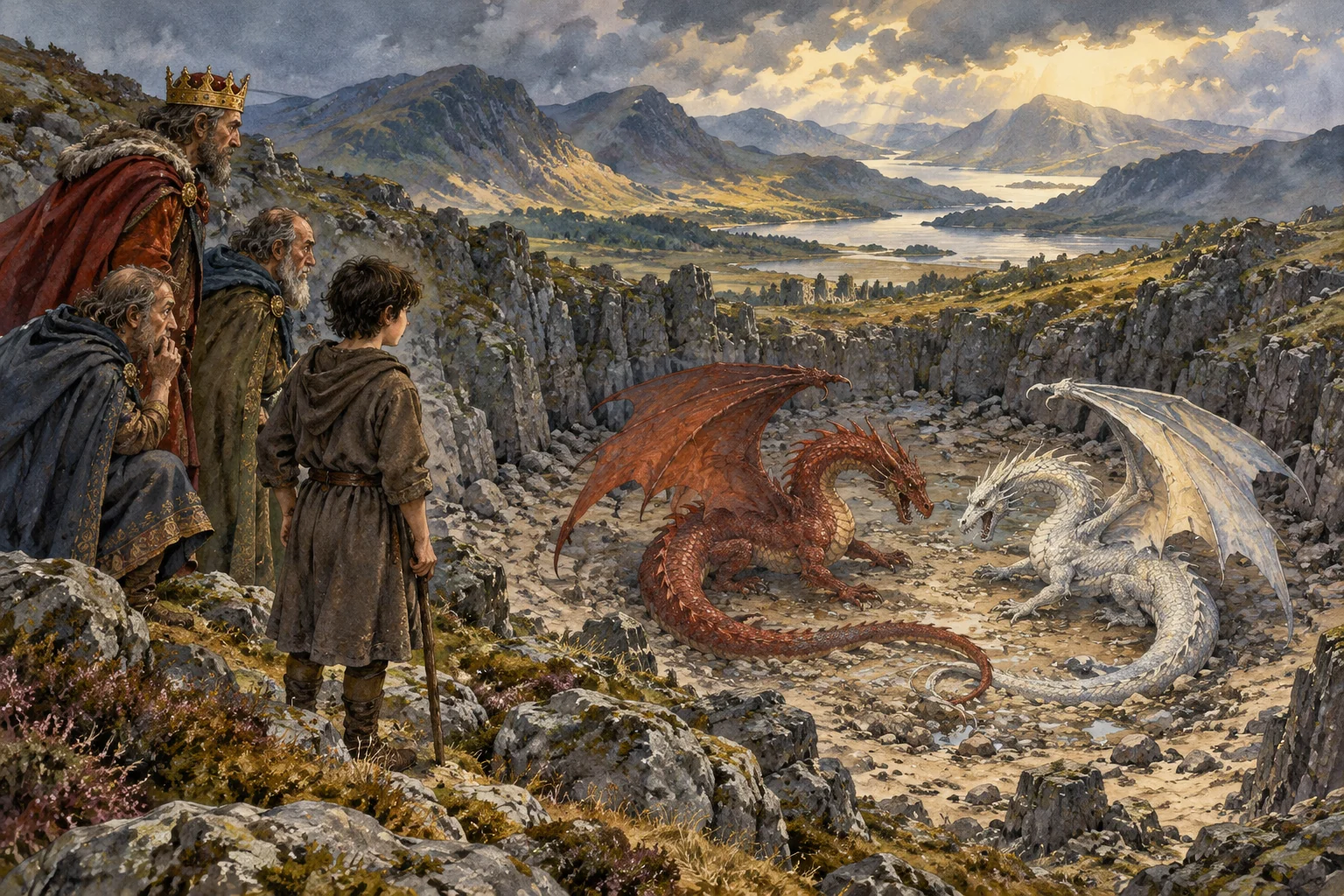
Merlin told the king to order digging. Beneath the foundations lay a pool. When it was drained, two hollow stones were exposed; inside them slept two dragons. The prediction had been tested in front of the very men who had demanded his death.
One dragon was red and the other white. They emerged into a fierce struggle. The white drove the red back, but the red renewed the attack. Vortigern asked what their conflict meant. Merlin wept as he interpreted it: the white dragon represented the Saxons the king had brought into Britain; the red represented the Britons, facing oppression before a future reversal.
In Geoffrey’s book, this is the opening of a long, difficult series of prophecies. It is not simply a cheerful explanation of a flag. A king who wanted security learns that the deeper danger belongs to his own political choices. Our retelling ends with the opening interpretation rather than pretending to decode every subsequent prophecy. Geoffrey, VI.17–19; VII.3.
Versions and variations
Before Merlin: Ambrosius
The earlier Historia Brittonum, §§40–42 names the boy Ambrosius (Ambrose in the translation), not Merlin. Its dragons are discovered inside a folded tent in vessels beneath the pool. The red expels the white; the boy claims the stronghold and tells Vortigern to leave. Geoffrey reshapes this material and calls his prophet Merlin, also Ambrose.
How did the dragons get there?
The separate Welsh tale Lludd and Llefelys tells of a dreadful scream across Britain. Following his brother’s advice, Lludd traps two fighting dragons in a cauldron of mead at the island’s centre. As they sleep, he wraps and buries them in the strong place later called Dinas Emrys. This explains their concealment; it is not the same scene as the threatened boy’s examination.
The place association
The modern site of Dinas Emrys carries these traditions. The literary sequence, the naming of the hill and its archaeological remains need to be read as related but different kinds of evidence.
Context and evidence
The child’s questions reverse the power of the scene: the supposedly knowledgeable advisers cannot explain what he can reveal. The dragons then give political conflict a memorable visual form. Neither episode is an archaeological report.
The early compilation and Geoffrey are not two independent eyewitnesses. Geoffrey’s account develops earlier narrative material. The source register records that relationship so repeated details are not mistaken for independent confirmation.
Sources for this entry
- Geoffrey of Monmouth, History of the Kings of Britain, Book VI. Composed c.1136–38; English version in J. A. Giles, Six Old English Chronicles (1848). Book VI, chapters 17–19. Principal retelling: threatened boy, pool and hollow stones. Read source · About this book
- Geoffrey of Monmouth, History of the Kings of Britain, Book VII. Composed c.1136–38; Giles collection (1848). Book VII, chapter 3, opening. Dragon combat and political interpretation. Read source · About this book
- Anonymous compiler, traditionally attributed to Nennius, Historia Brittonum (History of the Britons). Ninth-century compilation; Fordham transcription of Giles (1848), with §§56 and 73 supplied from the Camelot Project. Sections 40–42. Earlier Ambrosius narrative. Read source · About this book
- Anonymous Welsh storytellers; translated by Charlotte Guest, The Mabinogion. Nineteenth-century translation, collected edition; Project Gutenberg 5160. “The Story of Lludd and Llevelys”. Related account of the dragons’ burial. Read source · About this book
Research coverage
The named passages have been compared for this entry. This is an initial source-led guide, not a collation of every manuscript, translation, oral account or modern adaptation.
The Myths · Arthurian collection · Editorial approach
Further Reading