Manx fairy feasts and stolen treasures · story
The silver cup
A farmer follows the riders who have exhausted his cattle and brings back a cup. Another telling attaches the treasure to a different church.
Research reviewed 18 October 2026.
Read the story
The riders in the cowhouse
This retelling follows Sophia Morrison’s “The Silver Cup”, including its Rushen church ending.
A farmer at Colcheragh had fine cows, but they became tired and thin and gave little milk. A remedy involving dust from a crossroads did no good. He decided to keep watch in the cowhouse, hidden among the straw.
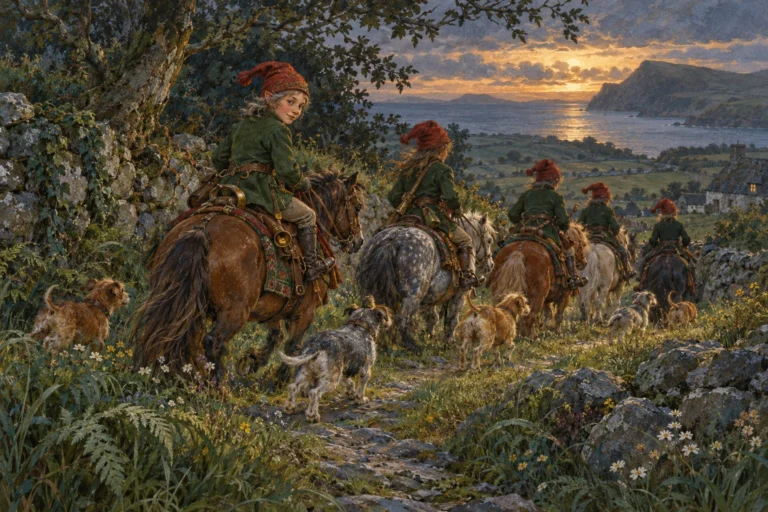
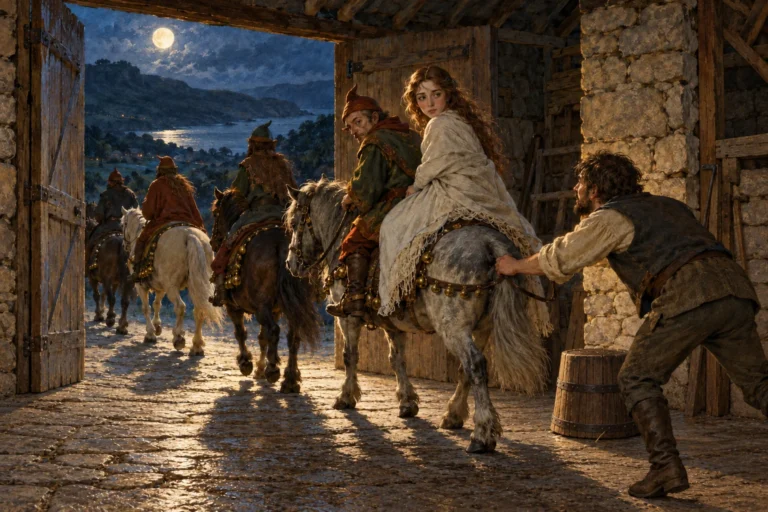
Little men arrived in green clothing with hunting gear, accompanied by a pack of tiny, many-coloured dogs. They took the cows for their ride. The farmer followed on his own horse until the company reached a hill. Horns sounded, the hillside opened, and he went inside with them.
There was music and dancing, with Hom Mooar playing the fiddle. To the farmer’s horror, the cows seemed to be slaughtered and prepared for the feast. He recognised people among the company, and received a warning: he must neither eat nor drink if he hoped to get away.
The cup and the escape
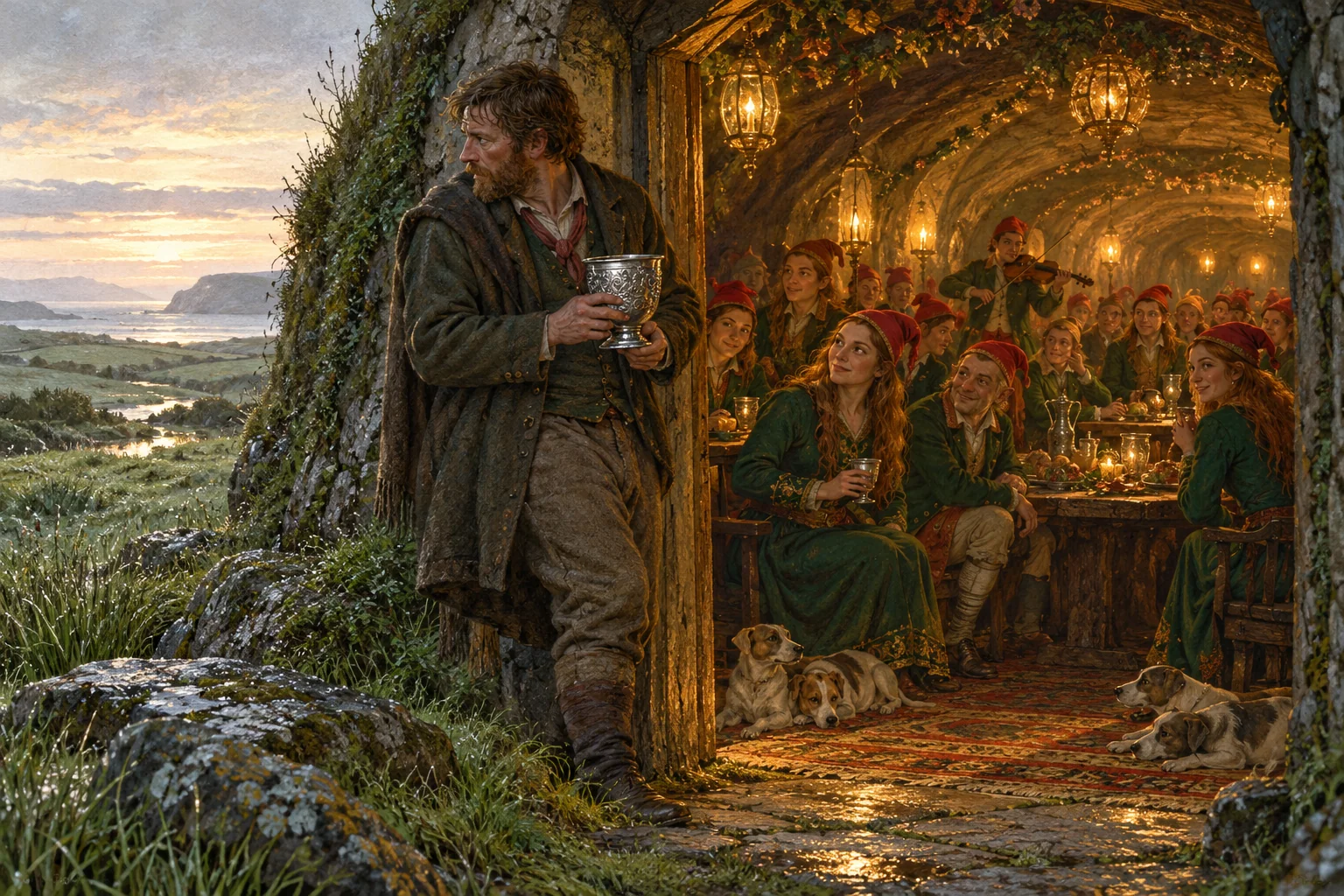
As he prepared to leave, he was offered wine in a carved silver cup. Thinking of his lost cattle, he resolved to take it. He offered a toast, threw out the wine and extinguished the lights. In the confusion he escaped with the vessel.
The Little People pursued him. He kept to wet places and avoided the stepping stones, while his pursuers called to him to stay on dry ground. At last he reached the protection of a churchyard.
Morrison’s telling ends with the cup associated with Rushen church and, later, said to have gone to London. The cows, despite what the farmer had seen at the feast, were back the next day. The narrative leaves that contradiction in the world of enchantment.
Versions and variations
Morrison’s Colcheragh and Rushen version
The failing cattle, night hunt, hill opening, named fiddler and pursuit through wet ground form the distinctive sequence in the 1911 telling. The cup is taken as compensation for apparent loss.
The fairy cup of Kirk Malew
Moore’s 1891 collection reproduces an account credited to Waldron. A man follows music to a feast on a common, receives a warning from someone he recognises, throws away the drink and finds the company gone. He keeps the cup, which a minister dedicates to church use at Kirk Malew. The cattle-hunt sequence is absent from this printed account.
Keep the churches separate
Rushen and Malew are not interchangeable labels. Nor does either narrative, by itself, prove that a surviving silver vessel came from a fairy feast. The reported journey to London belongs to Morrison’s telling and has not been established as an object’s documented provenance.
Context and evidence
Food and drink mark a dangerous threshold: accepting hospitality may prevent a human visitor from leaving. The warning comes from a familiar face already inside the gathering, making the supernatural company partly continuous with the human community.
The two books preserve related cup stories with materially different routes, settings and endings. Their comparison does not justify merging the churches or treating a single supposed relic as evidence for both.
Sources for this entry
- Sophia Morrison, Manx Fairy Tales. London: David Nutt, 1911. “The Silver Cup”, pp.27–33. Read source — Complete cattle-hunt and Rushen version. About this book
- A. W. Moore, The Folk-Lore of the Isle of Man. Douglas and London, 1891. Chapter III, “The Fairy Cup of Kirk Malew”. Read source — The account explicitly credited to Waldron; examined here through Moore, not as a separate reading of Waldron’s original. About this book
Research coverage
The passages named below have been read and compared. This entry does not claim to include every oral performance, manuscript witness or modern adaptation; unexamined leads are identified separately.
The Myths · Manx collection · Editorial approach
Further Reading