Irish fairy folklore · story
The Legend of Bottle Hill
A struggling farmer exchanges his last cow for an apparently empty bottle. Its gift makes him prosperous, but a second bargain brings two men with cudgels into the family kitchen.
Also found as: The Legend of the Bottle Hill · Bottle Hill · Mick Purcell and the Magic Bottles
Research reviewed 17 October 2026.
Read the story
This retelling follows “The Legend of Bottle Hill” in the 1906 edition of Croker’s collection. William Maginn’s reported contribution is discussed below. The mysterious stranger is left unnamed, as he is in this account.
Mick Purcell’s little farm near the old preceptory of Mourne was failing. The oats had been ruined, the chickens had sickened, and even the pig had brought little money. Two payments of rent were due. He and his wife Molly had children to feed, and their remaining cow was the last thing likely to raise enough money.
They agreed that Mick should take her to the Cork fair. He left on Sunday so the animal could rest before Monday’s selling. Molly tried to encourage him, remembering occasions when help had arrived unexpectedly. Mick walked on with the cow, hoping that another such occasion was waiting somewhere ahead.
He passed the old walls at Mourne and wondered about the treasure people said lay buried there. Later, crossing a stretch of mountain country, he reached the top of a hill. A small old man appeared, wrapped in a coat that covered almost his whole body. His face was wrinkled, his eyes red, and he moved so smoothly that Mick could scarcely see how he walked.
The stranger knew Mick’s name and wanted his cow. In exchange he offered a bottle.
Mick laughed. An empty bottle would not satisfy his landlord or fill his children’s stomachs. But the old man spoke of everything that might happen on the road: the cow might die, buyers might pay too little, robbers might take the money. Gradually the poor bargain began to sound less hopeless than the journey.
The instructions were peculiar. Mick must bear Molly’s anger quietly, have the floor swept and a clean cloth spread on the table, place the bottle on the ground and tell it to do its duty. Desperate enough to try, he handed over the cow. When he looked again, the animal and the stranger had vanished.
At home Molly’s anger exceeded anything he had imagined. She was ready to break the bottle over his head. Mick stopped her and coaxed her into preparing the room. The floor was swept with a bunch of heath, the clean cloth was found, and he set his purchase down.
“Bottle, do your duty.”
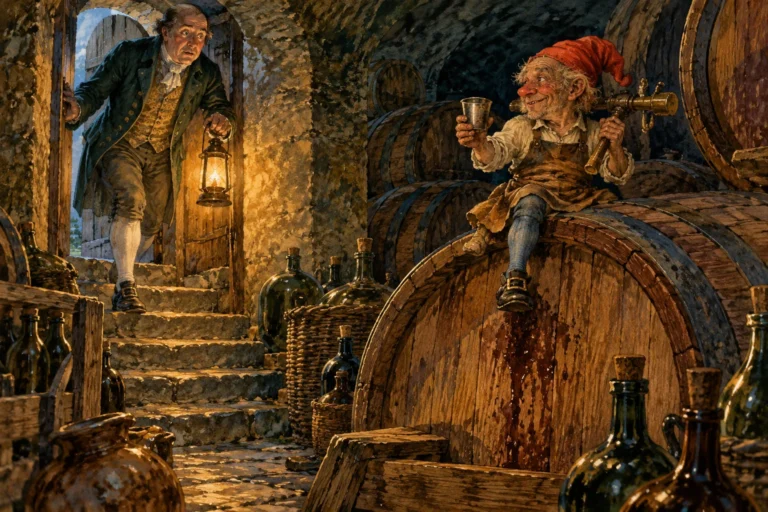
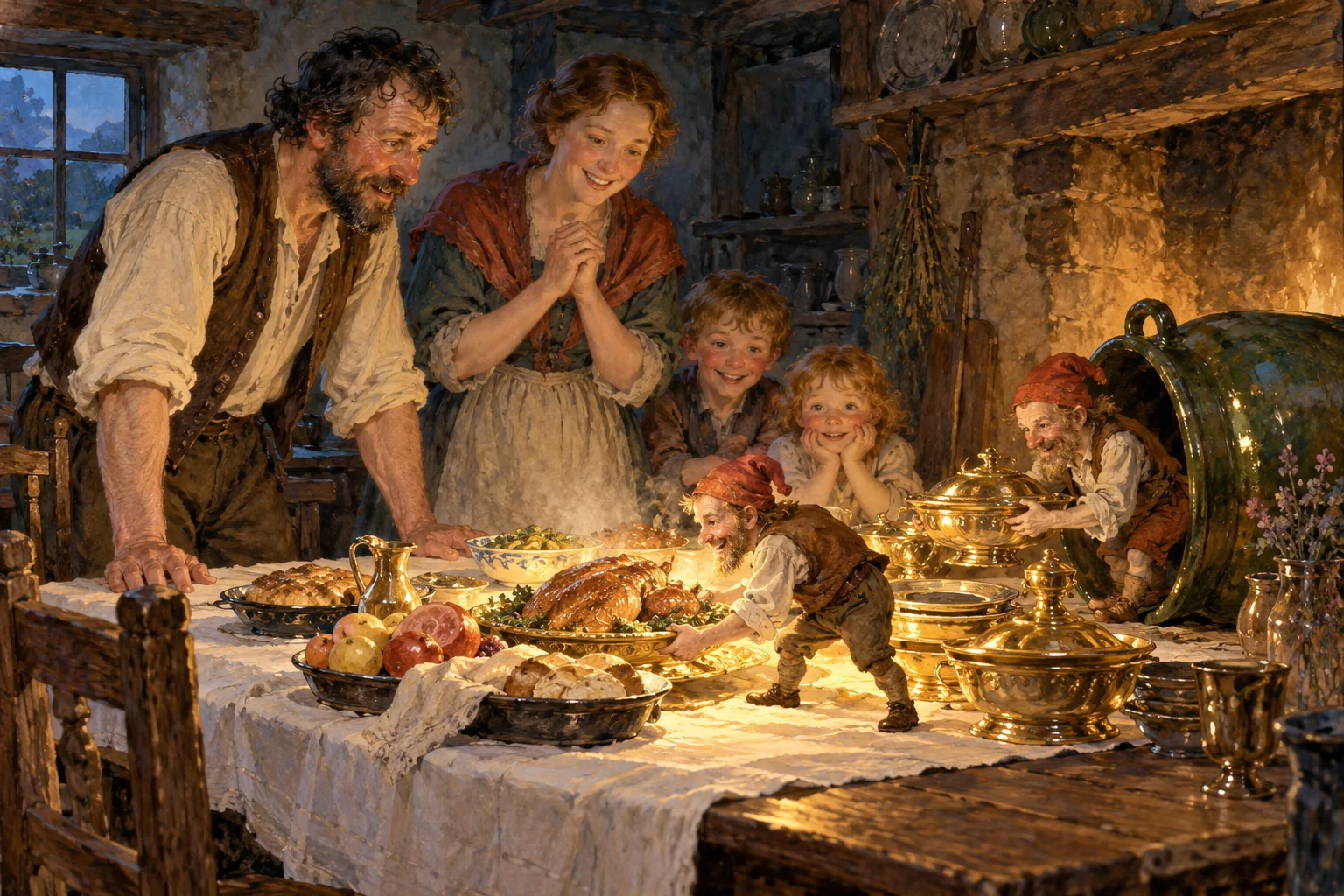
Two tiny fellows came out. They moved rapidly between bottle and table, laying out dishes of food on gold and silver plate. When everything was ready, they disappeared inside again. The family ate, scarcely believing what had happened. Afterwards the precious plates were still there.
Mick sold plate in Cork. Soon he had a horse and cart and more land. Prosperity was difficult to conceal, and the landlord demanded to know its cause. Mick resisted questions and offers of money, but at last the landlord proposed a bargain he accepted: the farm would be his for ever in exchange for the bottle.
The bargain did not teach the family how to preserve their fortune. They spent what they had, and eventually poverty returned. Once again Mick set out with a single remaining cow. Once again he met the old man on the hill.
There was another bottle, and the same exchange was offered. Mick accepted eagerly. This time the stranger said that they would not meet again. Thanking him, Mick declared that the place should be called Bottle Hill.
Molly prepared the house for the return of abundance. But when Mick gave the command, two large, powerful men emerged carrying cudgels. They struck everyone within reach. The expected feast became a beating, and only after the family had been knocked down did the men return to their bottle.
Mick helped his wife and children, then carried the bottle to the landlord’s house. A party was in progress. He announced that his new possession was better than the old one and offered a demonstration. The landlord’s bottle stood nearby, where Mick could see it.
At the command, the cudgel men burst out among the guests. Cups, dishes and wine went flying as they beat their way through the gathering. The landlord threatened Mick, but Mick demanded his first bottle back before he would stop them. The exchange was made, and the attackers returned to their container.
Mick became prosperous again. His son eventually married the landlord’s daughter, and Mick and Molly lived to old age. At their wake, quarrelling servants broke the bottles. Their wonders ended, but, the story says, the hill kept the name of the bargain that had changed the family’s fortunes.
Versions and variations
A published Italian comparison. In Henry Charles Coote’s “Some Italian Folk-lore”, the section “Joe (Geppone)”, a farmer from Mugello complains to the North Wind because it ruins his crops. The wind gives him a box that supplies food. His landlord, Prior Pier Leone, persuades him to surrender it in return for maintenance, then fails to honour that promise. A second box produces men with sticks. Joe uses it to recover the first and eventually keeps both. Coote draws his account from Domenico Comparetti’s collection and explicitly compares it with Bottle Hill. He is a translator and commentator here, not the named collector of this performance.
The differences matter. Mick trades cows with an uncanny stranger; Joe seeks out the wind responsible for his misfortune. Mick exchanges the first bottle for permanent possession of his farm, then spends his wealth. Joe’s hunger follows the prior’s broken promise. Coote’s version varies the number of attackers, including six at the prior’s dinner, while the Irish story’s bottles produce two small servers and two large cudgel men. The shared pattern makes the stories useful to compare, but it does not prove which country originated it or how either version travelled. It also matters that the Irish landlord does not steal Mick’s bottle: reducing the tale to theft would alter its moral complications.
Collection, contributor and later printing. The chosen text belongs to Croker’s collection, but Bates, chapter IX, pp.49–52, reports Maginn’s brother naming “The Legend of Bottle Hill” among the doctor’s contributions. That is the basis for the qualified credit here. The 1844 edition, chapter VI, pp.34–42, is an earlier printed form of the Irish story, not a separately identified oral witness. Neither the selected story nor its stranger’s appearance justifies silently renaming him a clurichaun.
Context and evidence
Food, rent, illness and the sale of an animal give the magic a practical setting. The first bottle answers hunger and produces saleable wealth; the second supplies violence that Mick redirects into bargaining power. The tale’s happy ending does not erase the beating of his family or make every bargain innocent. Those tensions are present in the published account.
“Bottle Hill” functions as an explanation of a place-name within the story. Its landscape is described from Mourne towards the Cork fair, but this entry does not identify a precise modern hill from that literary route. The name and the survival of a local tradition would require separate place evidence.
Sources for this entry
- Thomas Crofton Croker, collection; contribution attributed to William Maginn, Fairy Legends and Traditions of the South of Ireland. Seventh edition, June 1906; Thomas Wright, editor; Library Ireland transcription. The Legend of Bottle Hill, complete story. Read source — Chosen narrative; does not identify the stranger as a clurichaun. About this book
- Henry Charles Coote, translating and discussing Domenico Comparetti’s collection, Some Italian Folk-lore. The Folk-Lore Record 1 (1878), pp.187–215. Section ‘Joe (Geppone)’, from Mugello, and following comparison with Bottle Hill. Read source — Actual published Italian analogue examined; transmitted through Coote from Comparetti, not collected by Coote from an identified storyteller here.
- William Bates, The Maclise Portrait-Gallery. London: Chatto & Windus, 1883. IX: Crofton Croker, pp.49–52; paragraph beginning ‘My friend, the Rev. Charles Arthur Maginn’. Read source — Reports the contributor list recorded by Maginn’s brother; evidence of attribution, not an oral tale variant.
- Thomas Crofton Croker, collection, Fairy Legends and Traditions of the South of Ireland. Philadelphia: Lea and Blanchard, 1844, A New Edition. VI: The Legend of Bottle Hill, pp.34–42; selected passages and section placement. Read source — Earlier printed form consulted selectively; not claimed as a full line-by-line collation. About this book
Research coverage
The complete 1906 Irish narrative and Coote’s complete Geppone section and comparison have been examined. The Italian comparison is mediated by Coote’s rendering of Comparetti; the original Italian text and its collector metadata have not been collated. The 1825 Irish printing, independently recorded oral versions and a secure modern identification of Bottle Hill remain research gaps.
The Myths · Irish collection · Editorial approach
Further Reading