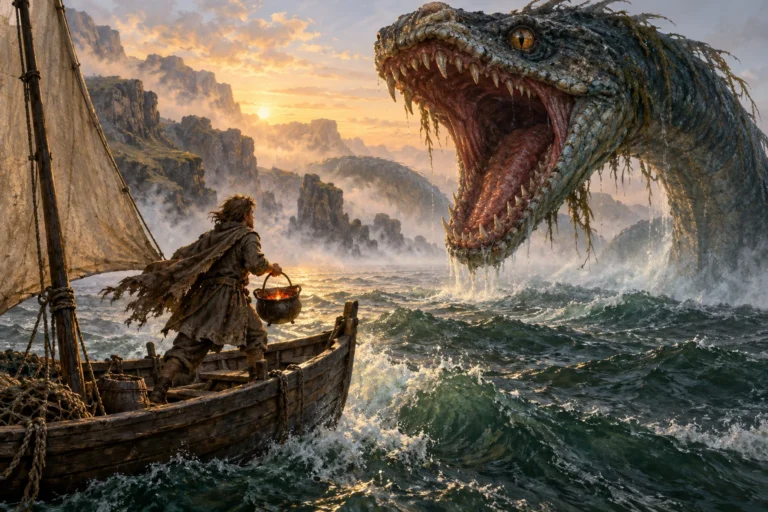
Highland saint’s legend · story
Columba and the water beast
A boat waits on the far bank. A monk swims towards it, and something dangerous rises from the river. Columba’s answer is a command.
Also found as: Saint Columba and the River Ness monster · Adomnán’s water beast · Colum Cille and the water beast
Research reviewed 28 October 2026.
Read the story
This original retelling follows Adomnán’s Life of Saint Columba, Book II, “An Aquatic Monster driven off by virtue of the blessed man’s prayer”, in the 1874 English edition. The opening includes a death, described without graphic detail.
Columba and his companions came to the River Ness while travelling in the province of the Picts. They needed to cross, but the boat they could use was moored on the other bank.
Near the water, local people were burying a man. They told Columba what had happened. The man had been swimming when a beast attacked him. People in a boat had tried to help, but by the time they reached him and drew him from the water, he was dead.
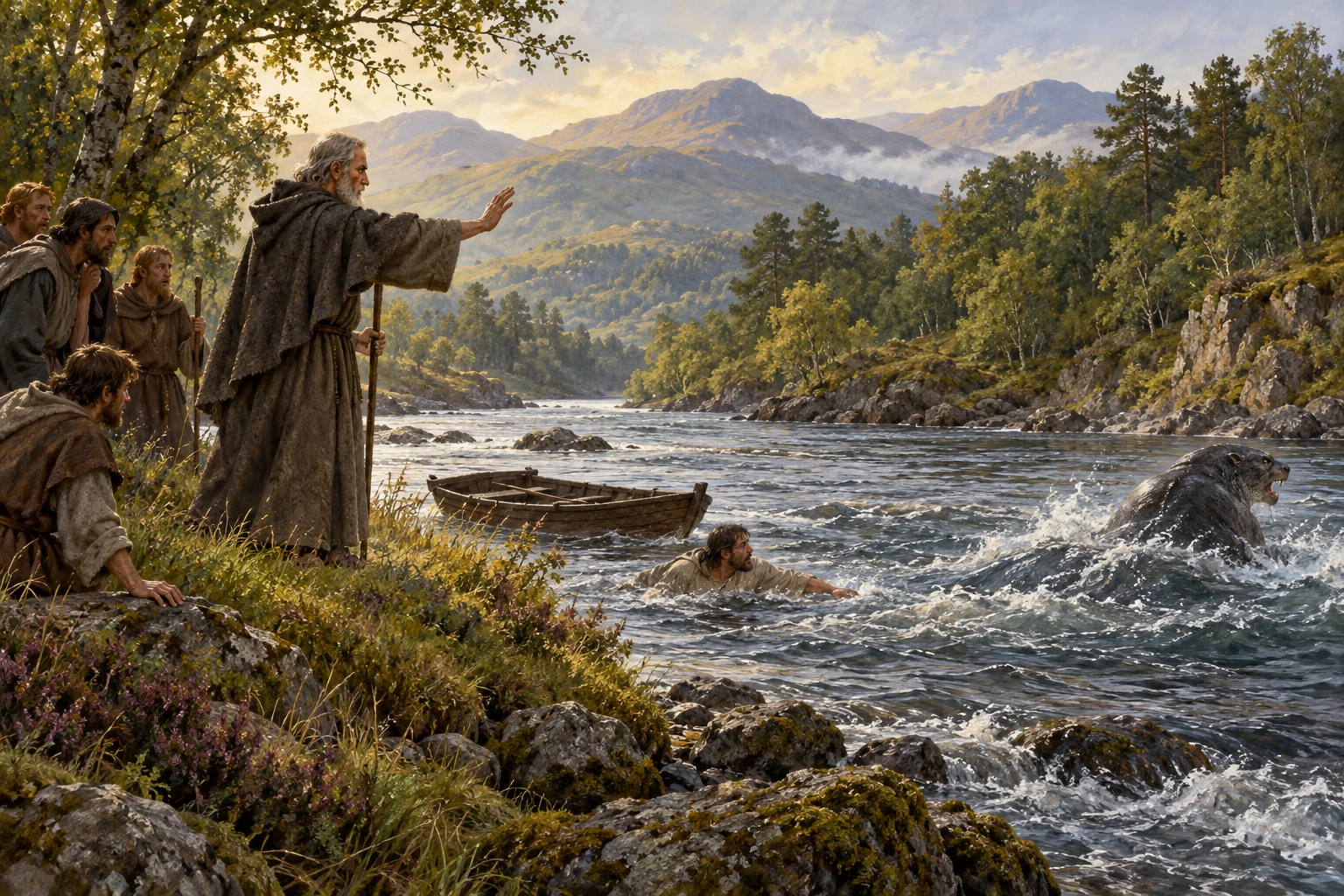
Columba listened. Then he told one of his companions to swim across and bring back the boat. Lugne Mocumin volunteered. He took off his outer clothes, kept his tunic on and entered the river.
He swam out from the bank. Beneath the water the creature lay hidden. The movement above disturbed it. It rose, opened its mouth and rushed towards him with a roar.
Those watching on the bank could see the danger. They were too frightened to act. The swimmer was in the middle of the river, and the beast was closing the distance.
Columba raised his hand. Calling on God, he made the sign of the cross and ordered the creature to go no farther. It must not touch the man. It must turn back at once.
The beast was almost upon Lugne, no more than the length of a spear-shaft away. At the command it stopped and fled, retreating faster than it had approached. The water opened between it and the swimmer.
Lugne reached the boat and brought it back safely. Columba’s companions gave thanks. The local people who had witnessed the encounter also praised the Christian God. Where they had expected another death, the story ends with deliverance.
Versions and variations
The River Ness in Adomnán
The setting is explicitly a river. The text gives a dangerous aquatic beast, an open mouth and an attacking movement, but no distinctive long neck, flippers or measured body length. The first victim remains dead in this chapter. Columba protects Lugne; he does not kill the creature or bring the buried man back to life. These details matter when later summaries turn the episode into an encounter with the familiar modern Nessie.
A later Irish Life changes the miracle
Borsje discusses a later Irish Life of Columba in which a man leaves the saint’s preaching, crosses a nearby river and is killed by a serpent. Columba then restores him to life. That account changes the victim’s role and the miracle’s outcome. Its quoted passage does not name the river. It should not be silently substituted for Adomnán’s Ness episode. Here it is consulted through Borsje’s quotation from Máire Herbert’s edition, not through an independent reading of the Irish manuscript.
When the beast becomes Nessie
Calling this “the first Nessie sighting” adds an identification that the medieval passage does not make. Readers can compare it with The Loch Ness Monster, but a shared association with Ness does not establish that two accounts describe the same animal or an unchanged tradition. Our Is the Loch Ness Monster real? review follows the modern evidence separately.
Context and evidence
Borsje places the composition of the Life around 697–704 and examines the episode as a miracle narrative. It is a later account of Columba’s life, not a record made beside the river at the moment described. The precise year commonly attached to the encounter is not supplied in the chapter used here.
The narrative’s decisive action is the command made in God’s name. Its final emphasis falls on the witnesses’ response. Reading it only as a wildlife report removes the purpose that its author gives the scene. This does not make the story unimportant: it tells us what this religious text presents as a demonstration of sanctity.
The passage names no exact crossing point, modern bridge or castle. Loch Ness is linked because the River Ness drains the loch, not because the two bodies of water can be exchanged in the retelling. The illustration leaves the animal’s identity imaginative.
For another Scottish encounter with a water monster, compare Assipattle and the Stoorworm. Assipattle defeats his enemy through practical ingenuity and fire. Columba turns his away through sacred authority. This is a comparison of narrative actions, not proof that one tale descended from the other.
Sources for this entry
- Adomnán, Life of Saint Columba. English translation in the William Reeves edition, Edinburgh: Edmonston and Douglas, 1874; electronic text at CELT, University College Cork. Book II, chapter XXVIII, “An Aquatic Monster driven off by virtue of the blessed man’s prayer” (II.27 in some modern editions). Read source — Complete chapter examined; principal source for the retelling. Book or article record
- Jacqueline Borsje, The monster in the river Ness in Vita Sancti Columbae: A study of a miracle. Peritia 8 (1994), pp.27–34. DOI: 10.1484/J.Peri.3.202. Especially pp.28–32. Read source — Dating, miracle context and the later Irish Life; the Irish passage is consulted through Borsje’s quotation, not independently collated. Book or article record
Research coverage
The complete medieval episode in the 1874 English translation and Borsje’s discussion were examined. The later Irish passage is known here through that scholarly discussion. This is not a collation of every manuscript, translation or modern Nessie retelling.
The Myths · Scottish collection · Editorial approach
Further Reading