
Learning & activities / England
Compare versions
The pedlar’s treasure: compare two tellings
Compare two endings of the Pedlar of Swaffham, with a printable reading worksheet about treasure, a second pot and evidence for a legend.
EnglandAges 9+A4 · 2 pages
Download and print
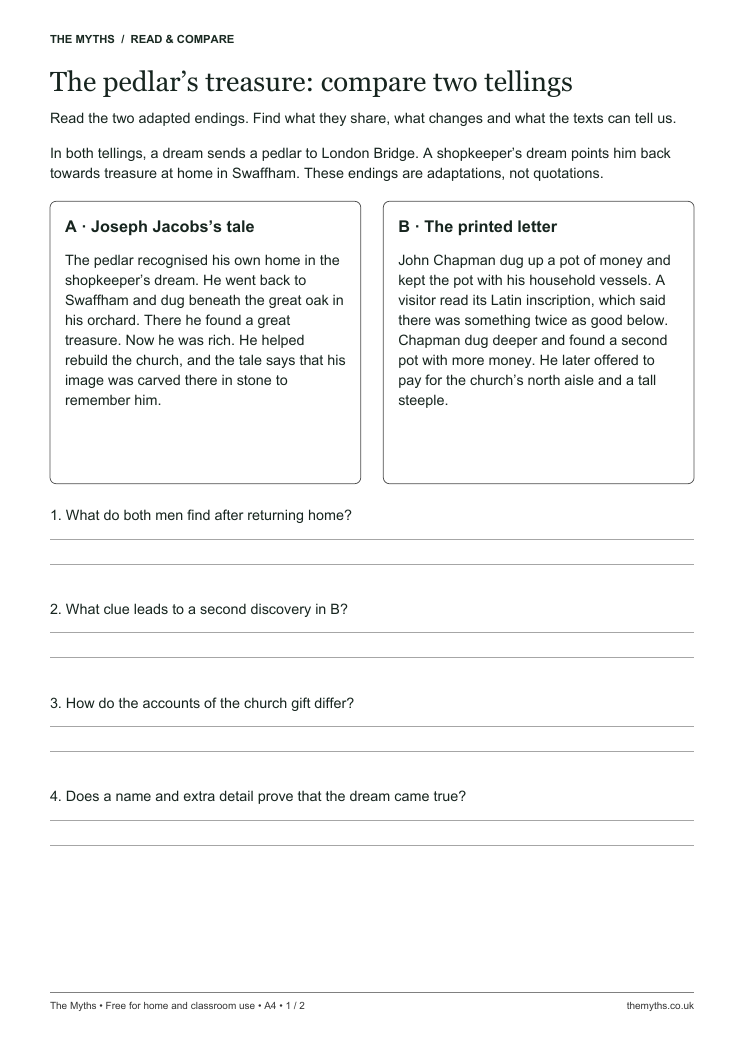
Read the two adapted endings. Find what they share, what changes and what the texts can tell us.
Black-and-white printable. Select A4 and “Fit to page” when printing. Free for personal, home and classroom use. No sign-up needed.
Try this activity
Underline one detail shared by both passages and circle one found only in the second. Explain why extra detail does not automatically make a story true.
Suggested ages are a guide. Choose the reading and practical support that suits your learner.
More to try: Colour the Pedlar of Swaffham
The story behind the picture
One telling gives the pedlar a great treasure after his journey. Another names John Chapman and adds a second pot discovered through a Latin inscription. Learners compare the clues and the different accounts of his gift to the church.
About this version
The passages compare Jacobs’s 1894 tale with the Dugdale-to-Twysden letter dated 29 January 1652-3 as printed in History of Norfolk, volume VI (1807), pp. 211-213. The printed transcription was consulted, not the original letter. These are shortened literary accounts, not evidence that treasure was found through a dream. The adult guide keeps the text witnesses and their dates distinct.
Follow the story
Sources for this activity
Source notes are for adults and older readers. Full texts may contain material beyond the selected activity.
- Joseph Jacobs: The Pedlar of Swaffham
More English Fairy Tales (1894), LXIII and notes. The main narrative has an unnamed pedlar, a great treasure and the rebuilding of the church; it does not include the second-pot episode. - History of Norfolk: Swaffham and the Chapman story
Blomefield, continued by Parkin, volume VI (1807), pp. 211-213. Printed letter from William Dugdale to Roger Twysden, dated 29 January 1652-3: named John Chapman, an inscribed first pot, a larger second treasure and an offer to fund the north aisle and steeple.
How we use sources and illustrations · Browse all activities