
Learning & activities / Scotland
Colouring
Colour the Loch Ness Monster
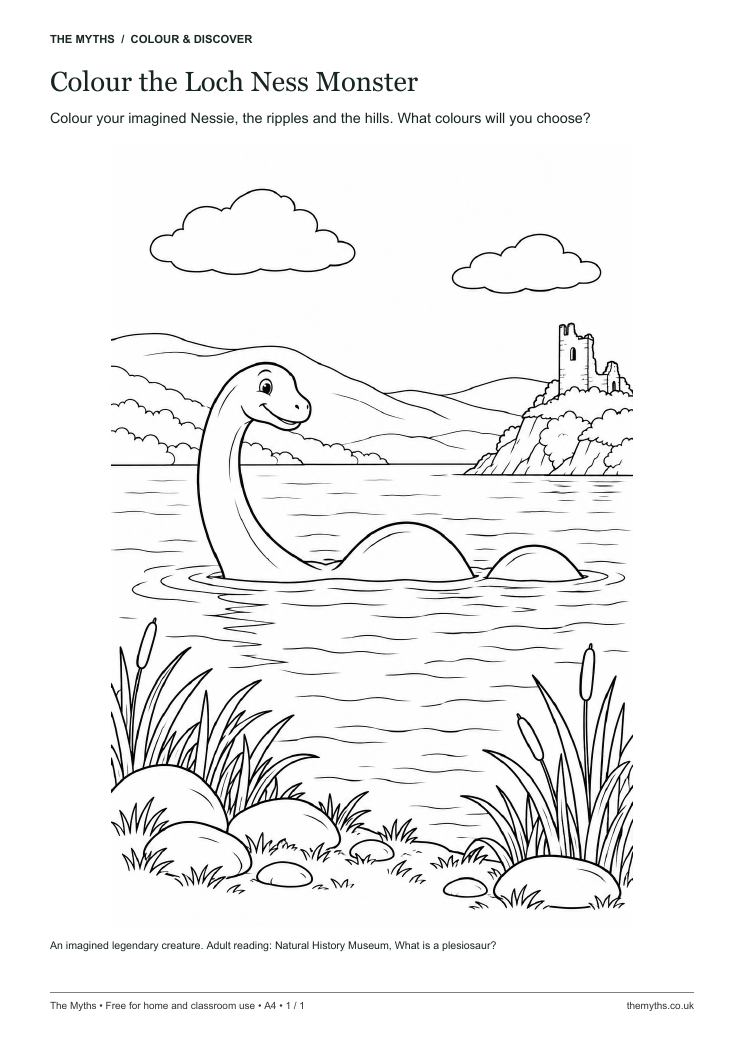
Give Nessie your own colours in a friendly Loch Ness Monster scene, with a simple activity about pictures and evidence.
ScotlandAges 5+A4 · 1 page
Download and print
Colour your imagined Nessie, the ripples and the hills. What colours will you choose?
Black-and-white printable. Select A4 and “Fit to page” when printing. Free for personal, home and classroom use. No sign-up needed.
Try this activity
Draw an ordinary water bird or fish beside your imagined creature on another sheet. Explain which details you could check by observing a real animal, and which details you invented.
Suggested ages are a guide. Choose the reading and practical support that suits your learner.
The story behind the picture
Nessie is the popular name for the legendary Loch Ness Monster. This picture uses the familiar long neck and humps, but its smiling creature and landscape are invented. A colouring picture is something we create, not evidence that the animal exists.
About this version
The Natural History Museum explains how the familiar plesiosaur-like image became established during the twentieth century and why searches have not demonstrated a living plesiosaur in the loch. This is a modern legendary-creature activity, not an illustration of a verified sighting. The castle is an imagined background, not a measured view of a particular ruin.
Follow the story
Explore the new Nessie collection with an adult: Columba and the water beast · The Loch Ness Monster · Loch Ness · Is the Loch Ness Monster real?. The colouring sheet is an imaginative activity; the linked research page distinguishes stories from evidence.
Sources for this activity
Source notes are for adults and older readers. Full texts may contain material beyond the selected activity.
- Natural History Museum: What is a plesiosaur?
James Ashworth’s museum article, especially its Loch Ness Monster discussion. Used for the distinction between the popular image, fossil animals and evidence; no real monster is asserted.
How we use sources and illustrations · Browse all activities