Lincolnshire wetland folklore · place
The Ancholme Valley and the Lincolnshire Cars
Marsh paths, drainage channels and changing ground lie behind the printed stories of the Buried Moon and Tiddy Mun.
Also found as: Lincolnshire Cars · Ancholme Cars · North Lindsey Cars
Research reviewed 18 October 2026.
The landscape Balfour describes
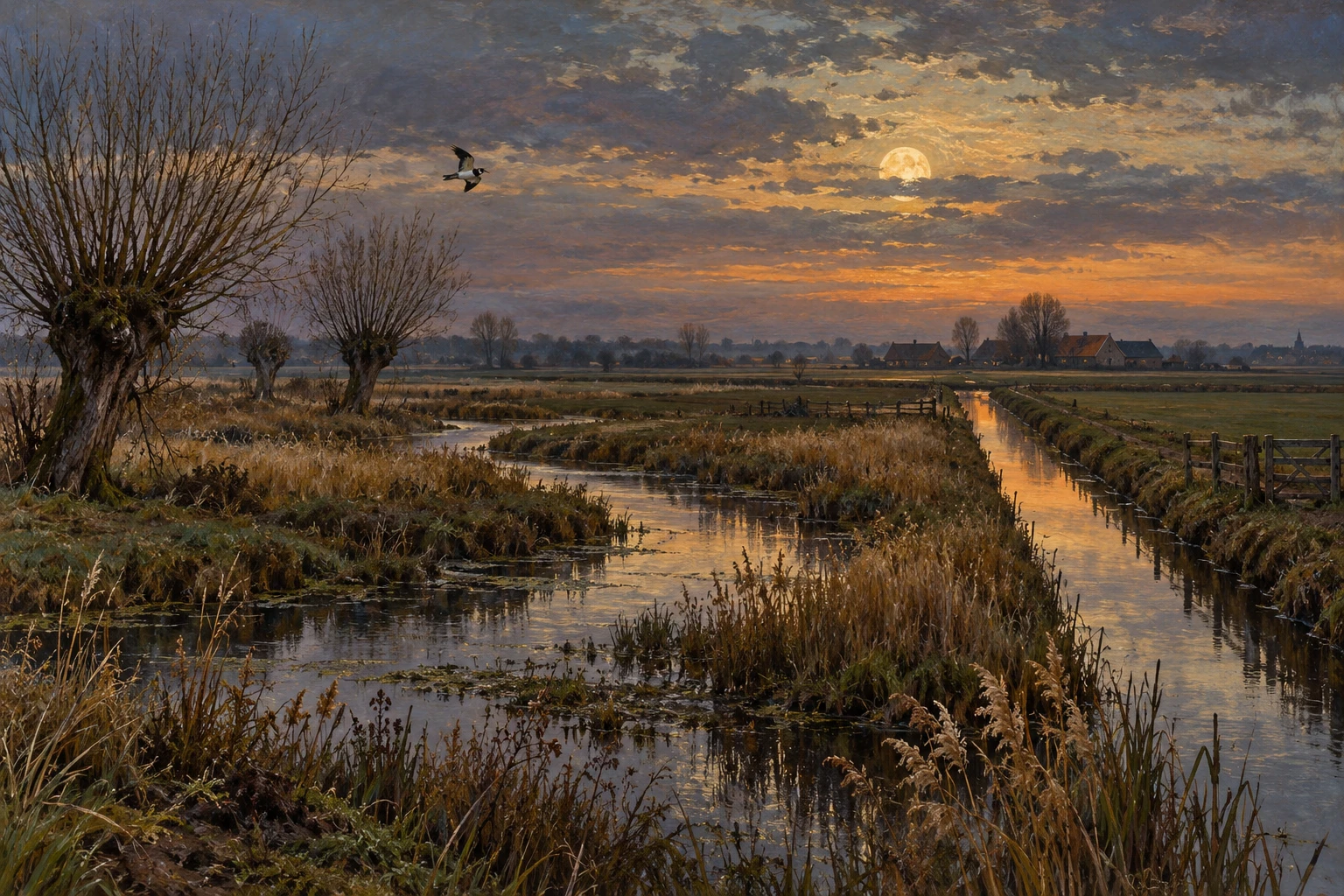
M. C. Balfour’s “Legends of the Lincolnshire Cars” introduces a low-lying landscape around the Ancholme. She describes cultivated land crossed by drains, the winding older stream and a straighter channel carrying water northwards. Her stories look back towards the wetter landscape remembered beneath those fields.
She explicitly distinguishes these Cars in north Lincolnshire from the true Fens farther south. That distinction is useful when reading Jacobs’s “The Buried Moon”, which begins with a broader account of fens. The original collecting context should remain visible.
This is a regional guide. Neither the Moon’s pool nor Tiddy Mun’s gathering place has been securely identified here as a particular surviving site.
Two stories of a changing wetland
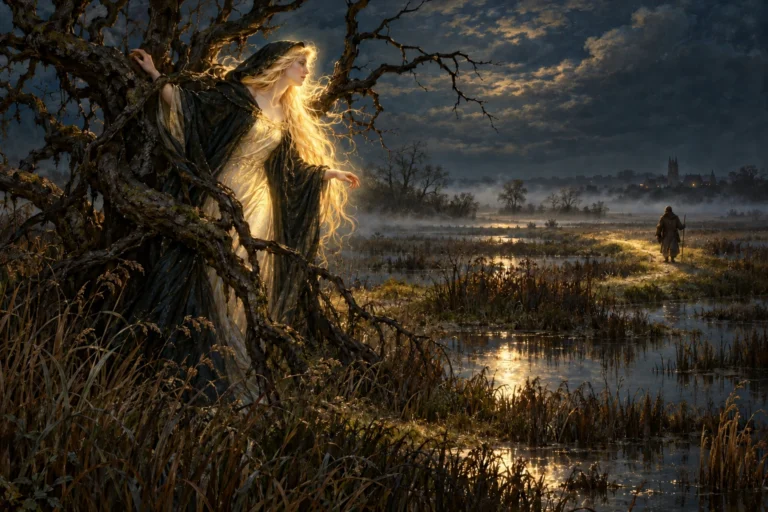
In “The Dead Moon”, difficult paths and deep water give the supernatural danger a physical setting. The Moon helps a lost man find his way, then needs the community to rescue her. A stone, a tree snag and a flickering light become the coffin, cross and candle that mark her prison.
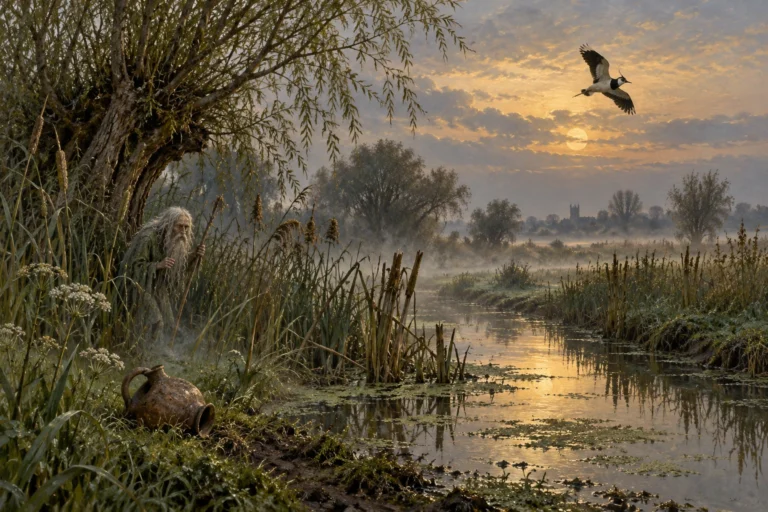
Tiddy Mun’s story turns drainage itself into the conflict. The being loses his pools, the people suffer, and a repeated water offering restores their relationship. Balfour’s narrator remembers this as something done in the past. It is not a dated engineering record.
The two accounts should be read together for their shared landscape, but their figures do not meet in the examined texts. A combined mythology in which Tiddy Mun imprisons the Moon would be an invention.
Landscape evidence and its limits
The North Lincolnshire Historic Environment Record’s indexed summary for the medieval course of the River Ancholme describes an old channel visible in aerial photographs and LiDAR, with a corresponding line detected by geophysical survey. This is independent evidence for a changing river landscape, not for either supernatural tale.
Balfour’s interpretation requires care. Her descriptions of supposedly primitive local people and very ancient pagan survivals are the assumptions of a nineteenth-century collector. They do not establish the age of an individual story or the origin of a custom.
The stronger conclusion is narrower: the published tales imagine danger, dependence and loss through a landscape of water and reclamation. Whether a particular episode preserves memories of a particular drainage scheme needs further evidence.
The illustration brings the old stream and the cultivated landscape together as a literary scene. It does not locate the Moon’s stone or reconstruct a documented ceremony.
Sources for this entry
- M. C. Balfour, Legends of the Lincolnshire Cars, Part I. Folk-Lore, volume II, 1891, pp. 145–170. Introduction, “Tiddy Mun” and “The Dead Moon”. Read source — Original printed accounts and collecting commentary. The dialect transcription and historical interpretations are the collector’s presentation. About this book
- Joseph Jacobs, More English Fairy Tales. 1894. LXVI, “The Buried Moon”, and its source note. Read source — An expressly abridged adaptation of Balfour, with much of the dialect removed. About this book
- North Lincolnshire Historic Environment Record, Medieval course of the River Ancholme. Record MLS20413, via Historic England Heritage Gateway; consulted 18 October 2026. Summary of aerial photography, geophysics and LiDAR observations. Read source — The record’s indexed summary identifies traces of the old river. It does not identify a supernatural site.
Research coverage
Balfour’s introductory landscape account and the two complete narratives were examined, with Jacobs’s adaptation. The heritage record’s indexed summary was checked for the old channel; the underlying survey reports have not been reviewed.
The Myths · English collection · Editorial approach
Further Reading