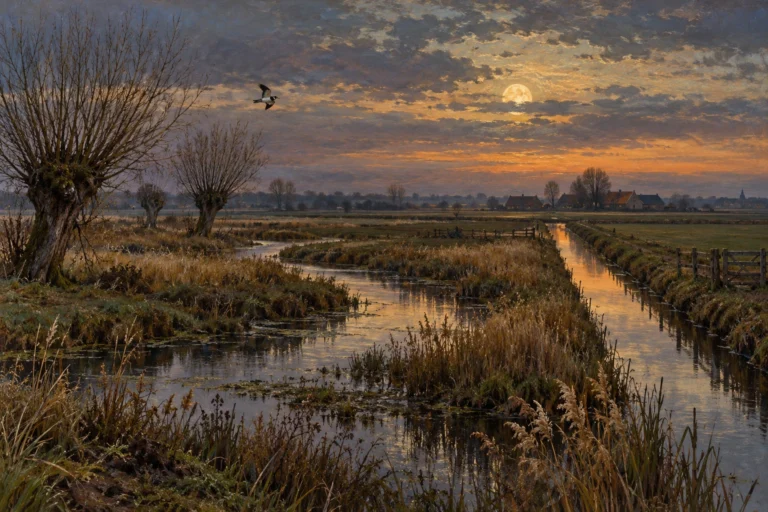
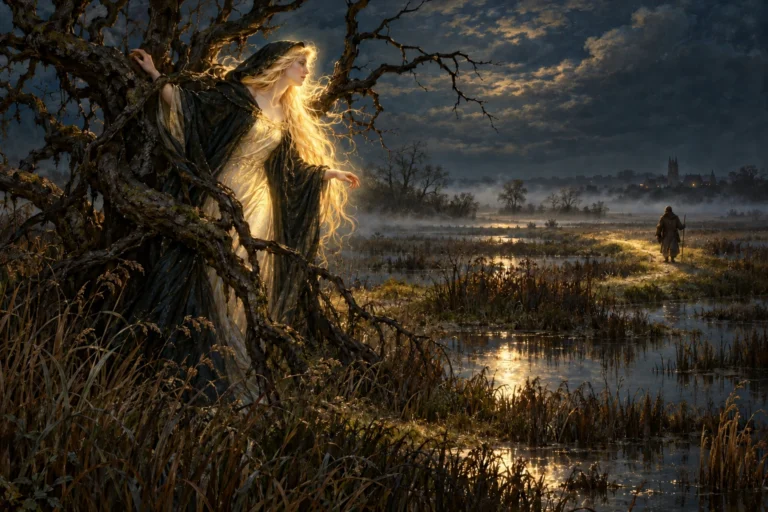
Lincolnshire Cars · figure
Tiddy Mun
A small grey marsh being can lower floodwater or turn against the people who drain his home. Balfour’s account connects him with the changing landscape of the Lincolnshire Cars.
Also found as: Tiddy Mun without a name
Research reviewed 18 October 2026.

The marsh being and his people
In M. C. Balfour’s 1891 collection, Tiddy Mun is an elderly, very small figure associated with the marsh pools. His white hair, grey appearance and uneven walk make him difficult to distinguish in mist. His call is compared with the cry of the pyewipe, the lapwing.
The old narrator remembers him as capable of helping. When water rose towards the doors, families went out at the new moon and called to him. His cry answered across the wet ground, and the floodwater receded by morning. Yet that helpful relationship depended on leaving him a watery home.
Drainage brings a crisis. The tale blames Dutch workers for emptying the pools, and says some disappear into the mud. Cattle fail, children sicken and families suffer. The neighbours finally gather at a dyke, each bringing fresh water, and ask Tiddy Mun to undo the harm.
They hear lamenting voices that mothers recognise as their dead children. Then the familiar lapwing-like cry answers from the river. The living children recover, livestock prosper and food becomes plentiful. Afterwards the families repeat their water offering at the new moon. The storyteller ends by saying that new ways have driven the being out of common memory.
What the source does and does not give us
One detailed printed account
Balfour frames the story as material from an elderly woman who had lived in the Cars. The narrator claims personal experience of offerings and sightings, but the article is still the collector’s edited representation. This entry does not have a second independent complete Tiddy Mun account to set beside it.
Helper and adversary within the same telling
The friendly flood-controller and the angry being of the drained pools are not separate variants here. They are successive roles in one narrative. Calling him simply a benevolent water spirit would conceal the disappearances and deaths; calling him only a monster would conceal the old relationship of mutual accommodation.
A neighbouring tale, not the same figure
The Moon in Balfour’s “The Dead Moon” also helps people navigate dangerous wet ground. Tiddy Mun does not appear in her rescue, and the Moon is not named as his companion or ruler. Their connection is the collector’s landscape and their shared concern with safety, water and community.
Drainage, grief and historical claims
The story gives environmental change a personal antagonist. Draining a marsh improves some human uses of the land while destroying the home of its supernatural resident. That is a reading of the narrative, not proof that an identifiable ritual survived unchanged from antiquity.
Its grief deserves attention too. Prosperity returns, but the mothers still remember their dead children. The ending does not undo every loss. Balfour also includes attacks on people accused of witchcraft when the community first seeks someone to blame. Those accusations belong to the tale and do not establish anyone’s guilt.
Real drainage history must be investigated through its own records. The story’s unnamed workers and loosely remembered past should not be turned into a dated account of disappearances. No evidence examined here establishes Tiddy Mun as a historical person or an ancient deity with a documented cult.
Sources for this entry
- M. C. Balfour, Legends of the Lincolnshire Cars, Part I. Folk-Lore, volume II, 1891, pp. 145–170. Introduction, “Tiddy Mun” and “The Dead Moon”. Read source — Original printed accounts and collecting commentary. The dialect transcription and historical interpretations are the collector’s presentation. About this book
Research coverage
Balfour’s introduction and complete Tiddy Mun narrative were examined. Claims of personal experience are attributed to her narrator. Later summaries have not been counted as additional oral witnesses.
The Myths · English collection · Editorial approach
Further Reading