place · England
Glastonbury and the claimed tomb of Arthur
The Somerset abbey’s medieval claim to have found Arthur and Guinevere is important evidence for the legend’s reception, rather than a settled identification of their remains.
Also found as: Glastonbury Abbey · Arthur’s tomb · Avalon · Somerset. Research reviewed 18 October 2026.

What the monks claimed
Glastonbury Abbey dates the reported discovery of Arthur and Guinevere’s grave to 1191. The claim became part of the abbey’s history, and a tomb was subsequently displayed in the church. Its present interpretation makes clear that physical remains of the claimed tomb no longer survive. The abbey’s account.
The abbey had suffered a major fire in 1184. Its rebuilding and changing support form part of the context in which the discovery was announced. That context invites questions about authority, patronage and pilgrimage; it does not, on its own, establish precisely how the claim was produced. Abbey history.
What the romances leave open
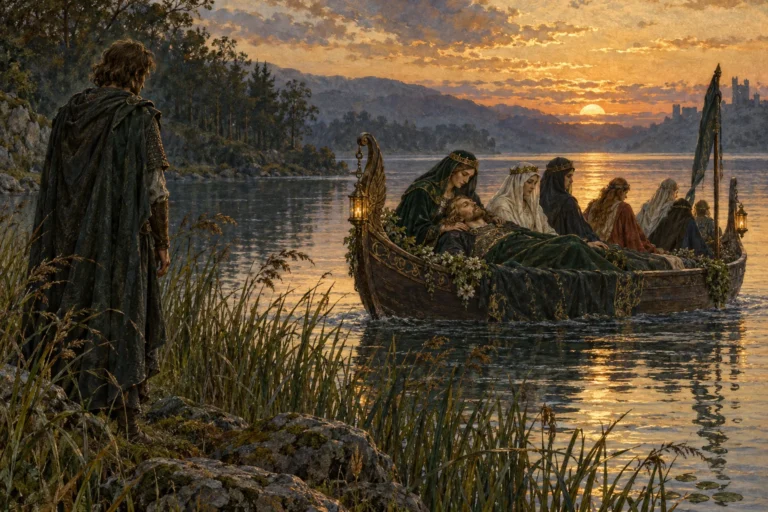
Geoffrey sends a wounded Arthur to Avalon for treatment. Malory’s final sequence combines a departing barge, Bedivere’s belief about an unnamed burial and the report that Arthur might return. Those endings should be read in their own terms before the Glastonbury claim is introduced. Compare the endings.
Associations and distinctions
Avalon and Glastonbury
An identification of a literary island with a real place belongs to the history of interpretation. It is not a place-name that can simply be inserted into every earlier text. The question “Who associated these places, and when?” is more useful than assuming the association has always meant the same thing.
A medieval report and an early medieval person
A report about a discovery in 1191 may be strong evidence for what people claimed in 1191. It is not automatically strong evidence about the identity of someone who supposedly lived centuries before. This distinction applies even when a claim was influential and widely repeated.
Context and evidence
The abbey’s archaeology has its own long research history, including reassessment of the excavation archive. Its archaeology overview is a route into that work. This entry does not claim to have examined the complete excavation archive or every medieval account of the discovery.
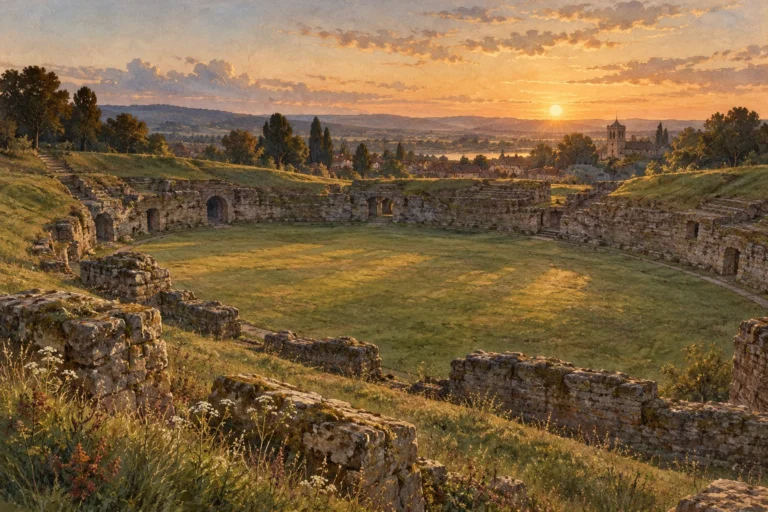
Keep the abbey, its alleged royal grave and the wider Glastonbury landscape distinct when following the connections. Our illustration evokes the wider Glastonbury landscape; it does not depict a verified Arthurian burial.
Sources for this entry
- Glastonbury Abbey, Arthur’s Tomb. Archaeology interpretation, consulted 18 October 2026. Arthur’s Tomb interpretation. The 1191 discovery claim and later monument. Read source
- Glastonbury Abbey, History. Site history and chronology, consulted 18 October 2026. Twelfth-century fire and rebuilding. Institutional context. Read source
- Glastonbury Abbey, Archaeology. Overview of the excavations and archive project, consulted 18 October 2026. Overview of excavations and archive reassessment. Further archaeological research. Read source
- Geoffrey of Monmouth, History of the Kings of Britain, Book XI. Composed c.1136–38; Giles collection (1848). Book XI, chapter 2. Avalon in Geoffrey. Read source · About this book
- Thomas Malory, Le Morte Darthur, volume II. Caxton book-and-chapter arrangement, first printed 1485; Project Gutenberg 1252. Book XXI, chapters 5–7. Departure, burial inference and return belief. Read source · About this book
Research coverage
The named passages have been examined and compared. This is a first source-led guide, not a collation of every manuscript, translation, local telling or adaptation.
The Myths · Arthurian collection · Editorial approach
Further Reading