story · England
The death of King Arthur and the voyage to Avalon
An accidental signal destroys a truce. Bedivere must surrender the king’s sword, while Arthur’s departure leaves an enduring uncertainty about death and return.
Also found as: Camlann · Avalon · Arthur’s last battle · Bedivere and Excalibur. Research reviewed 18 October 2026.
Read the story
The drawn sword
Arthur and Mordred had agreed to meet with a small company from each army. Neither trusted the other. Both sides had orders to attack if they saw a sword drawn. Then an adder stung one of the men at the meeting. He drew his blade to kill it. The waiting armies read the movement as treachery, and the attempted peace collapsed.
The battle consumed almost everyone. Lucan begged Arthur to let the surviving Mordred go, but the king would not. Arthur struck his son with a spear. Mortally wounded, Mordred forced himself along the weapon and dealt Arthur a devastating blow to the head. Mordred fell; Arthur survived long enough to be carried away.
Lucan and Bedivere brought the king to shelter. Lucan, himself terribly wounded, died while helping him. Arthur then gave Bedivere one final command: throw Excalibur into the water and report what happened.
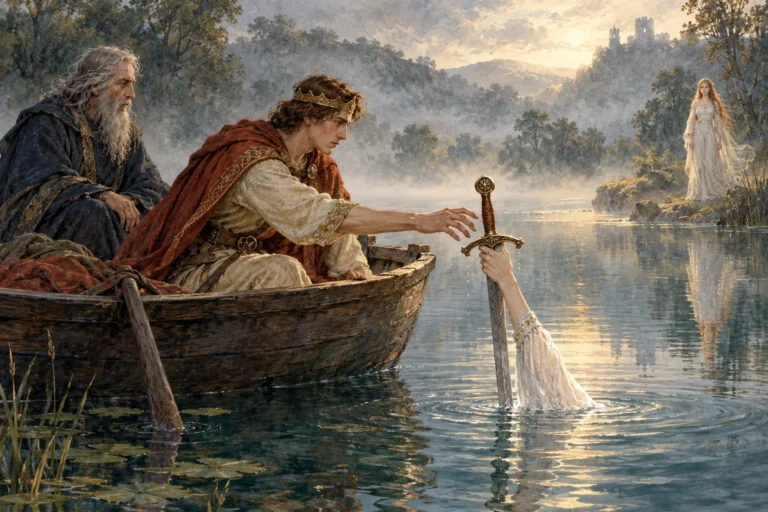
Bedivere could not bear to destroy so precious a sword. Twice he hid it, returned and described only the ordinary movement of wind and waves. Arthur knew he had disobeyed. On the third attempt Bedivere cast the sword out. An arm rose, caught it, flourished it three times and disappeared beneath the surface.
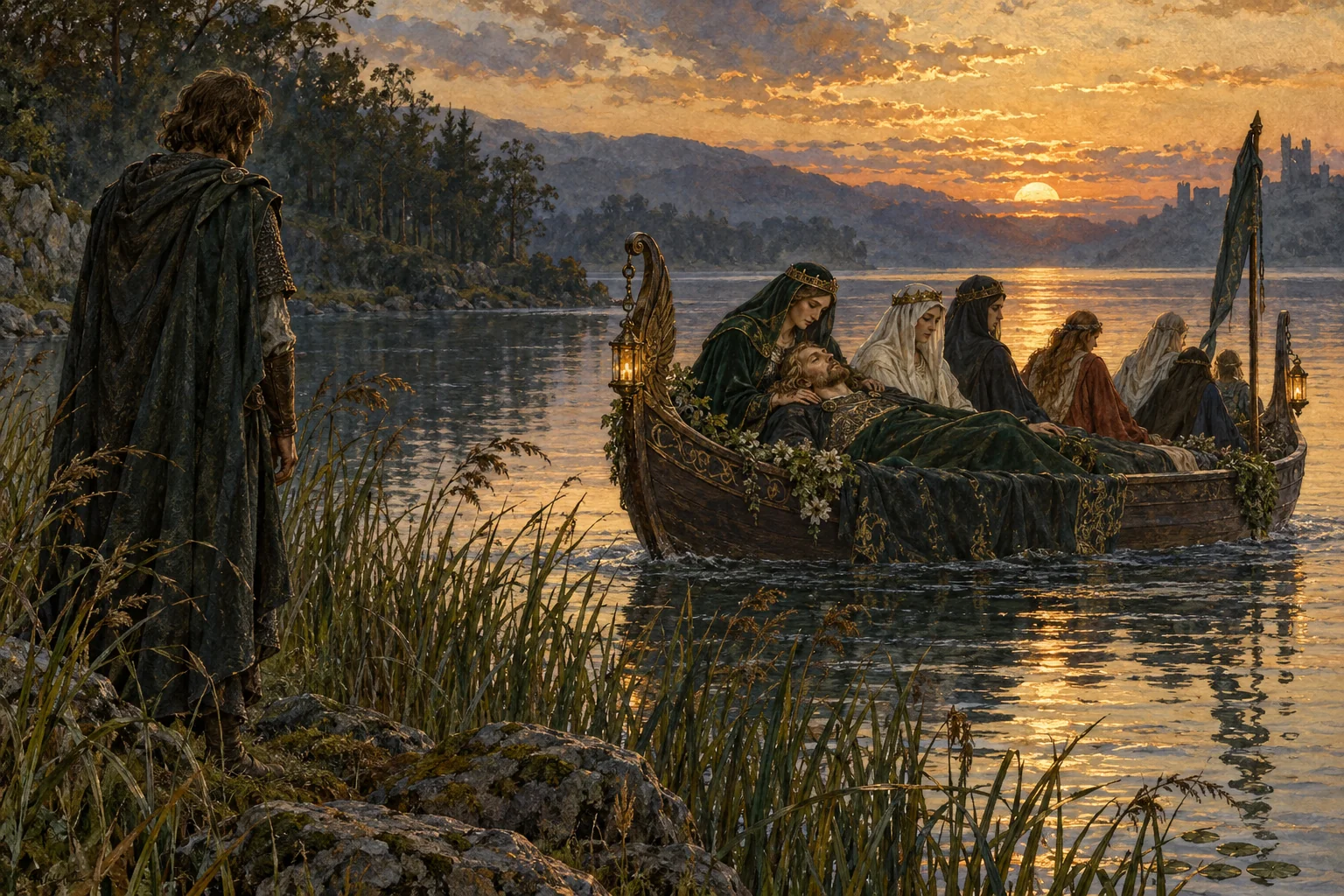
When Bedivere returned, Arthur asked to be carried to the water. A barge waited, filled with mourning women. Morgan received her brother and laid his head in her lap. Arthur said he was going to Avalon for the healing of his wound. The boat departed, leaving Bedivere alone.
The next morning Bedivere found a hermitage and a newly made grave. The hermit had received a body brought by women during the night, but did not know whose it was. Bedivere believed it to be Arthur’s and remained there in a religious life. Malory also records the belief that Arthur would return, while declining to settle the matter with complete certainty. Malory, XXI.4–7.
Versions and variations
A brief annal is not this plot
The Annales Cambriae places the fall of Arthur and Medraut at Camlann under the conventional date 537. That terse entry does not specify that they fought each other, that Medraut was Arthur’s son, or that an adder caused the battle. Those details must not be read backwards into it.
Geoffrey’s wounded king
In Geoffrey, XI.2, Modred is Arthur’s nephew and opponent. Arthur is wounded at the river Cambula and taken to Avalon for treatment, leaving Constantine to rule. The chapter does not provide Malory’s scene of Bedivere repeatedly withholding the sword.
The grave at Glastonbury
The later claim that Arthur and Guinevere had been found at Glastonbury Abbey has its own documented medieval history. It should not be treated as a simple confirmation of every romance’s ending.
Context and evidence
Malory places an avoidable misunderstanding at the start of the final catastrophe. At its end, the sword that could be measured as treasure must be relinquished, and the king passes beyond his surviving companion’s knowledge. These narrative choices sustain the tension between an ending and a hope of return.
Avalon is a literary destination in the accounts compared here. Its later identification with a particular landscape is a separate question. The evidence guide distinguishes the development of the story from evidence for a historical Arthur.
Sources for this entry
- Thomas Malory, Le Morte Darthur, volume II. Caxton book-and-chapter arrangement, first printed 1485; Project Gutenberg 1252. Book XXI, chapters 4–7. Principal retelling: truce, battle, sword, barge and disputed ending. Read source · About this book
- Anonymous annalists, Annales Cambriae (Annals of Wales). Medieval annalistic compilation; English transcription at Fordham. Entries conventionally labelled 516 and 537. Limits of the brief Camlann notice. Read source · About this book
- Geoffrey of Monmouth, History of the Kings of Britain, Book XI. Composed c.1136–38; Giles collection (1848). Book XI, chapter 2. Different genealogy and departure for Avalon. Read source · About this book
Research coverage
The named passages have been examined and compared. This is a first source-led guide, not a collation of every manuscript, translation, local telling or adaptation.
The Myths · Arthurian collection · Editorial approach
Further Reading