Manx household and farm folklore · story
The Fynoderee of Gordon
An immensely strong night worker helps a farm, mistakes a hare for a sheep and walks away when offered clothes. Morrison’s telling joins several encounters around one unpredictable Fynoderee.
Also found as: Fenodyree of Gordon · Phynnodderee of Gordon
Research reviewed 17 October 2026.
Read the story
A modern retelling following Sophia Morrison’s “The Fynoderee of Gordon”, 1911, pp. 48–53. The final episode includes violence towards the Fynoderee’s wife.
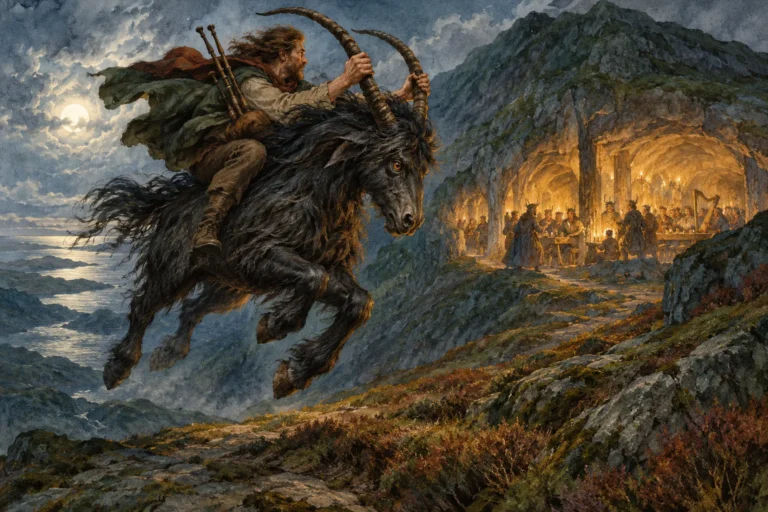
The Fynoderee of Gordon was a great shaggy being, with fiery eyes and strength beyond a human’s. A blacksmith once met him on the way home and was offered a handshake. The smith prudently put an iron ploughshare into the outstretched hand instead of his own. The Fynoderee squeezed it as though it were soft clay and remarked on the strength of Manxmen.
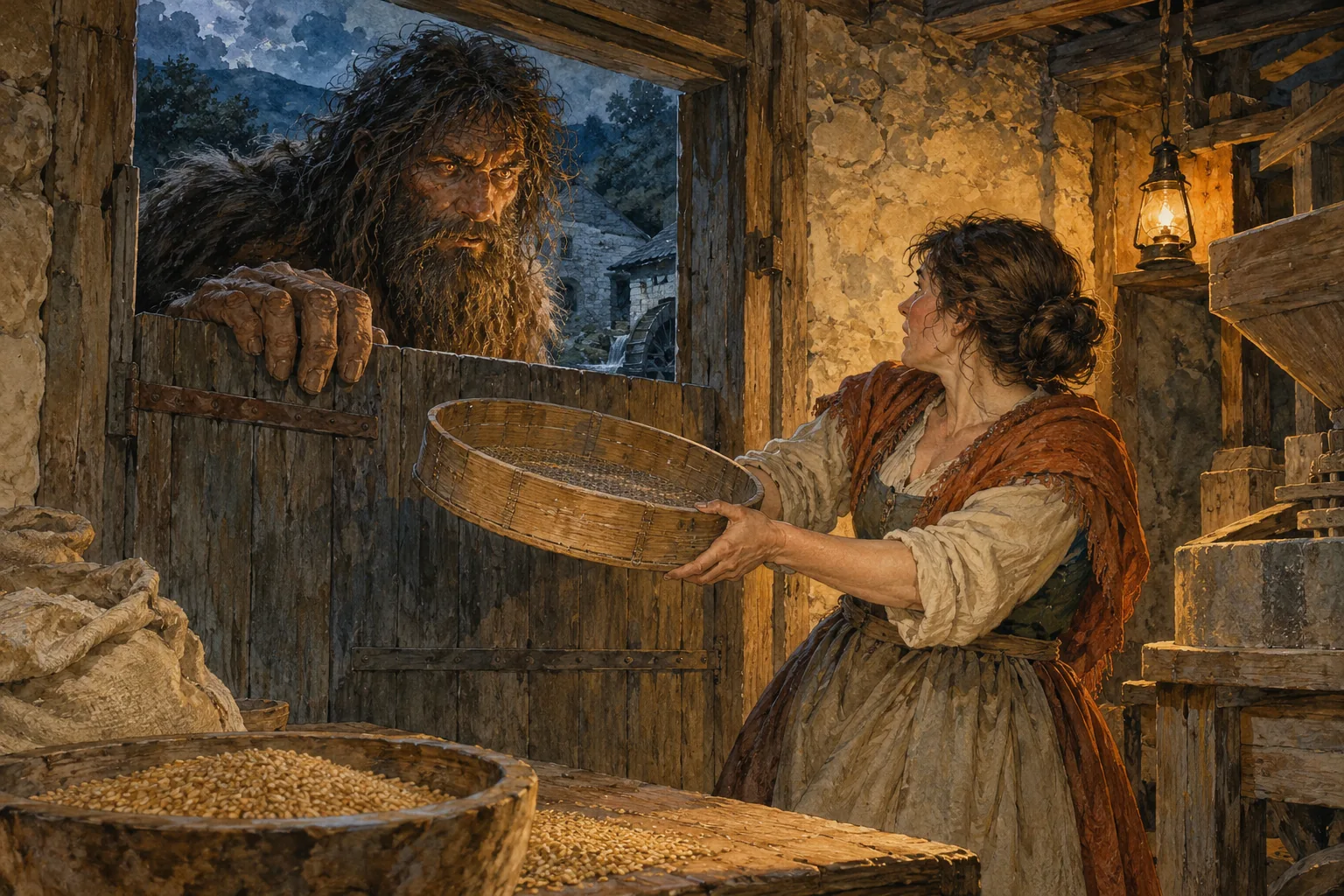
He worked after dark and kept out of sight during the day. One night, passing a mill in Glen Garragh, he noticed a light and looked through the open upper half of the door. Inside, Quaye Mooar’s wife was sifting corn. The appearance of that enormous head frightened her, but she quickly found a task for her visitor.
She handed him the sieve and promised to bake him a cake if he brought water from the river. The more water he carried, the larger the cake would be. Away he went. However much he scooped up, it ran through the sieve before he could bring it back. His strength was useless against the holes.
While he struggled, the woman escaped. Eventually he threw the sieve away in anger. When he returned to the mill, the light had gone out.
At Gordon, the Fynoderee worked for the Radcliffes. He ground their corn, threshed it and helped with hay and harvesting. The people could leave an entire stack in the barn overnight and find the work finished by morning. There was one condition: the sheaves had to be untied. A bound sheaf remained untouched.
People sometimes talked with him as they worked. On a frosty day he watched the farmer blowing on his fingers. The farmer explained that he was warming them. At supper, however, he blew on his porridge because it was too hot. The Fynoderee was suspicious of a man who could blow hot and cold with the same breath.
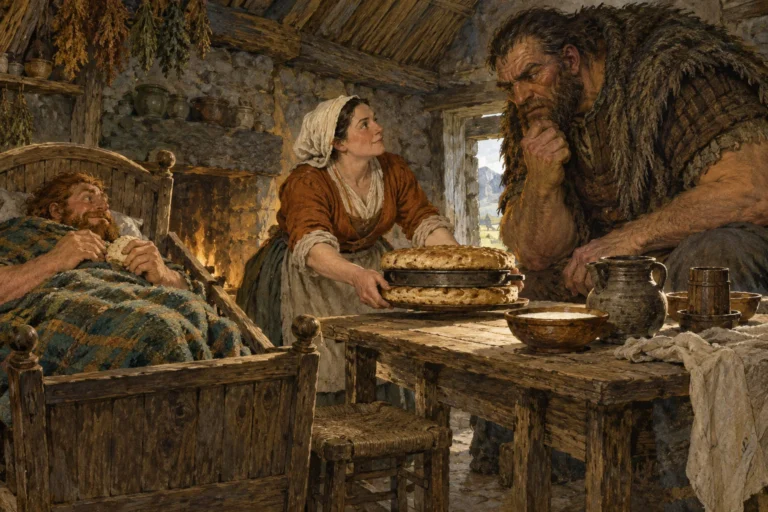
The farmer’s next kindness went even more badly. Thinking of the cold, he had a complete set of large clothes made for the naked helper: coat, waistcoat, breeches and cap. He brought them to the barn as a present.
The Fynoderee examined each garment and saw a threat in it. The clothes would bring sickness or harm to the parts they covered. The farmer might own Gordon and its neighbouring glens, he declared, but he did not own Glen Rushen. He threw the clothes aside and left.
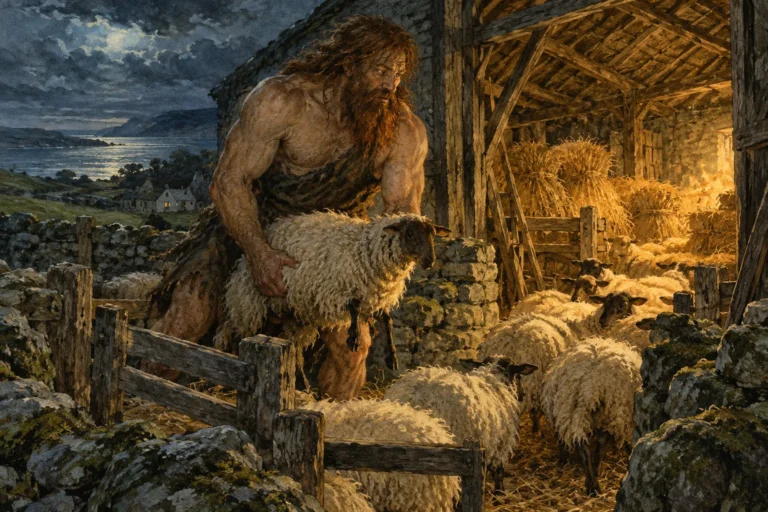
In Glen Rushen he found work with Juan Mooar Cleary, cutting hay and turf and looking after the sheep. During a snowstorm, Juan rose in the night to check his flock. The Fynoderee came to the window and told him to go back to sleep: the animals were already gathered in.
One troublesome brown yearling had taken an extraordinary chase. The Fynoderee had pursued it twice around Barrule before catching it. In the morning, Juan found all his sheep safe. Tied up amongst them was a large hare.
The tale ends on the mountain. The Fynoderee and his wife quarrelled while preparing porridge, and she ran away. He threw stones after her. One hurt her heel; others drove her further across the landscape, leaving rocks that the narrator associated with particular places. Finally she leapt over the sea to the Mountains of Mourne. Morrison’s teller leaves her there, beyond certain knowledge, while the Manx landscape retains the marks of their quarrel.
Versions and variations
The clothes change the relationship
Morrison gives the rejected clothes to Gordon’s farm helper, who then goes to Glen Rushen and continues working for another farmer. In Moore’s chapter IV, a stone-carrying Phynnodderee brings building material to Tholt-e-will; the offered clothes cause his departure. Moore credits the surrounding account to Train. That is a different work setting, not an additional event that must be added to Gordon’s story.
The animal and the mountain
Moore separately labels the hare-among-sheep anecdote “Oral” and makes the chase three circuits of Snaefell. Rhys also reports Snaefell and a hare mistaken for a small ram. Morrison gives two circuits of Barrule and a brown yearling. The recurring mistake survives while the place, number and description change.
A group of episodes
Morrison’s chapter links the handshake, sieve, hot-and-cold breath, clothes, sheep and final stone-throwing. The comparative sources do not all contain that same sequence. Rhys names Ballachrink and Lanjaghan as associated farms and admits that he found nobody who knew the being when he visited Glen Rushen in 1890. This is a valuable limit on his enquiry, not proof that the story had disappeared everywhere.
The Irish púca guide offers another useful comparison: clothing also ends supernatural work in the Kildare Pooka and Lady Wilde’s mill story, but the reasons differ. Motifs can be compared without treating the named beings as interchangeable.
Context and evidence
The farm episodes turn on ordinary labour: threshing, mowing, tending sheep and preparing food. Their supernatural worker can do more than people can, yet misunderstand things people take for granted. The sieve and the hare make strength comic; the final violence prevents an entirely cosy portrait.
These texts support a history of storytelling and belief. Neither a named farm nor a rock identified in a tale verifies the being’s existence. Morrison’s chapter preserves the place-names used in its narrative, but this entry has not independently surveyed every associated stone.
Rhys’s racial and linguistic origin theories belong to the scholarship of his period. They are not repeated here as settled explanations. The documented points of comparison are the actions in the accounts, the words the collectors record and the limits they acknowledge.
Sources for this entry
- Sophia Morrison, Manx Fairy Tales. London: David Nutt, 1911. “The Fynoderee of Gordon”, pp. 48–53. Read source — Named printed telling; oral collection shaped for publication About this book
- A. W. Moore, The Folk-Lore of the Isle of Man. Douglas: Brown & Son; London: D. Nutt, 1891. Chapter IV: The Phynnodderee; Legend of the Black Dog, Moddey Doo; distinguish the individual attributions. Read source — Comparison of collected material and acknowledged earlier print sources About this book
- John Rhys, Celtic Folklore: Welsh and Manx. Oxford: Clarendon Press, 1901, volume I. Chapter IV, opening discussion of the fenodyree, its localities, sheep and clothing. Read source — Comparison with reported local beliefs and the author’s fieldwork About this book
- John Rhys, Celtic Folklore: Welsh and Manx. Oxford: Clarendon Press, 1901, volume I. Chapter V, opening comparison: items 3–4 and the Blednoch brownie. Read source — Comparative motifs; not proof of a single origin About this book
Research coverage
Morrison’s full chapter is compared with Moore’s specifically attributed passages and Rhys’s discussions in chapters IV–V. This is not a complete inventory of Manx manuscripts, recordings or all later retellings.
The Myths · Manx collection · Editorial approach
Further Reading