Border legends and literary ballads · story
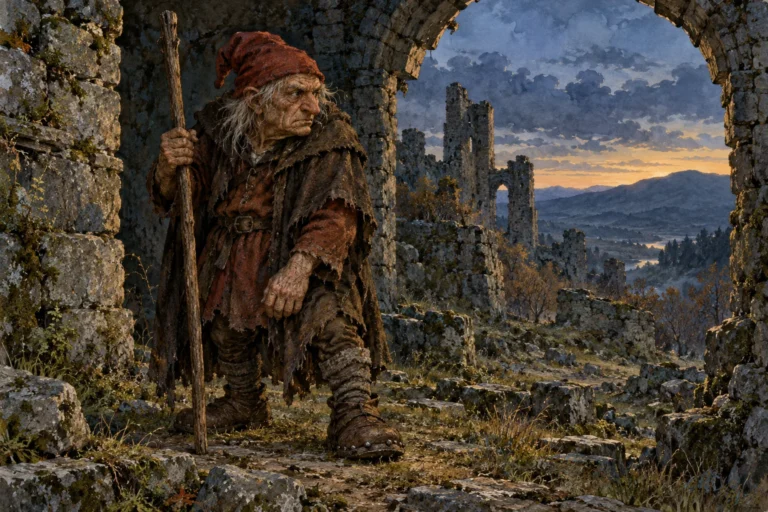
Lord Soulis and Redcap
A castle lord trusts a goblin’s promise that neither rope nor steel can harm him. John Leyden’s ballad turns that promise into a trap.
Research reviewed 18 October 2026.
Read the story
The lord and his familiar
This is a condensed prose retelling of John Leyden’s named literary ballad, printed in Walter Scott’s Minstrelsy. It is not presented as an anonymous medieval song.
At Hermitage, Lord Soulis believed himself protected by a sinister companion: Redcap. Ordinary ropes could not bind him and steel could not kill him. His confidence fed his cruelty. He killed a royal messenger, seized the woman loved by the heir of Branxholm, and made enemies throughout the country.
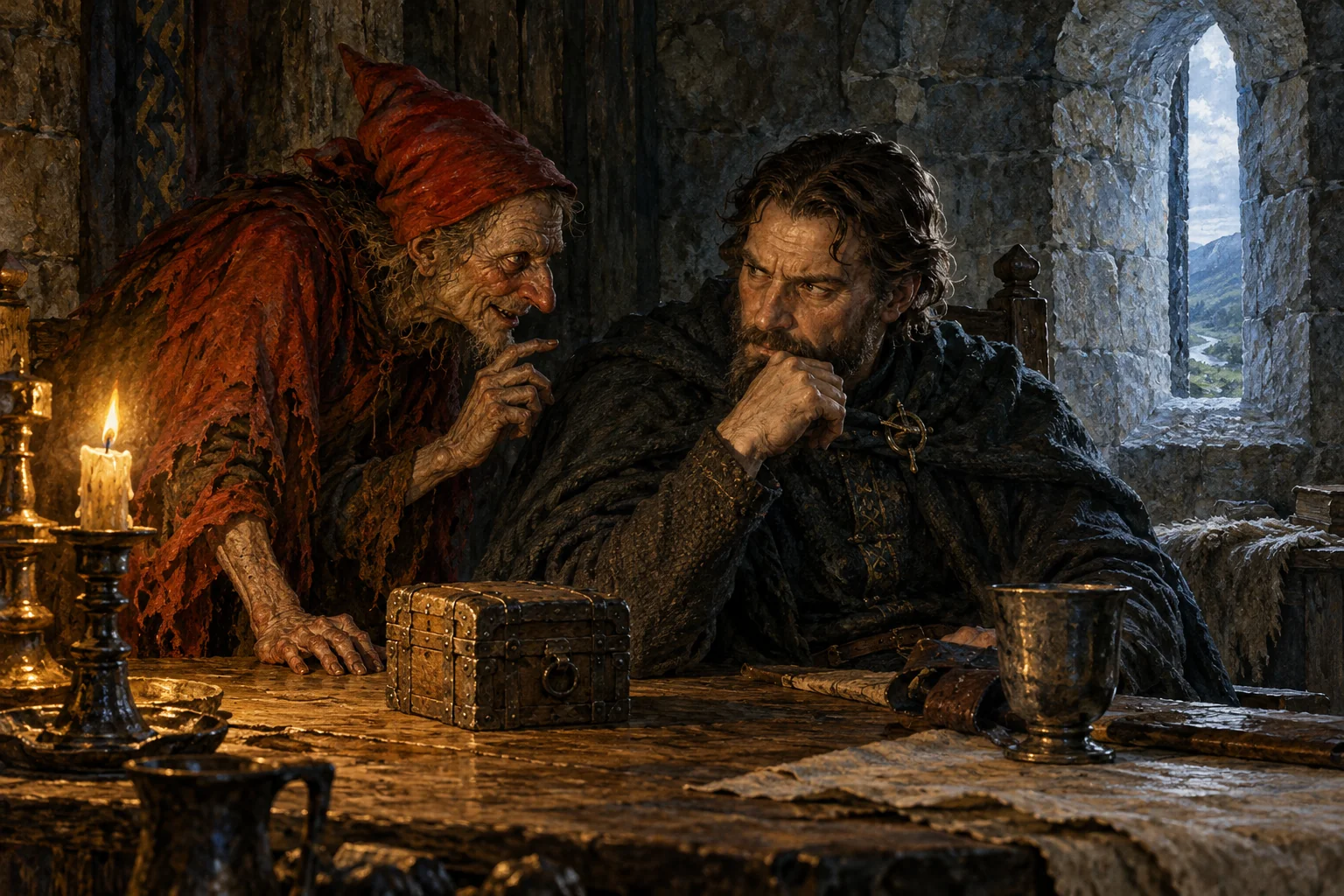
Redcap could be consulted through a locked chest. But his help came with warnings. Soulis was not to look inside; he was also warned about a tree that would come to the castle. Such a thing seemed impossible. When Soulis broke the rule of the chest, his protection began to unravel.
The coming tree
Soulis captured his rival and ordered him to choose the tree on which he would be hanged. The prisoner looked out and saw rescue approaching: men carrying hazel branches in their steel caps. The warning was coming true in human form.
Soulis could still withstand weapons, and the ropes placed around him broke. The rescuers turned to supernatural knowledge of their own. In the ballad, True Thomas takes part in overcoming him, while a book associated with Michael Scot gives instructions. Even an attempted rope of sifted sand and barley chaff fails as Redcap interferes.
The final answer is a cauldron at Nine Stane Rig. Wrapped in lead, the tyrant is boiled to death. The ballad ends with punishment that evades the promise about rope and steel; the protection was formidable, but never complete.
Versions and variations
Leyden’s ballad
The elaborate romance, the approaching branches, the rival lover and the magical book belong to Leyden’s composed narrative. Credit him whenever these details are retold. Scott’s volume places literary work alongside older material, which can make its status easy to miss.
Scott’s introductory prose
The introduction also reports a more compressed tradition: people complain to the king about Soulis, the king angrily tells them to boil him, and an attempted correction comes too late. This royal-command explanation is a different route to the cauldron ending; it should not silently replace the ballad’s plot.
Henderson’s later account
Henderson connects Redcap with Soulis and quotes the literary tradition. His 1879 discussion is useful evidence for the legend’s later circulation, but its use of Leyden does not independently establish the story’s antiquity.
Context and evidence
Hermitage is a real castle with a substantial archaeological history. That does not authenticate the goblin, the invulnerability or the execution described in the ballad. Historic Environment Scotland identifies both medieval building phases and nineteenth-century restoration.
The historical de Sules family and the literary tyrant require separate treatment. This entry has not established a contemporary record corroborating the cauldron death. True Thomas’s appearance also belongs to the ballad’s supernatural cast, not evidence that the historical Thomas witnessed it.
Sources for this entry
- John Leyden; edited and introduced by Walter Scott, Minstrelsy of the Scottish Border. Third edition, 1806, volume III. “Lord Soulis”, introduction, poem and notes, pp.245 onwards. Read source — Named-author literary ballad and its editor’s account of related tradition. About this book
- William Henderson, Notes on the Folk-Lore of the Northern Counties of England and the Borders. New edition, 1879. Chapter VII, Redcap and Lord Soulis passages. Read source — General Redcap description and an explicitly literary Soulis connection. About this book
- Historic Environment Scotland, Hermitage Castle, castle, chapel, enclosures, deer trap, park boundary and farmstead. Scheduled monument record SM90161, consulted 18 October 2026. Description and statement of national importance. Read source — Archaeological and architectural evidence for the place, separate from the supernatural narrative.
Research coverage
The passages named below have been read and compared. This entry does not claim to include every oral performance, manuscript witness or modern adaptation; unexamined leads are identified separately.
The Myths · Scottish collection · Editorial approach
Further Reading